top of page
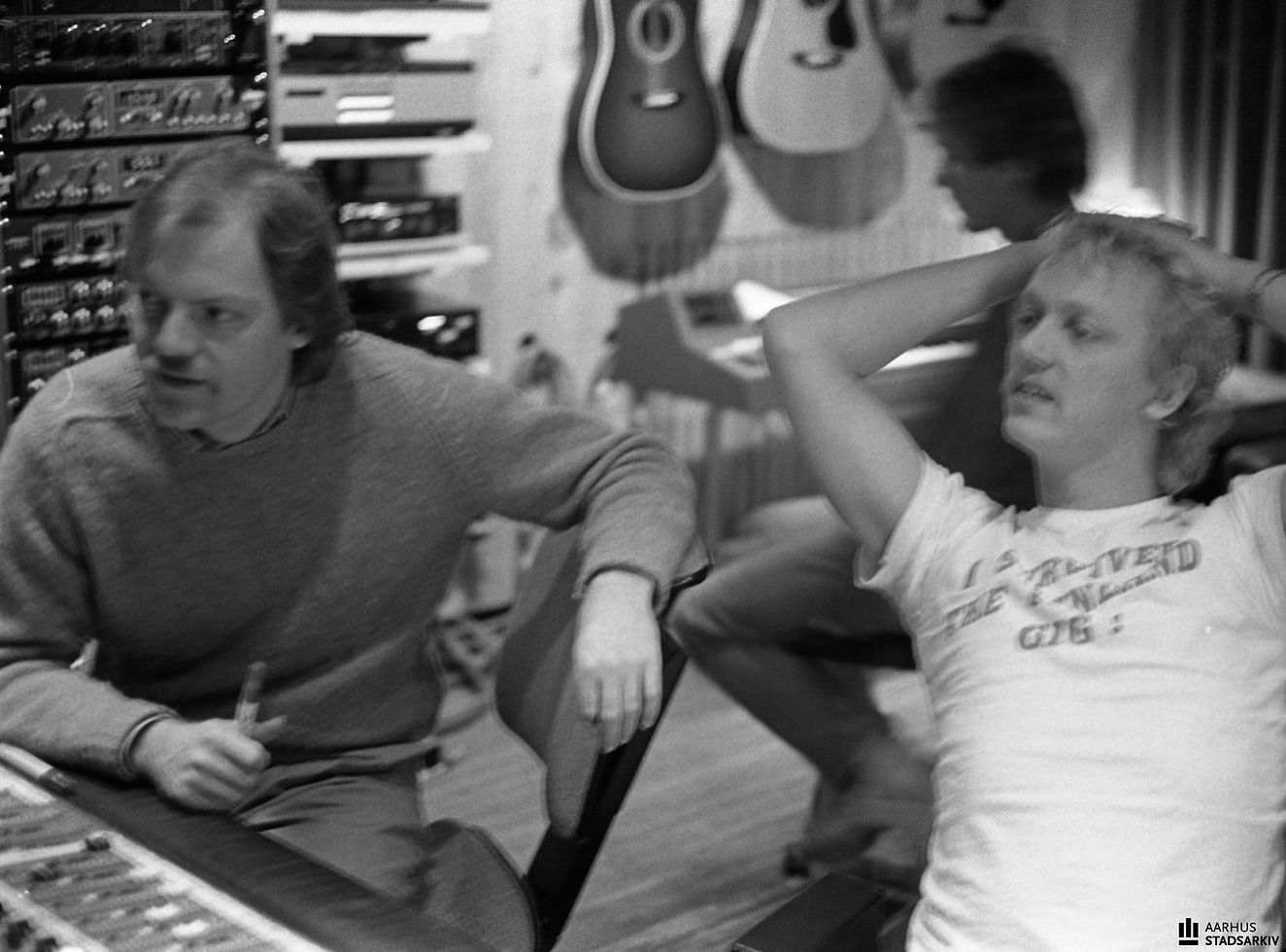
Two men beside the mixing desk at Feedback Recording in Viby, Aarhus, in January 1986.

Feedback Recording at Haraldsgade, 7 January 1986. Photo: Jens Tønnesen / AarhusArkivet.dk (CC BY 4.0).

Feedback Recording, usually called Feedback Studiet, occupied Haraldsgade 27 in Viby, Aarhus, Denmark. It grew out of Gnags’s own working environment and became a recording home for a much wider circle of musicians. Steel Pulse made True Democracy there. Danish artists gathered for “Afrika”. Thomas Helmig, TV-2, Henning Stærk and Poul Krebs all became part of its recording history.

Its busiest decades were the 1980s and 1990s. Understanding Feedback means looking at the records, the engineers and the practical independence that Gnags built around a house and a former workshop in Viby. The focus here is the original Haraldsgade studio.

Gnags, Genlyd and a workshop in Viby

Gnags established their collective at Haraldsgade in 1971. During the following years they developed a recording studio in an old carpenter’s workshop behind the house. Jacob Riis-Olsen contributed practical building skills, while Peter A.G. helped organise the project.

The studio belonged to a wider ambition to control how music was recorded and released. Gnags founded Genlyd Grammofon in 1974, creating a base for their own records and for other artists. As Aarhus Stadsarkiv’s history explains, the intention included keeping profits available for further work and new talent.

Feedback developed in stages. A contemporary Studio Sound report from December 1983 traced its beginnings to a rehearsal and demo setup with two Revox machines, followed by rebuilding and a 16-track installation in 1975. The rooms, equipment and uses of the buildings continued to change.

Peter A.G., Jacob Riis-Olsen and Jens J.G. Nielsen seated at Feedback Recording during the Gnags X sessions in March 1983.

Peter A.G., Jacob Riis-Olsen and Jens J.G. Nielsen at Feedback during the Gnags X sessions, 3 March 1983. Photo: Jørn Timm / AarhusArkivet.dk (CC BY 4.0).

Steel Pulse: True Democracy in Viby

One of Feedback’s important international recordings was Steel Pulse’s True Democracy, released in 1982. In a 2022 interview with the Jamaica Observer, singer David Hinds recalled the band having no record deal and little prospect of financing their next album. An opportunity in Denmark led them to travel by boat from England and record at Feedback with producer Karl Pitterson.

Hinds remembered the sessions taking 25 days. He also recalled a disagreement over “Rally Round”: Pitterson wanted another vocal performance, while Hinds initially felt the existing take was right. After several days he tried again, and later came to value Pitterson’s insistence.

Drummer Steve “Grizzly” Nisbett also recalled the invitation and the late-1981 Danish sessions in his interview with Andy Brouwer. Feedback’s story reaches into international reggae history as well as the Danish records most closely associated with the address.

1985: “Afrika” brings the scene together

On 13 July 1985, a large gathering of Danish artists came to Feedback for “Afrika”, written by Nanna and produced by Kim Sagild. The singers included Thomas Helmig, Sanne Salomonsen, Lis Sørensen, Bamse, Steffen Brandt, Henning Stærk and Peter A.G. The project raised funds for the Danish Red Cross.

Photographer Steen Tronsgaard documented the gathering. The anniversary feature at Promus and GAFFA’s session gallery preserve a visual record of musicians working together in the original rooms. The major gathering happened on 13 July. The single’s reproduced recording and mixing credits list work across several dates in July.

Sagild later remembered the pleasure of having so many artists together for a shared recording and an evening afterwards. His recollection helps explain the significance of Feedback as a meeting place, alongside the familiar sound of the finished single.

The records behind the reputation

The record sleeves give Feedback’s history some precision. They show artists returning, engineers working across different projects, and albums moving between studios for recording, overdubs and mixing.

Thomas Helmig’s debut, Thomas, was recorded at Feedback between January and March 1985. Its reproduced sleeve credits name Kim Sagild as producer, with Tom R. Andersen and Johannes Stærk engineering. The musicians included Gnags members Per Frost and Mads Michelsen, alongside other collaborators.

Henning Stærk Band recorded Soul Feet at Feedback in August 1985, with Billy Cross producing and Tom Andersen engineering. Mixing was split between Feedback and Werners. Stærk’s own discography records those roles.

TV-2’s Nærmest Lykkelig followed in 1988. The band’s original track-by-track credits place “Kys Det Nu”, “Monas Solarium” and “En Sommerdag For Alt For Længe Siden” at Feedback. Other tracks were recorded at Werners. Their next album, Vi Blir Alligevel Aldrig Voksne, was recorded at Feedback and Werners in 1989–90, then mixed at Werners.

Gnags returned to Feedback in January 1989 after travels in Cuba and Nicaragua. Mr. Swing King followed that September, with some of that Latin American inspiration carried into the arrangements, according to the band biography reproduced from Gnags’s own website.

The 1990s brought further work across different styles. Release credits identify Feedback as the recording studio for Gnags’s Øjne på stilke, produced and engineered by George Shilling in 1994. Thomas Helmig’s Groovy Day credits place part of its recording and mixing at Feedback alongside work in the United States.

The engineers who carried the work

Tom R. Andersen and Johannes Stærk recur throughout these credits. Their work connects artists and records that might otherwise seem to belong to separate stories. GAFFA’s 2017 tribute to Tom Andersen recognised him as a central figure in Feedback’s recording history.

Feedback also mixed recordings made elsewhere. Lars Lilholt’s Engang drog vi ud for at slå tiden ihjel was recorded at Dreamland and mixed at Feedback by Johannes Stærk. The band’s Kong Pukkelrygs Land was recorded in Silkeborg, then mixed at Feedback in December 1993 and January 1994.

There was a mobile operation too. Gnags’s Intercity was recorded at New Experimental College in Thy by Feedback Mobile Studio and mixed at Feedback in July 1980. That is part of Feedback’s wider work, although the recordings themselves were made away from Haraldsgade.

Poul Krebs: a week of night sessions in 1995

The making of Små sensationer gives a particularly vivid picture of Feedback in the 1990s. In Poul Krebs’s published biography, the starting point was 20 songs captured on a Walkman in Amsterdam, using his voice and acoustic guitar.

Working with producer Poul Martin Bonde and musicians from different stages of his career, Krebs began a week of night sessions at Feedback in late January 1995. Before the studio work started, the seven musicians played an improvised concert at Peter Gift in Aarhus. They then developed the arrangements in the studio.

The resulting album became Krebs’s commercial breakthrough and included “Sådan nogen som os”. The detailed account, also reproduced for the album’s anniversary tour, describes a deliberate attempt to preserve the immediacy of the new songs.

Inside the Whale and the life around the sessions

Marcus Winther-John’s published memoir excerpt records another part of Feedback’s later-1990s history. Inside the Whale returned there for the first week of the sessions for Rebeller uden sag, having made their first proper demos at the studio years earlier.

He remembers meals supplied by rock cook Chili John, including steak with chilli-chocolate sauce. Recording then moved to Mox in Copenhagen. The account, accompanied by a photograph identified as Feedback, gives a glimpse of the everyday life surrounding a record that became important to the band’s Danish-language breakthrough.

Inside Studio 1: changing rooms and equipment

Feedback’s equipment changed over the decades. The 1983 Studio Sound report described an Amek M2500 in the control room. It also recorded maintenance engineer Ole Toft building noise gates when Steel Pulse booked the studio, an example of technical work responding directly to a recording session’s needs.

In a later configuration, Studio 1 housed a Calrec UA-8000 “Polar” console. Calrec’s own history identifies the UA8000 as its first music console, developed for ABBA’s Polar Studios in Stockholm in 1984. Jakob Erland’s Gyraf documentation includes photographs explicitly identifying Feedback’s actual desk and describes the design as manufactured in very small numbers.

Tapetown founder Rasmus Bredvig, who worked at the original Feedback in its later years, remembers a huge main live room, a second recording space known as the “garage room”, and a side room between the main live room and the large control room. There was a kitchen and a lounge with an entire glass side, giving people space to eat and spend time together between sessions.

The main house had its own changing uses. By the time Bredvig worked there, rooms were shared among a group of engineers and producers, with Studio 1 used for recording. Those later arrangements were part of how the working community made the premises financially possible.

Gyraf Audio: equipment developed during real sessions

Equipment design was part of the life of Feedback. Gyraf Audio’s own account describes designs developed to meet the needs of the studio’s engineers. Working close to recording sessions made it possible to test a unit, hear a response, change the design and try it again quickly.

Freelance engineers carried this locally made equipment into other studios, generating wider interest. Production was established in the basement beneath Studio 2. Jakob Erland’s workshop became the base for a business whose equipment reached well beyond Haraldsgade.

That close relationship between recording and design was also observed by engineer George Shilling, who described Erland’s work at Feedback and the studio testing of his designs in a review of the Gyraf Gyratec XIV.

The later community: ET Mastering, Anders Boll and Tapetown

Feedback remained a working studio beyond its best-known decades. Efterklang recorded the core of Magic Chairs, released in 2010, there before adding further contributions in Copenhagen.

It also became an early professional home for another generation. Anders Boll began his professional career at Feedback before helping establish Lydhavnen, a connection documented in Aarhus Teater’s programme biography.

Emil Thomsen’s mastering work began in 2007, as ET Mastering’s own site records. Bredvig remembers Emil first working from the apartment he shared with Marie Højlund, then moving into Feedback in 2009. Tapetown took shape there too: Bredvig remembers choosing the name in Studio 1’s kitchen.

There are direct musical connections across the generations. MANI’s own biography describes recording at Feedback with Cy Nicklin after signing to Genlyd in 1982. Decades later, Emil Thomsen transferred and remastered the band’s catalogue for its reissue.

Several members of the later community helped establish Lydhavnen, carrying working relationships and knowledge into new rooms. Bredvig described that transition in a 2016 interview. Magnus Vad carried the Feedback name forward in his own studio after the original Haraldsgade operation ended.

A legacy built by making room for other musicians

At Steppeulven 2020, Gnags received the Pioneer Prize. The speech honouring the band recognised Genlyd and Feedback, and the decision to make production facilities available to other musicians. On the same evening, Anders Boll received Producer of the Year for his work with Ganger and Lowly. The contemporary awards report brings those two generations into the same room.

Feedback’s history can be followed through the records, but also through what people learned and built there: the studio skills, equipment designs and working partnerships that continued beyond the original address.

For more Danish recording history, read our article on Puk Studios. Our series also covers Sweet Silence Studios in Copenhagen.

A pale concrete wall with a single dark window cut into it, a big closed box like a cinema turned studio

Polar Studios was the Stockholm recording studio built by ABBA's Björn Ulvaeus and Benny Andersson with their manager Stig Anderson. It opened on 18 May 1978 in a former cinema on Kungsholmen, and in its first two years it produced ABBA's Voulez-Vous, Led Zeppelin's In Through the Out Door and Genesis's Duke. It closed in 2004. This guide covers the building, the desk, the records made there and the people who made them, and it ends with the thing we think most writing about famous studios gets backwards.


The short version: the most famous object from Polar now sits in a museum, and the most famous ABBA song was recorded three years before that object arrived in Sweden.


Polar Studios at a glance

  • Address: Sankt Eriksgatan 58-60, Kungsholmen, Stockholm, in an early 1930s building known locally as Sportpalatset because it had housed a public bath and sports facilities.

  • The room: a disused cinema, converted into a studio. Construction started in 1977.

  • Opened: 18 May 1978.

  • Founders: Björn Ulvaeus, Benny Andersson and Stig Anderson, owner of the Polar Music label.

  • The desk: a 40-channel Harrison 32 Series console, delivered in January 1978 and described by Harrison as the first 32-bus inline desk. It now lives in ABBA The Museum in Stockholm.

  • Key records: ABBA's Voulez-Vous, Super Trouper and The Visitors, Led Zeppelin's In Through the Out Door, Genesis's Duke, Anni-Frid Lyngstad's Something's Going On.

  • Closed: the studio left its original home on 1 May 2004, after 26 years, when the building changed hands and the rent went up.


Why ABBA built their own studio

By 1977 ABBA were one of the biggest acts in the world, and they had made every hit so far in rented Stockholm rooms, mainly Metronome and Glen Studios. Building their own place meant no booking calendar, no clock running on someone else's invoice and a room set up exactly the way Benny and Björn worked, which was slowly and obsessively, one layer at a time.


They put it in a cinema, which is a big, high-ceilinged box and a good start for a studio, and built the control room around the new Harrison. The desk was a statement in itself. In 1978 a 32-bus inline console was the newest way to run a big multitrack session, and Polar had one of the first.


Voulez-Vous (1979) was the first ABBA album made mainly at Polar, with only part of the title track's backing recorded in Miami. The sessions ran from March 1978 to March 1979, and six months in, only two songs were finished. Björn and Agnetha's marriage was ending at the time, and the tension in the band slowed things far more than any piece of equipment could speed them up. Super Trouper (1980) and The Visitors (1981) followed. The Visitors was cut on the studio's new 3M digital machine between March and November 1981, which made it one of the first mainstream pop albums recorded and mixed digitally. The final ABBA singles, "The Day Before You Came" and "Under Attack", were recorded there in 1982.


The ABBA sound was made before Polar existed

Most people get this part wrong. "Dancing Queen" was not recorded at Polar. The backing track was cut in August 1975, according to ABBA's own history of the song, and the Arrival album was made at Metronome and Glen Studios between August 1975 and September 1976. "Waterloo", "SOS", "Mamma Mia", "Fernando", "Knowing Me, Knowing You" and "The Name of the Game" all predate the Harrison desk too.


What those records had in common was not a room. It was a person. Michael B. Tretow engineered ABBA's records at Metronome and Glen, and he moved to Polar in 1978, where he later became studio manager. The trick that people now call the ABBA sound was his. He described recording the drums, the bass, the piano, the guitars and the vocals twice, with the tape machine slightly detuned on one pass through varispeed, then pairing the two versions left and right. Played back at normal speed, the pairs differ a little in pitch and tone, and the whole band shimmers.


That approach needs a tape machine with a varispeed control and an engineer who knows what he is listening for. It does not need a particular room, and Tretow brought it with him from rented studios into Polar. Benny Andersson's own tribute to Tretow called him the one who made the records timeless, which is a songwriter crediting an engineer, not a desk.


Led Zeppelin at Polar: In Through the Out Door

In November and December 1978, Led Zeppelin spent three weeks at Polar making what became their last studio album, In Through the Out Door. It is the most unusual record in their catalogue, and the reason is who turned up.


By the band's own accounts, Jimmy Page and John Bonham were frequently absent from the sessions, struggling with heroin and alcohol respectively. John Paul Jones and Robert Plant were there, working. Jones described the band as having split into two camps, with him and Plant in the cleaner one. Jones is a co-writer on six of the seven songs, more than on any other Led Zeppelin album, and "South Bound Saurez" and "All My Love" are the only two original Zeppelin songs Page did not help write.


Jones had just bought a Yamaha GX-1, a huge polyphonic synthesiser, and it is all over the record. That, more than the Stockholm room, is why In Through the Out Door sounds the way it does: a keyboard player with a new instrument and the time to use it, while the guitarist was not around. The album was then mixed at Page's home studio in Plumpton, England. It went to number one in the United States in its second week.


Genesis at Polar: Duke

A year later Genesis came to Stockholm. Duke was recorded at Polar from mid-November to December 1979 and mixed at Maison Rouge in London, then released in 1980. It mixes group-written pieces with songs each member wrote alone, including two by Phil Collins, and it points towards the shorter songs the band would make next.


Collins came back to Polar to produce Anni-Frid Lyngstad's 1982 solo album Something's Going On. She made it in her own band's studio, with a producer from London, and to our ears it sounds closer to a Phil Collins record than an ABBA one. Again, the sound arrived with the person.


After ABBA: the later years

ABBA stopped recording together in 1982, but Polar kept working for another two decades. Later clients included Roxette, Rammstein and the Backstreet Boys.


It closed because of property, not music. The building was sold, the rent rose sharply, and in 2004 Polar left Sankt Eriksgatan. The Harrison desk survived and is now on display at ABBA The Museum in Stockholm. Harrison marked the 20th anniversary of the closure in 2024.


What made Polar records sound the way they did

  • Tretow's varispeed doubling on the ABBA records, an engineer's technique rather than a feature of the building.

  • Time. Owning the room meant ABBA could spend months on an album without watching a clock. Voulez-Vous took thirteen months and The Visitors eight.

  • New instruments and new habits arriving with visitors. Jones's GX-1 on In Through the Out Door, Collins as drummer on Duke and as producer on Something's Going On.

  • Finishing elsewhere. Both of the famous visiting records were mixed in England, in rooms their makers already knew.


Our take: you are choosing people, not a room

We run a studio, so we have a stake in rooms mattering, and they do. A good room with a sympathetic acoustic makes some decisions easier, and a bad one fights you all day. We have argued for the room as part of the sound many times on this blog, and we stand by it.


But look at what Polar actually tells you. The most famous ABBA song predates the building. The most famous piece of equipment in the building is now a museum exhibit. The Led Zeppelin album made there sounds the way it does because of which band members showed up and what one of them had just bought. The Genesis album made there was shaped by a band changing direction, not by the desk. Every one of those sounds would have come out of a different room slightly different, and still recognisable.


Studio history gets told through rooms and desks because rooms and desks are easy to photograph. Gear mythology is a substitute for listening, and famous studios are gear mythology at building scale. The honest version is less romantic. A studio is the people in it, the time they have, and the decisions they are willing to commit to. The room is the least portable of those, and the least important.


That matters when you choose where to record or who mixes your record. The question is not which console they have or what was recorded there in 1978. The question is whose ears you are hiring, what they think your kind of music should sound like, and whether they will protect what makes it yours. You cannot rent Tretow by booking the room he worked in.


Nordic studios, and why so few people write about them

Stockholm, Copenhagen and the rest of Scandinavia produced a disproportionate number of the rooms that shaped rock and pop records, and most of their history is written in Swedish or Danish or not at all. We have covered the Danish side in Puk Studios, where Depeche Mode mixed Music for the Masses, and Sweet Silence, where Metallica made Ride the Lightning. If you are thinking about making a record up here yourself, our guide to recording studios in Denmark and planning a destination recording in Scandinavia are the practical versions of this story.


Polar Studios FAQ

What albums were recorded at Polar Studios?

ABBA's Voulez-Vous, Super Trouper and The Visitors, Led Zeppelin's In Through the Out Door, Genesis's Duke and Anni-Frid Lyngstad's Something's Going On. Later clients included Roxette, Rammstein and the Backstreet Boys.


Was "Dancing Queen" recorded at Polar Studios?

No. "Dancing Queen" was recorded in 1975, and the Arrival album was made at Metronome and Glen Studios in Stockholm. Polar did not open until May 1978.


Where was Polar Studios located?

In a former cinema at Sankt Eriksgatan 58-60 on Kungsholmen in Stockholm, in a 1930s building known as Sportpalatset.


Is Polar Studios still open?

No. Polar left its original building on 1 May 2004 after 26 years. Its Harrison console is on display at ABBA The Museum in Stockholm.


Why did Led Zeppelin record at Polar Studios?

Led Zeppelin recorded In Through the Out Door at Polar over three weeks in November and December 1978, when it was one of the newest and best-equipped studios in Europe. The album was mixed afterwards at Jimmy Page's home studio in England.


Keep reading


Ready for a mix made by ears rather than a gear list? We mix indie rock, post-punk and shoegaze from Denmark for artists everywhere, and we will tell you honestly what we would keep and what we would change. Send us the rough mix.

Electric Lady Studios in New York during the build process

Jimi Hendrix never got to use the studio he built.

Electric Lady Studios at 52 West 8th Street in Greenwich Village, New York, opened in August 1970. Hendrix had spent two years and approximately a million dollars converting a former nightclub into a state-of-the-art recording facility designed specifically around his way of working: late nights, improvisation, long sessions, the freedom to record whenever an idea arrived rather than when a hired studio was available.

He used it for roughly six weeks before his death on September 18, 1970.

The studio he left behind went on to become one of the most significant recording spaces in New York, and the recordings made there across five decades span an extraordinary range of music. What they share is the particular quality of the space itself and the philosophy that built it.


Why Hendrix built it

By 1968 and 1969, Hendrix was spending enormous amounts of money on studio time, primarily at Record Plant and other New York studios where sessions could last through the night and into the following day. The costs were significant, and more importantly, the lack of ownership meant that he was always a guest in someone else's space, working around the schedules and priorities of a commercial facility.

The decision to build Electric Lady came from a desire for permanence and control. A studio that was his would be available whenever he needed it, configured exactly to his preferences, without the social and commercial dynamics of hired time. He worked with studio designer Eddie Kramer and acoustician Eddie Pilchner to create a space that was not just functional but extraordinary: curved walls, ambient lighting that could shift the feel of the room, and two large studios designed to handle anything from solo recording to full band sessions.

The design philosophy was that the environment should support creativity rather than simply accommodate it. The visual and atmospheric qualities of the space were considered as carefully as the acoustic ones. Studio A and Studio B were both designed to feel like places where music wanted to be made.


The recordings

The first major recordings at Electric Lady after Hendrix were by artists who had been friends and contemporaries: Stevie Wonder, The Rolling Stones, Bob Marley. As the studio's reputation developed through the 1970s, the roster expanded across genres in a way that reflected the studio's location in Greenwich Village and its history.

Led Zeppelin recorded there. David Bowie used it during his New York periods. John Lennon recorded there. Bruce Springsteen cut tracks at Electric Lady during the Born to Run sessions. AC/DC recorded Back in Black there in 1980, months after the death of Bon Scott, in sessions that produced one of the most commercially successful albums ever made.

The range reflects the studio's character: large enough and well-equipped enough to handle any kind of session, with a specific atmosphere that artists returned to. Stevie Wonder worked at Electric Lady extensively through the early 1970s while making Innervisions, Fulfillingness' First Finale, and Songs in the Key of Life, three consecutive albums that remain among the most ambitious creative achievements in popular music.


What the space does

Electric Lady has a quality that is difficult to quantify but consistently described by artists and engineers who have worked there: it feels like a place where serious work gets done, and doing serious work there feels natural rather than effortful.

This quality is partly the acoustic design, which remains excellent decades after its construction because the original engineering was done to a standard that did not require subsequent compromise. The rooms sound right. The monitoring environments are accurate. The physical experience of working there is comfortable in a way that supports long sessions.

But it is also the history. A studio where Hendrix, Wonder, Bowie, Lennon, and hundreds of other significant artists have worked carries an accumulated weight that is not supernatural but is real. The knowledge that important work has been done in a space changes the relationship of subsequent users to that space. It raises the standard implicitly.

The architecture reinforces this. The curved walls and the careful lighting are not cosmetic. They create an environment that feels unlike a clinical workspace and unlike a domestic environment: somewhere in between, designed specifically for the activity of making music with other people.


The continuity question

Electric Lady is still operating, which makes it unusual among the great studios of its era. Many of the facilities discussed in this series, Puk, Sweet Silence, the original Muscle Shoals Sound Studio, no longer exist as active recording spaces. Electric Lady has continued because it was built with a permanence in mind that most studios of its era were not.

The current studio has been updated technically while preserving the original design. The rooms still look substantially as they did in 1970. The acoustic character that Hendrix and his collaborators built into the space is still present.

This continuity matters because it allows direct comparison between the recordings made there across decades. The specific qualities of the room that appear on Stevie Wonder's recordings from 1972 and on a recording made in 2020 are the same qualities, produced by the same physical space. The studio is a constant across fifty years of changing technology, changing musicians, and changing music.


What it means for how we think about recording spaces

The story of Electric Lady is partly a story about what it means to invest seriously in a recording environment. Hendrix spent a million dollars in 1970, roughly equivalent to seven or eight million today, on a space designed around a specific philosophy of how recording should work. The return on that investment has been fifty years of recordings that could only have been made there.

The investment is not always possible at that scale. But the underlying philosophy, that the space in which recording happens shapes what gets made, and that designing the space to support the work rather than simply accommodate it is worth doing, applies at every scale.

We think about it at Tapetown when we make decisions about our own spaces, about where to position musicians relative to each other, about what the room should feel like when a band is playing. The acoustic decisions are inseparable from the human ones. A room that musicians feel good in produces different recordings from a room that functions correctly but feels like a workplace.

Hendrix understood this. He did not live to fully benefit from it, but the studio he built has been proving him right ever since.


bottom of page