


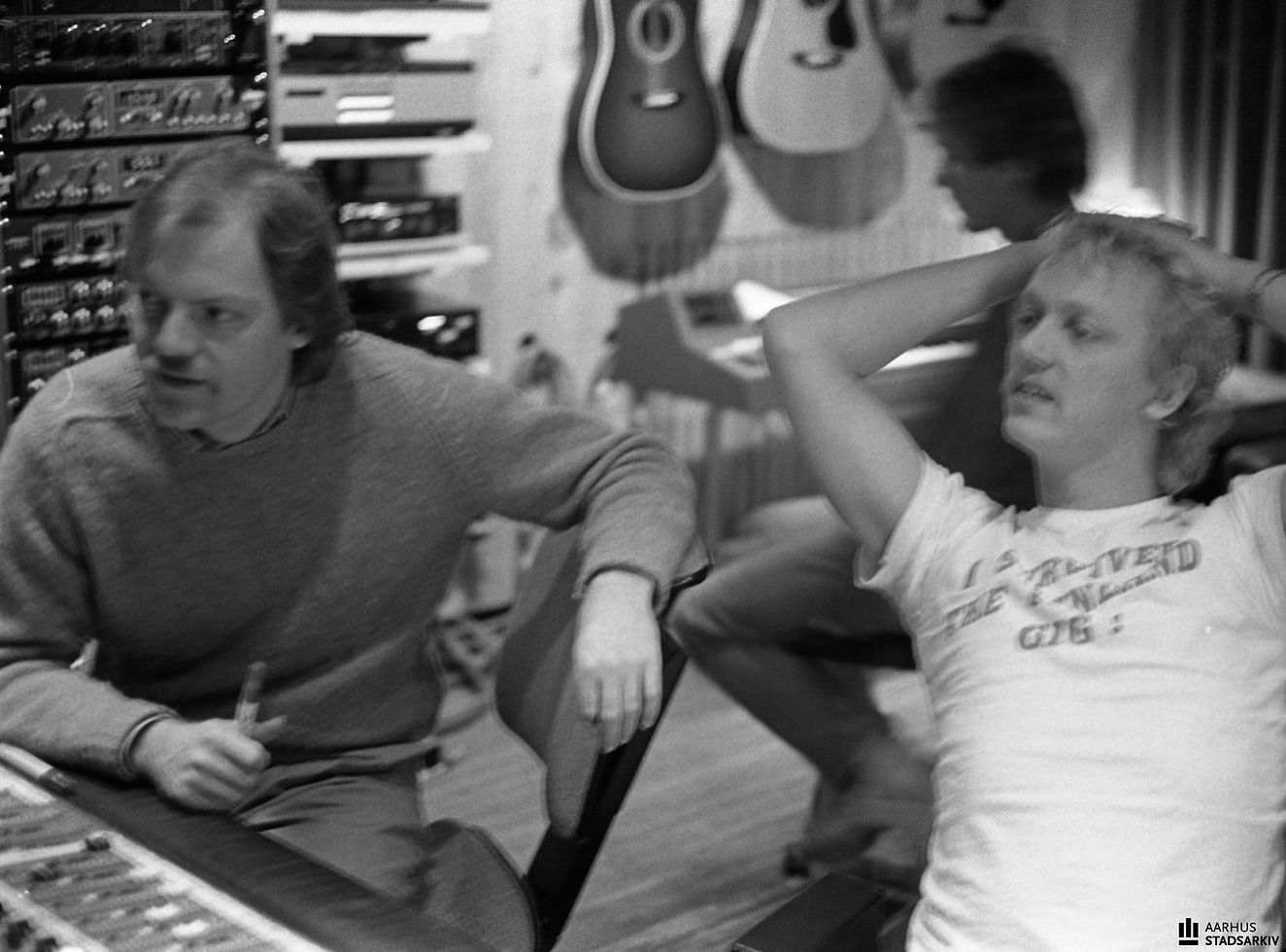
About a Studio: Feedback Studiet, Aarhus
Feedback Recording at Haraldsgade, 7 January 1986. Photo: Jens Tønnesen / AarhusArkivet.dk (CC BY 4.0).
Feedback Recording, usually called Feedback Studiet, occupied Haraldsgade 27 in Viby, Aarhus, Denmark. It grew out of Gnags’s own working environment and became a recording home for a much wider circle of musicians. Steel Pulse made True Democracy there. Danish artists gathered for “Afrika”. Thomas Helmig, TV-2, Henning Stærk and Poul Krebs all became part of its recording history.
Its busiest decades were the 1980s and 1990s. Understanding Feedback means looking at the records, the engineers and the practical independence that Gnags built around a house and a former workshop in Viby. The focus here is the original Haraldsgade studio.
Gnags, Genlyd and a workshop in Viby
Gnags established their collective at Haraldsgade in 1971. During the following years they developed a recording studio in an old carpenter’s workshop behind the house. Jacob Riis-Olsen contributed practical building skills, while Peter A.G. helped organise the project.
The studio belonged to a wider ambition to control how music was recorded and released. Gnags founded Genlyd Grammofon in 1974, creating a base for their own records and for other artists. As Aarhus Stadsarkiv’s history explains, the intention included keeping profits available for further work and new talent.
Feedback developed in stages. A contemporary Studio Sound report from December 1983 traced its beginnings to a rehearsal and demo setup with two Revox machines, followed by rebuilding and a 16-track installation in 1975. The rooms, equipment and uses of the buildings continued to change.

Peter A.G., Jacob Riis-Olsen and Jens J.G. Nielsen at Feedback during the Gnags X sessions, 3 March 1983. Photo: Jørn Timm / AarhusArkivet.dk (CC BY 4.0).
Steel Pulse: True Democracy in Viby
One of Feedback’s important international recordings was Steel Pulse’s True Democracy, released in 1982. In a 2022 interview with the Jamaica Observer, singer David Hinds recalled the band having no record deal and little prospect of financing their next album. An opportunity in Denmark led them to travel by boat from England and record at Feedback with producer Karl Pitterson.
Hinds remembered the sessions taking 25 days. He also recalled a disagreement over “Rally Round”: Pitterson wanted another vocal performance, while Hinds initially felt the existing take was right. After several days he tried again, and later came to value Pitterson’s insistence.
Drummer Steve “Grizzly” Nisbett also recalled the invitation and the late-1981 Danish sessions in his interview with Andy Brouwer. Feedback’s story reaches into international reggae history as well as the Danish records most closely associated with the address.
1985: “Afrika” brings the scene together
On 13 July 1985, a large gathering of Danish artists came to Feedback for “Afrika”, written by Nanna and produced by Kim Sagild. The singers included Thomas Helmig, Sanne Salomonsen, Lis Sørensen, Bamse, Steffen Brandt, Henning Stærk and Peter A.G. The project raised funds for the Danish Red Cross.
Photographer Steen Tronsgaard documented the gathering. The anniversary feature at Promus and GAFFA’s session gallery preserve a visual record of musicians working together in the original rooms. The major gathering happened on 13 July. The single’s reproduced recording and mixing credits list work across several dates in July.
Sagild later remembered the pleasure of having so many artists together for a shared recording and an evening afterwards. His recollection helps explain the significance of Feedback as a meeting place, alongside the familiar sound of the finished single.
The records behind the reputation
The record sleeves give Feedback’s history some precision. They show artists returning, engineers working across different projects, and albums moving between studios for recording, overdubs and mixing.
Thomas Helmig’s debut, Thomas, was recorded at Feedback between January and March 1985. Its reproduced sleeve credits name Kim Sagild as producer, with Tom R. Andersen and Johannes Stærk engineering. The musicians included Gnags members Per Frost and Mads Michelsen, alongside other collaborators.
Henning Stærk Band recorded Soul Feet at Feedback in August 1985, with Billy Cross producing and Tom Andersen engineering. Mixing was split between Feedback and Werners. Stærk’s own discography records those roles.
TV-2’s Nærmest Lykkelig followed in 1988. The band’s original track-by-track credits place “Kys Det Nu”, “Monas Solarium” and “En Sommerdag For Alt For Længe Siden” at Feedback. Other tracks were recorded at Werners. Their next album, Vi Blir Alligevel Aldrig Voksne, was recorded at Feedback and Werners in 1989–90, then mixed at Werners.
Gnags returned to Feedback in January 1989 after travels in Cuba and Nicaragua. Mr. Swing King followed that September, with some of that Latin American inspiration carried into the arrangements, according to the band biography reproduced from Gnags’s own website.
The 1990s brought further work across different styles. Release credits identify Feedback as the recording studio for Gnags’s Øjne på stilke, produced and engineered by George Shilling in 1994. Thomas Helmig’s Groovy Day credits place part of its recording and mixing at Feedback alongside work in the United States.
The engineers who carried the work
Tom R. Andersen and Johannes Stærk recur throughout these credits. Their work connects artists and records that might otherwise seem to belong to separate stories. GAFFA’s 2017 tribute to Tom Andersen recognised him as a central figure in Feedback’s recording history.
Feedback also mixed recordings made elsewhere. Lars Lilholt’s Engang drog vi ud for at slå tiden ihjel was recorded at Dreamland and mixed at Feedback by Johannes Stærk. The band’s Kong Pukkelrygs Land was recorded in Silkeborg, then mixed at Feedback in December 1993 and January 1994.
There was a mobile operation too. Gnags’s Intercity was recorded at New Experimental College in Thy by Feedback Mobile Studio and mixed at Feedback in July 1980. That is part of Feedback’s wider work, although the recordings themselves were made away from Haraldsgade.
Poul Krebs: a week of night sessions in 1995
The making of Små sensationer gives a particularly vivid picture of Feedback in the 1990s. In Poul Krebs’s published biography, the starting point was 20 songs captured on a Walkman in Amsterdam, using his voice and acoustic guitar.
Working with producer Poul Martin Bonde and musicians from different stages of his career, Krebs began a week of night sessions at Feedback in late January 1995. Before the studio work started, the seven musicians played an improvised concert at Peter Gift in Aarhus. They then developed the arrangements in the studio.
The resulting album became Krebs’s commercial breakthrough and included “Sådan nogen som os”. The detailed account, also reproduced for the album’s anniversary tour, describes a deliberate attempt to preserve the immediacy of the new songs.
Inside the Whale and the life around the sessions
Marcus Winther-John’s published memoir excerpt records another part of Feedback’s later-1990s history. Inside the Whale returned there for the first week of the sessions for Rebeller uden sag, having made their first proper demos at the studio years earlier.
He remembers meals supplied by rock cook Chili John, including steak with chilli-chocolate sauce. Recording then moved to Mox in Copenhagen. The account, accompanied by a photograph identified as Feedback, gives a glimpse of the everyday life surrounding a record that became important to the band’s Danish-language breakthrough.
Inside Studio 1: changing rooms and equipment
Feedback’s equipment changed over the decades. The 1983 Studio Sound report described an Amek M2500 in the control room. It also recorded maintenance engineer Ole Toft building noise gates when Steel Pulse booked the studio, an example of technical work responding directly to a recording session’s needs.
In a later configuration, Studio 1 housed a Calrec UA-8000 “Polar” console. Calrec’s own history identifies the UA8000 as its first music console, developed for ABBA’s Polar Studios in Stockholm in 1984. Jakob Erland’s Gyraf documentation includes photographs explicitly identifying Feedback’s actual desk and describes the design as manufactured in very small numbers.
Tapetown founder Rasmus Bredvig, who worked at the original Feedback in its later years, remembers a huge main live room, a second recording space known as the “garage room”, and a side room between the main live room and the large control room. There was a kitchen and a lounge with an entire glass side, giving people space to eat and spend time together between sessions.
The main house had its own changing uses. By the time Bredvig worked there, rooms were shared among a group of engineers and producers, with Studio 1 used for recording. Those later arrangements were part of how the working community made the premises financially possible.
Gyraf Audio: equipment developed during real sessions
Equipment design was part of the life of Feedback. Gyraf Audio’s own account describes designs developed to meet the needs of the studio’s engineers. Working close to recording sessions made it possible to test a unit, hear a response, change the design and try it again quickly.
Freelance engineers carried this locally made equipment into other studios, generating wider interest. Production was established in the basement beneath Studio 2. Jakob Erland’s workshop became the base for a business whose equipment reached well beyond Haraldsgade.
That close relationship between recording and design was also observed by engineer George Shilling, who described Erland’s work at Feedback and the studio testing of his designs in a review of the Gyraf Gyratec XIV.
The later community: ET Mastering, Anders Boll and Tapetown
Feedback remained a working studio beyond its best-known decades. Efterklang recorded the core of Magic Chairs, released in 2010, there before adding further contributions in Copenhagen.
It also became an early professional home for another generation. Anders Boll began his professional career at Feedback before helping establish Lydhavnen, a connection documented in Aarhus Teater’s programme biography.
Emil Thomsen’s mastering work began in 2007, as ET Mastering’s own site records. Bredvig remembers Emil first working from the apartment he shared with Marie Højlund, then moving into Feedback in 2009. Tapetown took shape there too: Bredvig remembers choosing the name in Studio 1’s kitchen.
There are direct musical connections across the generations. MANI’s own biography describes recording at Feedback with Cy Nicklin after signing to Genlyd in 1982. Decades later, Emil Thomsen transferred and remastered the band’s catalogue for its reissue.
Several members of the later community helped establish Lydhavnen, carrying working relationships and knowledge into new rooms. Bredvig described that transition in a 2016 interview. Magnus Vad carried the Feedback name forward in his own studio after the original Haraldsgade operation ended.
A legacy built by making room for other musicians
At Steppeulven 2020, Gnags received the Pioneer Prize. The speech honouring the band recognised Genlyd and Feedback, and the decision to make production facilities available to other musicians. On the same evening, Anders Boll received Producer of the Year for his work with Ganger and Lowly. The contemporary awards report brings those two generations into the same room.
Feedback’s history can be followed through the records, but also through what people learned and built there: the studio skills, equipment designs and working partnerships that continued beyond the original address.
For more Danish recording history, read our article on Puk Studios. Our series also covers Sweet Silence Studios in Copenhagen.

