top of page

Updated: 4 days ago


Empty modern gallery with suspended pastel blocks, glossy floor, and a distant display counter under warm blue-pink light

The safety net is real. What it costs you is more real.


Let's be honest about the technology before we indict it. 32-bit float recording is a genuine technical marvel. The dynamic range is so vast as to be essentially infinite for any practical recording application. You cannot clip it at the input stage. You can record a drummer playing at full volume, realise you had the gain forty decibels too high, pull it back in post, and retrieve a usable take. This is real. It works. It is not marketing.

And it is making engineers worse. Not obviously worse, not in ways that show up as clipped takes or distorted vocals. Worse in the way that matters more: in attention, in decision-making, in the quality of listening that separates an engineer who captures something extraordinary from one who simply administers a session and hands over the files.

Here is the mechanism.


Gain staging is not a technical chore. It is a musical decision.

When you set the gain on an input, whether that is an analogue preamp, a console channel, a standalone microphone preamplifier, you are not performing housekeeping. You are making a choice about where in that circuit's character this sound is going to live.

A signal hitting a transformer-coupled preamp at the top of its headroom behaves differently than the same signal at half that level. The harmonics change. The way the circuit responds to transients changes. The sound has a different relationship to the noise floor, to the saturation curve, to the particular personality that a piece of equipment took decades of engineering and manufacturing to develop. These are not subtle differences. They are audible to anyone who has spent real time listening, and they are absolutely gone if you decide you will sort the level out in post.

The 32-bit float engineer sets gain somewhere in the ballpark and moves on. There is no consequence for the wrong choice, so there is no pressure to make the right one. Over time, over hundreds of sessions, the muscle that makes that decision stops developing. The ear that knows where a signal should sit in a circuit stops being trained. You get engineers with excellent recall of plugin parameters and a diminishing ability to hear what is actually happening in a room.


The safety net changes your posture before you touch a single fader.

There is a psychological dimension to 32-bit float that nobody in the gear conversation wants to discuss, because the gear conversation is about specifications and the psychological dimension is about character.

When you know you cannot make an unrecoverable mistake at the gain stage, you stop being fully present to the gain stage. Your attention, which is the most valuable thing you bring to a session, quietly relocates. You start thinking about the mix, about the session schedule, about the conversation you need to have with the band about the arrangement in the third song. The input gain becomes something you will revisit later rather than something you are deciding now.

This is not a criticism of individual engineers. It is a description of how humans respond to the removal of consequences. Every safety net ever invented has produced this effect in its domain. The question is not whether the effect happens, it does, reliably, in every field where it has been studied, but whether you are aware of it happening to you and whether you are choosing to compensate for it.

Most engineers using 32-bit float recorders are not aware. The sessions do not fail. The takes are clean. The files come back with headroom and nothing peaking and nothing wrong, exactly, and something slightly not right that nobody can put their finger on and that everybody agrees is probably down to the performance or the room or the arrangement or the day.

It is usually the gain staging.


You can recover the waveform. You cannot recover the sound.

Here is the version of this argument that engineers who defend 32-bit float will dismiss as mysticism, and here is why they are wrong.

When a signal is hitting a preamp hard, when it is working, when the circuit is under pressure, when the transformer is at the edge of its linear range, it is producing harmonic content. Second-order harmonics, primarily, the even-order distortions that the human ear does not register as distortion but as presence, as warmth, as the quality that makes certain recordings feel three-dimensional in a way that technically cleaner recordings do not. That harmonic content is generated by the interaction between the signal level and the circuit. It exists at the point of capture or it does not exist at all.

When you record at the wrong level and pull it back in post, you are not recovering the sound. You are recovering the amplitude information about the sound. The harmonic story the preamp would have told if you had driven it correctly, that story was never written. What you have is a clean, uncoloured, dynamically accurate, slightly dead recording of a signal that was not allowed to do what it was going to do.

This is the core of the problem. 32-bit float promises that no information will be lost. What it cannot promise, what no digital system can promise, is that the information you needed was ever captured in the first place.


The engineers who developed real ears learned on systems that punished them.

The engineers whose work you admire, the ones with genuine discernment, the ones who can hear what a room is doing before a note is played, who know within seconds of a singer opening up whether the mic choice is right, who can feel a session going sideways before it goes sideways, those engineers learned on systems where a wrong gain decision was immediate, irreversible, and expensive.

They clipped takes. They salvaged what they could. They listened to the difference between a take captured at the right level and a take captured at the wrong one, and they did not get to pretend the difference did not matter because they had a 32-bit safety net to hide it. They had to hear it, sit with it, understand it, and make sure it did not happen again.

That is not nostalgia. That is a description of how expertise is built in any craft that involves physical systems and real consequences. You learn what the system does by feeling what happens when you push it wrong. Remove the consequence and you remove the lesson, permanently, for every engineer who will never experience it.

We are now training a generation of engineers who are technically proficient, who understand signal flow, who can operate a DAW with considerable skill, and who have ears that have never been sharpened by a real mistake. The takes are clean. Nothing is obviously wrong. And the recordings are missing something that nobody can quite name.


The answer is not to throw away your recorder.

Tapetown does not operate on a principle of deliberate technical primitivism. We use modern equipment. We use converters with performance that would have been unimaginable twenty years ago. The argument here is not about bit depth.

The argument is about posture. About where your attention is when the session is running. About whether the act of setting gain is a decision you are making or a step you are completing. About whether the safety net is something you are aware of and consciously working against, or something you have simply accepted as the natural condition of modern recording.


Make decisions. Commit to them. Set the gain where it should be and know why it should be there. If you are using a 32-bit float recorder, use it the same way you would use a system that costs you the take if you get it wrong, because the cost is still there, it is just hidden, and it is paid later, in the quality of the recording, in the life of the sound, in the thing that listeners feel but cannot name when they say a record sounds a little flat, a little safe, a little like something was not quite committed to.


Commit. That is the job. The bit depth is not an excuse.

Finishing a record? Send us the rough mix.


TL;DR:

  • Vibe Over Perfection: We prioritize raw emotion and unique sonic character over clinical pitch-correction and synthetic polish.

  • The Technical Foundation: Choosing the right transducer (tube, condenser, or ribbon) is the most critical decision for establishing vocal authority.

  • Signal Commitment: We utilize high-end analog tube compressors during tracking to instill "physical presence" before the sound hits the DAW.

  • Psychology of Performance: The producer’s primary role is to cultivate a safe, high-vibe environment where the artist can be truly vulnerable.

  • The Beauty of Imperfection: Why subtle cracks, breaths, and natural micro-tonal variations are the elements that make a vocal unforgettable.

high end vintage mics

1. Introduction: The Vocal as the Soul of the Production

In any mix, the vocal is the focal point. It is where the message lives, and it is where the listener finds a point of identification. However, in modern pop and indie production, we see a dangerous trend: vocals are often treated as static instruments to be corrected, tuned, and polished until every trace of humanity is erased.

At Tapetown, we hold a fundamentally different view. We believe that character beats perfection every time. Our goal is not to produce the most "correct" vocal, but the most compelling one. A vocal with character possesses Sonic Authority; it feels as though the singer is standing in the room with you. Achieving this requires a combination of technical expertise, elite analog gear, and a deep understanding of human psychology.


2. Microphone Selection: Finding the Vocal’s "Home"

The first step in vocal production at Tapetown is finding the microphone that complements the singer’s unique tonal color. There is no "best" microphone—only the right match for the specific voice and the emotional context of the song.


  • Large Diaphragm Tubes (Vintage Class): We often utilize microphones based on classic circuits (such as U47 or C12 styles). The vacuum tube within the microphone adds subtle harmonic distortion, making the midrange rich and complex. This gives the vocal a "larger-than-life" feel essential for indie, rock, and modern alternative pop.

  • Ribbon Microphones for Intimacy: If a singer has a particularly bright or sibilant voice (harsh 's' sounds), a ribbon microphone can be the perfect choice. Its natural high-end roll-off mimics the way the human ear perceives sound, creating an incredibly intimate and warm texture.

  • Dynamic Mics for Raw Energy: Sometimes, the best tool for an aggressive rock vocal is a high-quality dynamic microphone. It allows the singer to move freely and deliver a more visceral performance without sacrificing the core of the sound.


3. Preamp and Compression: Building "Physical Presence"

Once we’ve identified the right microphone, we route the signal through our analog chain. We believe in "printing" the sound during recording, which means making definitive choices about compression and EQ at the source.


Analog Compression During Tracking: We frequently use tube compressors (such as Variable-Mu or optical LA-2A styles) to control vocal dynamics before they hit the computer. But we don’t do it just for volume control—we do it to create Analog Weight. An analog compressor "glues" the vocal together and provides a physical texture that helps the singer hear themselves more clearly in the mix. This builds a level of confidence in the performance that cannot be replicated with plugins after the fact.


4. Psychology Behind the Mic: The Producer’s Vital Task

You can have the most expensive equipment in the world, but if the singer doesn't feel safe, you will never capture a "magic take." Vocal recording is a vulnerable process. At Tapetown, we see ourselves as much as psychologists and coaches as we do engineers.


Creating the Safe Space: We spend significant time dialing in the perfect headphone mix. If the singer feels like a star in their own ears, they will perform like one. We work with lighting, atmosphere, and clear communication to remove the technical barriers of the studio. Our goal is for the artist to forget the microphone and fully immerse themselves in the song’s universe. This is where the unplanned moments happen—the moments that end up defining the record.


5. Daring to Keep the Flaws: Why "Perfect" is Boring

In a world dominated by Auto-Tune and Melodyne, leaving a vocal raw has become a radical act. We fight against the urge to align everything to a mathematical grid.


The Human Artifacts: A slight crack in the voice on a high note, the sound of a sharp intake of breath before a vital lyric, or a note that floats slightly flat to convey melancholy—these "flaws" are what create emotional connection. If we remove them, we remove the singer’s soul. At Tapetown, we use digital correction as a surgical tool, never as a blanket process. We would much rather have a take with massive emotion and a few "mistakes" than a take that is technically flawless but cold.


6. Mixing the Vocal: The Hybrid Approach

In the mixing phase, we double down on our analog philosophy. We often "round-trip" the vocal out of the computer to run it through our analog outboard chain one last time. This adds that final three-dimensional depth, ensuring the vocal sits firmly in the center of the soundstage while maintaining an airiness and width that makes it pleasant to listen to for hours on end.


7. Conclusion: Your Voice is Your Brand

Your vocal is not just a sound source; it is your most important brand asset. By choosing an approach to vocal production that values character, analog quality, and human nerve, you ensure that your music is not just heard, but felt.

At Tapetown, we are dedicated to finding your true voice. We combine the best of the classic analog world with a modern understanding of the artist's needs. The result is a vocal production with authority, soul, and an unforgettable character that defines your career.

Finishing a record? Send us the rough mix.


analogue outboard gear in recording studio

TL;DR: The Analog vs. Digital Paradox


  • The Science: Analog is a continuous physical wave; digital is a discrete mathematical approximation. Both are vital, but they serve different purposes.


  • The Weight: "Analog Weight" is the result of magnetic saturation in transformers and harmonic richness in tubes—physics that algorithms still struggle to replicate perfectly.

  • The Psychology: Digital fatigue is real. Analog's "musical imperfections" mimic natural sound, making it easier for the human brain to process and enjoy for longer periods.

  • The Hybrid Solution: The most professional records today use a "Best of Both Worlds" approach—digital for precision/editing and analog for character, depth, and "Sonic Authority."

  • The Career Impact: High-end production isn't just a luxury; it’s a strategic investment that ensures your music stands out in a saturated global market.


Table of Contents:


  1. Introduction: The Convergence of Two Eras

  2. The Physics of the Wave: Continuous Voltage vs. Discrete Samples

  3. Harmonic Saturation: The Mathematical Beauty of Iron, Copper, and Vacuum

  4. The Psychoacoustics of Listening: Why the Brain Craves Imperfection

  5. The History of Digital Evolution: From 16-bit Limitations to 32-bit Floating Point

  6. The Hybrid Philosophy: Integrating the Best of Both Worlds

  7. Engineering the Signal Path: The Critical Journey from Membrane to Converter

  8. The Economics of Quality: Why High-End Production is a Career Investment

  9. Technical Deep-Dive: Transformers, Impedance, and Phase Integrity

  10. Conclusion: The Future of Sonic Excellence


1. Introduction: The Convergence of Two Eras

In the landscape of 2026, the debate between analog and digital recording has evolved from a simple rivalry into a sophisticated synergy. For decades, the industry was divided. On one side stood the traditionalists, guarding their power-hungry vacuum tubes and temperamental tape machines. On the other side were the digital pioneers, championing the limitless possibilities and clinical precision of the computer.

Today, we have entered the era of the Paradox. Why, in a time where a laptop can simulate a million-dollar studio, do the world's leading artists still travel to specialized facilities to record through hardware designed in the 1950s? The answer is not found in nostalgia or aesthetic trends. It is found in the fundamental nature of sound itself.

This treatise explores the concept of Sonic Authority. It is a term that describes the weight, texture, and physical presence of a recording. At its core, this authority is built upon the interaction between human emotion and physical electricity. As we dive into this masterclass, we will explore why the marriage of analog weight and digital precision is the only way to achieve true sonic excellence in the modern age.


2. The Physics of the Wave: Continuous Voltage vs. Discrete Samples

To understand the difference between analog and digital, we must start with the physics of a sound wave. Sound is an analog phenomenon. It is a continuous, uninterrupted wave of pressure moving through the air. In an analog recording system, this air pressure is converted into a continuous stream of electrical voltage. This voltage is a direct analogue of the original sound wave. It has infinite resolution because it is a physical reality.

Digital recording, however, operates on the principle of Sampling Theory. To store sound on a hard drive, the computer must take "snapshots" of the analog voltage at a specific rate. This is known as the Sample Rate. While a rate of 96kHz or 192kHz provides an incredibly high-resolution approximation, it remains, by definition, a series of discrete dots connected by a mathematical algorithm.


The Sampling Gap is where the paradox begins. While digital systems are mathematically "perfect" within their limits, they operate on a grid. Analog systems have no grid. In an analog circuit, there is no quantization error. The electrons move through copper and iron in a fluid, organic flow. This lack of a grid is what gives analog recordings their sense of "air" and "depth." When engineers speak of Three-Dimensional Depth, they are often referring to the absence of the digital artifacts that can subtly flatten a soundstage.


3. Harmonic Saturation: The Mathematical Beauty of Iron, Copper, and Vacuum

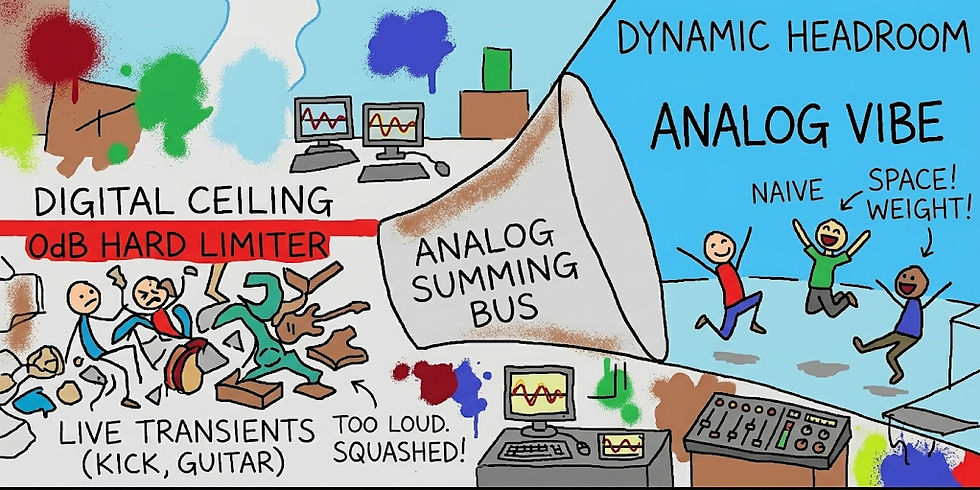
The most significant reason professional engineers continue to use analog hardware is for a phenomenon known as Harmonic Saturation. In the digital world, distortion is usually a catastrophic error. When a digital signal hits the ceiling of 0dBFS, it clips, resulting in a harsh and unlistenable square wave. In the analog world, distortion is a spectrum of musicality.

Consider the role of the Transformer. A transformer is a physical object consisting of an iron or steel core wrapped in copper wire. As you push a loud signal through this component, the metal core becomes magnetically saturated. It cannot hold any more magnetism, so it begins to gently "squash" the peaks of the waveform. This is Magnetic Saturation.


Unlike a digital limiter, which cuts the wave abruptly, a transformer rounds it off. This creates what we call "soft-knee" compression. More importantly, it generates low-frequency harmonics that the human ear perceives as "thickness" or "heft." This is the scientific definition of Analog Weight. It makes a kick drum feel solid and a bass guitar feel massive in a way that digital code struggles to replicate.

The Vacuum Tube, or valve, operates similarly but with a different harmonic profile. Tubes are famous for adding "Even-Order Harmonics." These are frequencies that are mathematically related to the original note in a way that sounds warm and musical to our brains. A tube circuit is a living thing; it reacts to the heat of the room and the intensity of the performer's touch. It breathes with the music, providing a level of dynamic character that algorithms can only attempt to simulate.


4. The Psychoacoustics of Listening: Why the Brain Craves Imperfection

The human ear is not a scientific measurement tool. It is an emotional organ evolved over millions of years to detect subtle changes in our environment. Evolution has taught us to listen for organic noise, slight pitch drifts, and the complex "rub" between frequencies.

Digital audio is often "too perfect." It has a noise floor that is silent and a frequency response that is mathematically flat. While this is a technical achievement, it can be fatiguing to the brain over long periods. This is known as Digital Fatigue. The brain has to work harder to "believe" in the sound because it lacks the micro-fluctuations found in the natural world.


Analog hardware introduces subtle "errors"—noise, phase shifts, and non-linearities. These artifacts, when managed by a skilled engineer, provide the listener with a sense of comfort and familiarity. It makes the music feel human. It creates a sense of "Presence" that allows the listener to relax and immerse themselves in the performance. This is why a record mixed through an analog console often feels more "emotive" than one mixed entirely inside a computer.


5. The History of Digital Evolution: From 16-bit Limitations to 32-bit Floating Point

To appreciate the current state of technology, we must look at the evolution of digital audio. In the early 1980s, the introduction of 16-bit Pulse Code Modulation (PCM) was a revolution, but it came with significant flaws. The limited dynamic range and high quantization noise created a sound that was often described as "cold," "brittle," or "harsh." This early experience defined the "Analog vs. Digital" war for decades.

As we moved into the 24-bit era, the noise floor dropped significantly, and the resolution improved. Today, we have 32-bit floating-point recording. Mathematically, the dynamic range of a 32-bit float system is so vast that it exceeds the physical capabilities of any hardware and the limits of human hearing. Digital is no longer "bad"—it is now a transparent medium.


However, transparency is not always the goal in art. While digital provides a perfect "window" into the sound, analog provides the "lens" that shapes it. The history of digital evolution has been a journey toward perfection, while the history of analog has been a journey toward character. In 2026, the master engineer knows how to use the transparency of digital to capture the character of analog.


6. The Hybrid Philosophy: Integrating the Best of Both Worlds

The modern professional does not choose between analog or digital. They choose both. This is the Hybrid Philosophy. It is the understanding that the computer is the world's best editor, while the hardware is the world's best painter.

In a hybrid workflow, we capture the initial performance through high-end analog preamps and compressors. We "print" the Analog Weight onto the digital file from day one. This ensures that the foundation of the song has the necessary Sonic Authority. Once the audio is inside the DAW, we utilize the surgical precision of digital tools for editing, tuning, and complex routing.

In the mixing stage, we move back out of the box. By using analog summing and outboard EQs like the Pultec, we re-introduce the three-dimensional depth that can sometimes be lost during heavy digital processing. This "round-trip" ensures that the final result has the grit and soul of a 1970s classic and the clarity and impact of a 2026 masterpiece.


7. Engineering the Signal Path: The Critical Journey from Membrane to Converter

The signal path is the lifeblood of a recording. It is an unbroken line of electrical energy that must be protected at every stage. We view the signal path as a series of deliberate choices.

It begins at the microphone membrane. The choice of a tube, condenser, or ribbon mic is the first "EQ" applied to the sound. From there, the signal travels to the preamp. Here, the choice of a transformer-balanced or a transformerless circuit dictates the "speed" and "weight" of the transient.

One of the most critical stages is Impedance Matching. The electrical relationship between the mic and the preamp determines how the microphone "breathes." A mismatch can lead to a loss of high-end detail or a muddy low-end. By understanding the science of the signal path, we ensure that the artist's performance is captured with total integrity before it ever reaches the digital converter.


8. The Economics of Quality: Why High-End Production is a Career Investment

In a world where millions of songs are uploaded to streaming platforms every month, the barrier to entry has never been lower. However, the barrier to success has never been higher. To stand out in a saturated market, an artist must possess a sound that is undeniably professional.

Investing in high-end production is not just about "better audio." It is about Career Longevity. A record with Sonic Authority commands respect from radio programmers, festival bookers, and label A&Rs. It signals that the artist is serious about their craft.

High-end production also ensures that a song translates across all listening environments. Whether a fan is listening on high-end audiophile speakers or cheap earbuds, a well-engineered, analog-weighted mix will maintain its impact. This consistency is what builds a global brand in the music industry.


9. Technical Deep-Dive: Transformers, Impedance, and Phase Integrity

For the technically minded, the paradox of analog vs. digital is best understood through the lens of Phase Integrity. Phase refers to the timing relationship between sound waves. Digital filters, particularly those used in "In-the-box" EQs, can often shift the phase of a signal in a way that sounds "smeared" or "plastic."

Analog EQs, especially passive designs like the Pultec, handle phase in a much more musical manner. Because they rely on physical components like inductors and capacitors, the phase shift is gradual and follows the laws of nature. This is why analog EQs feel "attached" to the sound, whereas digital EQs can sometimes feel like they are "sitting on top" of the sound.

Furthermore, the concept of Headroom is vital. Analog circuits often have a "soft" limit. As you approach the limit of the voltage, the circuit begins to compress and saturate. This provides a safety net that sounds good. Digital has a "hard" limit. One decibel over the limit results in total failure. This is why tracking through analog gear leads to a more relaxed and dynamic recording process.


10. Conclusion: The Future of Sonic Excellence

As we look toward the future, the Analog vs. Digital Paradox will continue to drive innovation. We will see even better digital emulations, and we will see new boutique hardware manufacturers pushing the limits of electrical design.

However, the core truth remains: music is a human experience. As long as humans have ears that crave warmth and hearts that react to vibration, the physical weight of analog gear will remain essential. At our studio, we are committed to this pursuit of excellence. We bridge the gap between the eras, ensuring that your music has the authority, the weight, and the soul it deserves.


In 2026, the ultimate recording is not a digital one or an analog one. It is a Human one, empowered by the best of both worlds. If you wish to explore some interesting opinions on the current state of audio, head over to the Audio Pope's archive here: https://memeplugins.com/

bottom of page