top of page

A stoner or doom album in Europe is most often mastered in Sweden, the UK or Portugal, by one of a handful of engineers who also mix or play this music: Magnus Lindberg at Redmount in Stockholm (Cult of Luna's Mariner, 2016), Tony Lindgren at Fascination Street in Örebro (standard mastering published from 149 euro), Karl Daniel Lidén (Greenleaf, Lowrider, Dozer, Domkraft), Greg Chandler at Priory Recording Studios near Birmingham (Esoteric, Indesinence), Esben Willems of Monolord at Studio Berserk, and Jaime Gomez Arellano at Orgone Studios, now in Portugal (Ghost, Cathedral, Paradise Lost). The American references bands name, Brad Boatright at Audiosiege above all, are listed for comparison. We master indie and alternative records online from Denmark, so Tapetown is on the list where it belongs: at the fuzz and psych end, not the metal end.

How we built the list

Each engineer has a mastering credit on a stoner, doom, sludge or post-metal record, confirmed through a studio page, an interview or a credits page, all linked. Where a studio publishes a mastering price we quote it; where it does not, we say so. Where the credit says "mixed and mastered" we say that, because in this scene the two often come from the same room. Checked 1 November 2026.

The engineers and studios

Engineer and studio

Where

Credits we checked

Published mastering price

Stockholm, Sweden

Cult of Luna and Julie Christmas, Mariner (mixed and mastered at Redmount, 2016); plays live drums in Cult of Luna; mixing and mastering now take most of his time

On request

Örebro, Sweden

Masters alongside Jens Bogren; the studio's online ordering lists standard mastering, stem mastering and vinyl mastering

Standard mastering from 149 euro, stem mastering from 239, vinyl mastering from 49

Sweden

Greenleaf, Trails & Passes (2014), Hear the Rivers (2018), Echoes from a Mass (2021) and The Head & The Habit (2024); Lowrider, Refractions (2020); Dozer, Drifting in the Endless Void (2023); Domkraft, Sonic Moons (2023); all mixed and mastered

On request

Sutton Coldfield, England

Esoteric (his own band), Indesinence, Vessels of Light and Decay; Landskap, III; Shattered Hope, Waters of Lethe; online mastering through the studio's Master My Track service

On request

Sweden

Monolord, Your Time To Shine (Relapse, 2021), recorded, mixed and mastered at his own studio; drummer in Monolord

On request

Portugal (formerly London)

Ghost, Cathedral, Paradise Lost, The Plague Within (producer, 2015), Sólstafir, Oranssi Pazuzu, Angel Witch; producer and mixer first, mastering by arrangement

On request

Wales

Conan (his own band), Revengeance (2016); Slomatics, Future Echo Returns (2016); Mammoth Weed Wizard Bastard, Yn Ol I Annwn (2019); recording and mixing at a residential studio in the Welsh countryside; ask about mastering

On request

Portland, Oregon

Sleep, Noothgrush, Off!, Pierced Arrows; the mastering name on more stoner and sludge sleeves than anyone in the US

On request

Aarhus and Djursland, Denmark

Online mastering for indie and alternative records, including fuzz, psych and the heavier end of garage; Gustav Scheel masters, Rasmus Bredvig mixes

Quoted per project

Why so much of it is Swedish

Four of the engineers above are in Sweden, and that is not an accident. The Swedish stoner scene of the 2000s, Dozer and Greenleaf in Borlänge, Demon Cleaner and Lowrider around them, produced the people who record and master the scene now: Lidén drummed in Demon Cleaner and Greenleaf before he mixed them, Willems is Monolord's drummer, Lindberg plays live with Cult of Luna. A mastering engineer who has stood behind a kit on a doom stage knows what a 20-minute side with a down-tuned bass needs, and bands from Germany, the UK and the US send their masters there for that reason.

What doom asks of mastering

Loudness is not the problem; room is. A doom master has to hold a low B or A string, a kick drum and a bass amp in the same 40 to 80 Hz region without the three turning into one note, and it has to do that across a side that may be two songs long. Three practical consequences. First, the mix should arrive with headroom and without a brickwall limiter on the bus, so the mastering engineer sets the final level rather than fighting one that is already set. Second, vinyl needs its own thinking: a 12-inch side at 33 rpm cuts cleanly up to about 18 minutes, and heavier, brighter material shortens that, so a long doom side is quieter on the record than its streaming master unless the side is split. Third, streaming normalises loudness anyway; Spotify's default plays everything at about minus 14 LUFS, so a master that is crushed to be loud gains nothing and loses the dynamics the genre runs on. We explain the vinyl side in a separate post on mixing for vinyl and streaming at the same time.

How to choose

Pick by records, not by genre tag. Listen to two albums the engineer mastered at the volume you listen at, on the speakers you own, and ask three questions: does the low end stay separate when the whole band hits, do the quiet passages still feel heavy, and does the vinyl pressing sound like the streaming version. Then ask for one song mastered before you book the album. Most engineers on this list will do that.

What it costs

Fascination Street publishes its prices, and they are a fair guide to the Swedish market: standard mastering from 149 euro a song, stem mastering from 239, vinyl mastering from 49. Most of the others quote on request, and the US references are in dollars plus shipping if you want a lacquer cut there. Tapetown quotes mastering per project, because the number of songs and the formats change the price; send the mixes through the contact page and we tell you what we would do and what it costs.

FAQ

Who mastered Cult of Luna's Mariner?

Mariner, Cult of Luna's 2016 album with Julie Christmas, was mixed and mastered at Redmount Studios in Stockholm, Magnus Lindberg's room. Lindberg also plays live drums with the band.

Who masters Greenleaf and Lowrider?

Karl Daniel Lidén mixed and mastered Greenleaf's albums from Trails & Passes (2014) to The Head & The Habit (2024), Lowrider's Refractions (2020) and Dozer's Drifting in the Endless Void (2023), at Tri-Lamb Studios.

Can a doom album be mastered online?

Yes. Fascination Street takes orders online and communicates by email, Priory offers online mastering through its Master My Track service, and Tapetown masters online for artists anywhere. Send the final mixes without bus limiting, name the formats you need, and say which records you want to sit next to.

Does Tapetown master doom metal?

We master indie and alternative records, including fuzz, psych and the heavier end of garage and noise. For down-tuned doom and metal production the engineers above have deeper credits than we do, which is why they are on this list; if your record sits between psych and doom, send it and we will tell you honestly whether we are the right room.

If your record is fuzz, psych or heavy indie rather than metal, start with online mastering at Tapetown and send us a mix.
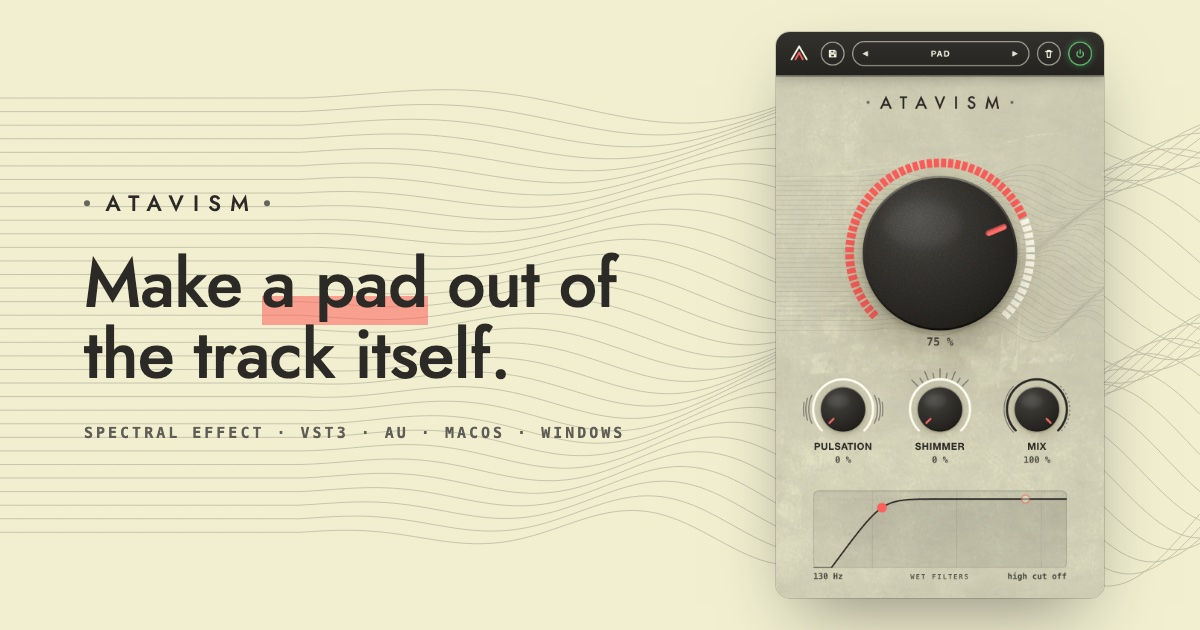
Atavism by Parallel Minds, a spectral plugin that makes a pad out of the track itself

Atavism is a spectral effect plugin from Parallel Minds that turns a track into a pad made of its own harmony. You put it on a track, a bus or the master and turn one knob: the hits fade out, the notes that ring keep ringing, and the pad follows every chord change in time with the song. It costs $39, runs as VST3 and AU on macOS and as VST3 on Windows, and has eight presets and nine automatable parameters. This guide covers what each control does, how Atavism relates to Paulstretch, shimmer reverbs and freeze effects, how to use it in band music, and why we think a pad made from the take beats one added on top.


Parallel Minds is a one-person studio in Lyon, France, run by William Garrido. Its first release, Reverie, turns thirty seconds of any recording into long ambient pieces. Atavism, released in September 2026, takes the same spectral thinking and puts it inside the song, on the timeline, as an ordinary insert effect.


Atavism at a glance

  • What it is: a spectral effect that makes a pad out of whatever audio it sits on.

  • Price: $39 (€39) from Parallel Minds. One-time purchase, one licence for macOS and Windows. It launched at $29 (€29) until 24 October 2026.

  • Formats: VST3 and AU on macOS 11 or later (Universal), VST3 on Windows 10 and 11. There is no AAX version, so Pro Tools is not covered yet.

  • Controls: one main knob, then Pulsation, Shimmer and Mix, plus a low cut and a high cut that act on the pad only.

  • Presets: eight (Init, Pad, Wings, Halo, Breathing, Octave, Distant, Trace), and you can save your own.

  • Latency: around 300 ms, compensated by the DAW. Short mode brings it down to 170 ms.

  • Licence and demo: offline key, no account. The demo is the full plugin with a two-second mute at the end of every minute.


What Atavism actually does

Most ambient effects add something to a sound: a room, an echo, a frozen slice. Atavism works the other way round. It takes away the timing of a sound and keeps its harmony.


Parallel Minds describe the process in four steps. The plugin separates what rings from what hits, and lets the hits go. It keeps the notes that stand out and drops the noise underneath them. It smears each moment forward over the seconds that follow. Past 75% on the knob it does that smear a second time, until only the lines that persist are left.


Two details set it apart. The smear only goes forward, so nothing sounds before the note is played. And nothing is held or stretched. When the chord changes, the pad changes with it, and the song keeps its length and its place on the timeline. Stop the music and the pad swells for a few seconds, then goes out on its own.


That is why the developer insists on what Atavism is not: a reverb, a delay, a freeze, a time stretcher or a synth. There is no pitch tracking and nothing is triggered. The pad is made from partials that are already in the sound, which is why, in their words, "it cannot play a wrong note."


The controls, explained

  • The main knob: the distance from the track to its pad. At 25% the attacks are gone and the groove is only hinted at. At 100% only the sustained lines are left.

  • Pulsation: a slow, irregular swell, so a long pad does not sit still.

  • Shimmer: grows the octave above inside the pad. Because it is built from the pad, it stays in key.

  • Mix: dry to wet, always in time with the track. Fully wet gives you a pad on its own track. 35 to 60% sits it under the track it comes from.

  • Low cut and high cut: two filters on the pad only. The low cut keeps the pad away from the bass, the high cut takes the air off it. The dry track is never filtered.


Every knob learns a MIDI controller with a right-click, and a bounce with the same settings comes out the same every time, Pulsation included.


How to use Atavism in band music

Under the chorus: a pad that was already in the room

Put Atavism on the band bus or the guitar bus with Mix around 40%. The Wings preset is made for exactly this. Raise the low cut until the pad stays clear of the bass. What you get under the chorus is not a new instrument. It is the chords the band already played, held between the hits.


Outros and breakdowns: dissolve the drums

Automate the main knob from zero to full over the last bar of a section. The drums fade into the chord, and the band seems to melt instead of stop. It suits the end of a song or the bar before the last chorus.


Intros: start from the song itself

Bounce the first phrase fully wet and place it in front of the song. The intro is then made of the song's own harmony, so it leads into the first chord without a join.


Guitars and vocals: a held cloud on a send

A guitar chord, a vocal line or a room recording at full knob with Shimmer becomes a held cloud about an octave wide. Keep it on a send so the dry signal stays direct. If you want to play through it, use Short mode.


Live recordings: mind what you feed it

On a one-take recording, everything in the microphone is part of the source, bleed included. Start on a bus or a room microphone instead of a single close mic, and use the two filters to keep the pad out of the low end.


Why a pad made from the take matters

Our opinion: most ambient plugins make any input sound expensive, and that is the problem. The result belongs to the plugin, not to the band. Wash is easy. A song is hard.


What we like about Atavism is where the pad comes from. Most of what we do is bands in a room, one take, every microphone hearing every instrument. When a record like that needs something under the last chorus, the usual answer is an overdub: a synth or an organ that was never in the room. A pad made out of the take itself is a different thing. It is still the band, and it keeps the shared sound of the room that we wrote about in how we mix live recordings.


It also fits the kind of tool we like. We mix in a hybrid analog setup because hardware makes you decide early: a compressor you print on the way in, a tape echo you ride by hand, a pedal the guitarist plays through instead of an effect added later. The plugins we keep are the ones that behave the same way. One knob is a decision, not a menu. We would rather own a tool that does one strange thing properly than one that does forty normal things.


The rule is the same as with any strong effect. Use it on purpose, in one place, and commit to it. A pad under every song is wallpaper. A pad that arrives once, made from the chord the band is already playing, is an arrangement choice.


Atavism compared to similar plugins

Atavism has relatives, and knowing them makes it easier to see what is new.

  • Paulstretch: Paul Nasca's free extreme time stretch is the sound many people will think of first. Slow anything down far enough and it becomes a drone. Paulstretch makes the audio longer. Atavism stays in time with the song. Parallel Minds know that territory, since Reverie uses Paulstretch as one stage of its engine.

  • Shimmer reverbs: the octave-up reverb that goes back to Brian Eno and Daniel Lanois in the 1980s, and that Valhalla Shimmer made a standard. Atavism's Shimmer puts the octave inside the pad instead of on a reverb tail.

  • Freeze effects: an Electro-Harmonix Freeze, or the freeze button on a reverb, grabs one moment and holds it. Atavism holds nothing. It follows the chords.

  • Zynaptiq Adaptiverb: the closest relative in thinking. It builds a reverb tail from the harmonic content of the input instead of from room reflections, and keeps that tail in tune. It is a much deeper tool and costs several times as much. We have written about Zynaptiq's Wormhole before.

  • Eventide Physion Mk II: splits a sound into its transient and tonal parts so you can treat each on its own. Mute the transients on a guitar and you are in the same neighbourhood. Physion is a toolbox with hundreds of presets. Atavism is one decision.

  • Granular plugins: Output Portal and its kind chop a sound into grains and scatter them. You get clouds too, but they drift away from the song's timing. Atavism's stay locked to it.


How Atavism might fare

We think it has a real chance. You can say what it does in one sentence, and most plugins cannot manage that. The price is low enough to try on a hunch. The demo is the whole plugin, the key works offline and there is no account to create, which is how a small developer earns trust.


Film and game composers will probably get there first, because turning a cue into its own underscore saves them real time. For bands, the obvious places are intros, outros and the bar before the last chorus.


Two things hold it back for now. There is no AAX version, so studios on Pro Tools cannot open it. And 300 ms of latency is fine in a mix but too much for monitoring through an insert while you play, which is why Short mode on a send exists.


The harder part is the shelf it sits on. There are a lot of ambient plugins, and "not a reverb" takes a sentence to explain. But a plugin built around one clear idea tends to outlast a big one with none, and Atavism is all one idea.


Parallel Minds Atavism FAQ

What does Atavism do?

Atavism turns the audio it is placed on into a pad made from that audio's own harmony. Hits fade, sustained notes stay, and the pad follows the chord changes in time with the song.


Is Atavism a reverb?

No. There is no room and no decaying tail, nothing repeats, and nothing is frozen or stretched. It removes the timing of a sound and keeps its harmony.


How is Atavism different from Paulstretch?

Paulstretch makes audio longer by stretching it. Atavism does not change the length of anything. The pad stays on the timeline and changes with the chords.


Does Atavism work in Pro Tools?

Not at the moment. It is VST3 and AU on macOS and VST3 on Windows. There is no AAX version.


How much latency does Atavism add?

Around 300 ms, compensated by the DAW, or 170 ms in Short mode. For playing through it, put it on a send so the dry signal stays direct.


How much does Atavism cost?

$39 as a one-time purchase covering macOS and Windows. It launched at $29 until 24 October 2026. The free demo is the full plugin with a two-second mute every minute.


Keep reading


Made a record where the take is the point? We mix shoegaze, post-punk and indie rock for artists who want the performance kept, not replaced. Send us the rough mix.

Tapetown's hybrid mix studio in Aarhus, Denmark, with a mixing console and a tape machine

Short answer: yes, a band in Chicago, Toronto or Melbourne can have its record mixed and mastered in Denmark without anyone getting on a plane. We mix and master for artists across Scandinavia, Europe, the UK, the US, Canada and Australia, remotely, with attended sessions across time zones.

This post explains how that works in practice: what to send, how quotes and time zones work, what you get back, and who actually mixes your record.

Who mixes your record

Tapetown has studios in Aarhus and on Djursland, Denmark, and the mixing happens in our mix studio in central Aarhus. Two engineers mix and master:

  • Rasmus Bredvig, Tapetown’s founder, mixes indie, alternative, punk rock and post-punk with raw energy and bite. His recording and mixing credits include Catch The Breeze’s Glow and FLOWERS’ Doom City. He leads mixing for the Tapetown Sessions.

  • Gustav Scheel is a trained recording engineer who mixes indie, alternative, folk, Americana and indie pop with a smooth, spacious and refined approach. He focuses on vocal presence, depth and natural dynamics. Before Tapetown he worked as a recording engineer with artists such as Lukas Graham and Macklemore.

The sound you want guides the engineer choice. Both mix indie and alternative. On selected projects they work together, combining Gustav’s refinement and space with Rasmus’s rawness and bite. The engineer, scope, revisions and delivery dates are agreed with your quote.

Bands from North America we have mixed

Rasmus has mixed Tapetown Sessions for artists from the US, among them Bambara, Moaning, The Fresh & Onlys and Mikal Cronin, and from Canada, dumb.

  • Most of those sessions were recorded while the bands toured Europe.

  • Bambara's was recorded in Copenhagen by another engineer, and mixed by Rasmus.

The mixing is the same work we do online: agreed audio files in, mixes out, notes in between. Every international band we have mixed, country by country: International Artists Mixed at Tapetown, by Country.

These sessions were covered by music sites in North America and Australia, such as Destroy//Exist, The Joy of Violent Movement and We All Want Someone to Shout For in the US, Some Party in Canada and Indie30 in Australia. In all, our sessions and records have been covered by more than 120 independent music publications in 19 countries since 2013: Tapetown in the press.

How it works, step by step

  1. Send a rough mix and a couple of references. A rough mix of one or more songs is enough to start, plus two or three records whose sound you love. Tell us your release date if you have one.

  2. Get a quote. We quote every project individually after hearing your rough mix, so there is no public price list. We quote in Danish kroner (DKK), euros (EUR) or US dollars (USD).

  3. Send the agreed audio files. We agree whether the project needs individual multitracks or grouped stems before you export. Multitracks contain individual recordings; stems combine sources such as drums or backing vocals. Consolidate the files from the same start point and include your rough mix. We agree the file-transfer method with you. Our track preparation guide explains the details.

  4. First mix, then notes. You get a first mix, listen in your own room and car, and send notes. Most notes are small, like a vocal a little louder in the chorus. We talk them through rather than guess.

  5. Attend a session, if you want to. You can listen in real time from your own studio while we work, and give notes as we go.

  6. Mastering and delivery. We master in-house, and we also work with Emil Thomsen at ET Mastering: see online mastering. Finished mixes are delivered as stereo WAV files. Other formats and stems are also available, so just tell us what you need for your release.

Time zones: how far apart are we?

Denmark is on Central European Time (UTC+1, or UTC+2 in summer). For most of the year:

  • New York, Toronto: 6 hours behind Denmark. A 3 pm session in Aarhus is 9 am for you.

  • Chicago: 7 hours behind. A 3 pm session in Aarhus is 8 am.

  • Los Angeles, Vancouver: 9 hours behind. A 3 pm session in Aarhus is 6 am.

  • London, Dublin: 1 hour behind. A 3 pm session in Aarhus is 2 pm.

  • Sydney, Melbourne: 8 to 10 hours ahead, depending on the season. A 3 pm session in Aarhus is 11 pm to 1 am.

  • Perth: 6 to 7 hours ahead. A 3 pm session in Aarhus is 9 pm to 10 pm.

Attended sessions: we arrange them around your time zone, wherever you are.

The rest of the work doesn't need you in the room at the same time. Notes you send at the end of your day can be worked on during ours.

What a mix costs, and why we quote

Prices for mixing vary a lot, from marketplace mixes to big-name mixers. Our post What does professional mixing cost in 2026? explains the ranges and what each level buys.

We quote each project individually, because the work differs from song to song. The quote depends on:

  • the number of songs;

  • whether you need mastering too;

  • how much editing the audio files need;

  • your deadline.

The quote is in USD, EUR or DKK, whichever is easiest for you.

Is a mixing engineer abroad the right choice?

Not always. If you want to sit in the room for every decision, a local engineer is the simpler choice.

Working with us online makes sense when the sound matters more than the postcode:

  • you play indie rock, post-punk, shoegaze, alternative or folk;

  • you want a mix that keeps the character of the performance, rather than a pop template;

  • you like the idea of hybrid analogue mixing: digital editing, then the audio runs through transformers, tubes and analogue circuits.

How to judge any engineer, here or at home, is in How to choose a mixing engineer for alternative music.

FAQ: mixing with Tapetown from outside Europe

Do I need to come to Denmark?

No. Everything works online: files, notes and attended sessions. If you are touring Europe anyway and want to sit in, our mix studio is in central Aarhus. Let us know early, because attended mixing in person depends on the studio schedule.

Which currency do you quote in?

We quote in Danish kroner (DKK), euros (EUR) or US dollars (USD).

How do attended sessions work across time zones?

We arrange them around your time zone. You listen in real time from your own studio and give notes as we go.

What do you deliver?

Finished mixes as stereo WAV files. Other formats and stems are also available, so just tell us what you need for your release.

How long does it take?

It depends on the project and what else is in the studio. Tell us your release date, and we give you a clear delivery window once we have heard your tracks.

Who will actually mix my record?

Rasmus Bredvig or Gustav Scheel, depending on the sound you want. Both mix indie and alternative, and they work together on selected projects. We agree the engineer with your quote.

Ready to send something? Send us the rough mix and tell us where you are, what you are releasing and when. We will listen and come back with an honest view and a quote.

bottom of page