


10 Weird Reverb Plugins Every DIY Music Producer Should Try
Updated: Sep 18
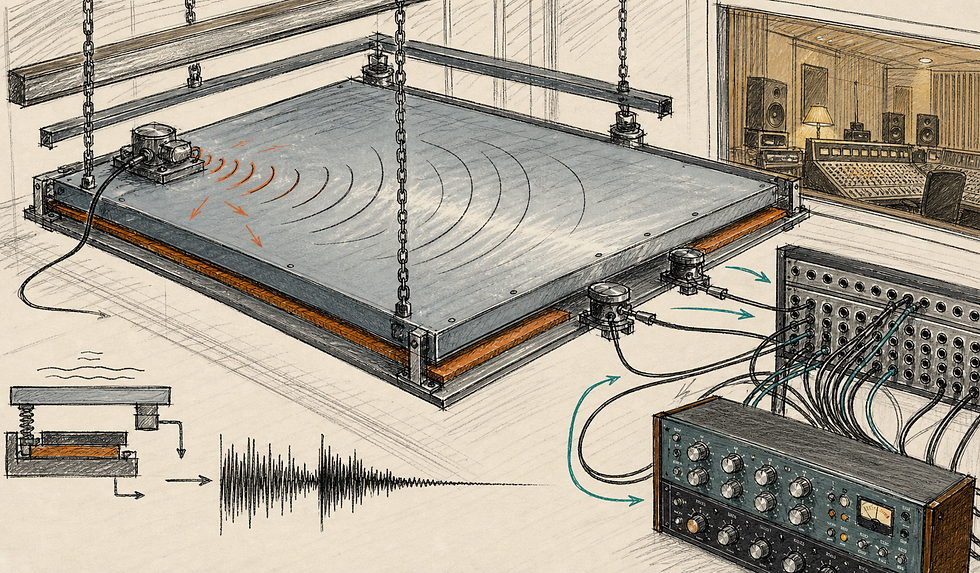
The weird reverb plugins worth trying are the ones that do something a normal room or plate cannot: u-he Protoverb, Valhalla Supermassive, Variety of Sound epicPLATE, MeldaProduction MConvolutionEZ, Voxengo OldSkoolVerb, Smartelectronix Ambience, Eventide Blackhole, Black Rooster Audio RO-GOLD, Denis Tihanov's OrilRiver and D16 Tekturon. Seven of the ten are free. This guide covers what each one does, what it costs, which systems it runs on and where it actually fits in a mix, plus how to use strange reverb without drowning your song.
Reverb is the effect most home mixes get wrong. Too much of it, on everything, all the same size. A weird reverb used on purpose on one sound is often better than a polite hall across the whole track, because it gives that one sound a place and a personality. That is the reason this list exists.
Weird reverb plugins at a glance
u-he Protoverb: free, Win/Mac/Linux. A "research" reverb that models room resonances instead of avoiding them.
Valhalla Supermassive: free, Win/Mac. Over 20 huge delay and reverb modes, updated with new modes for free.
Variety of Sound epicPLATE mkII: free, Windows only. Classic plate sound with a warm, dense tail.
MeldaProduction MConvolutionEZ: free, Win/Mac. Simple convolution reverb for loading impulse responses of odd spaces.
Voxengo OldSkoolVerb: free, Win/Mac. Diffuse, slightly grainy algorithmic reverb with an 80s feel.
Smartelectronix Ambience: free/donationware, old but alive. Lush, cheap-sounding in a good way.
Eventide Blackhole: paid (list price $199, often on sale). Enormous, otherworldly spaces.
Black Rooster Audio RO-GOLD: free, Win/Mac. EMT 140 plate with a 24k gold plate, four controls.
Denis Tihanov OrilRiver: free, Win/Mac. Clean algorithmic rooms and halls.
D16 Group Tekturon: paid (around $75). A 16-line multitap delay that turns into rhythmic pseudo-reverb.
What makes a reverb plugin weird?
A normal reverb tries to sound like a real space: a room, a hall, a chamber, a plate. A weird one does at least one of three things. It exaggerates something real spaces do (resonance, metallic ringing, endless decay). It is technically limited in a way that has character (old freeware, low sample rates, crude diffusion). Or it blurs into another effect (delay, pitch, granular). All three are useful, as long as you know which one you are reaching for.
The 10 weird reverb plugins, one by one
1. u-he Protoverb
Protoverb is a free experimental reverb from u-he, the company behind Diva and Zebra. Instead of trying to avoid room resonances like most algorithms do, it models as many of them as possible. The result sounds alive and a bit unruly, like a real room with bad acoustics. Push the controls and it turns into a haunted, ringing space.
Where it fits: on a guitar or a vocal that feels too clean, for a room that sounds like it has walls. Runs on Windows, Mac and Linux. Get Protoverb from u-he.
2. Valhalla Supermassive
Supermassive is Valhalla DSP's free reverb and delay for enormous spaces. It started with a handful of modes named after galaxies and constellations and has kept getting new ones in free updates, so the count is now over 20. Some modes are washes, some are rhythmic echoes, and several are somewhere in between.
Where it fits: shoegaze and ambient guitars, synth pads, a vocal that should dissolve at the end of a phrase. Automate the mix knob instead of leaving it high, or it will own the track. Valhalla Supermassive.
3. Variety of Sound epicPLATE mkII
epicPLATE is a free plate reverb from Bootsy's Variety of Sound, and the mkII version is still free. It aims at the dense, warm tail of classic studio plates rather than a bright modern one. It runs on Windows only (VST2 and VST3).
Where it fits: snare and vocals, the two places plates have lived since the 1960s. If you are curious where that sound comes from, read our piece on the EMT 140 reverb unit. epicPLATE downloads.
4. MeldaProduction MConvolutionEZ
MConvolutionEZ is the free, simplified convolution reverb in MeldaProduction's free bundle. You load an impulse response, a recording of how a space responds to a click or a sweep, and the plugin puts your sound in that space.
The weird part is up to you. Impulse responses of stairwells, water tanks, cars, cardboard boxes and old spring units are all over the internet, and many are free. Where it fits: sound design, putting one instrument in a strange physical space, or making your own IR of your rehearsal room. MConvolutionEZ.
5. Voxengo OldSkoolVerb
OldSkoolVerb is Voxengo's free algorithmic reverb. It sounds diffuse, a little grainy and very much like the digital rack units of the 1980s. It is not trying to be realistic, which is what makes it useful.
Where it fits: a synth or a drum machine that needs a period-correct space, or a vocal that should sound like it came off an old record. Win and Mac. OldSkoolVerb.
6. Smartelectronix Ambience
Ambience is a freeware reverb from the early 2000s that never quite died. The original was Windows only, and a later nag-free build added Mac AU and VST support. Its interface looks its age, and its sound is lush, soft and a bit cheap in the best sense.
Where it fits: ambient beds, lo-fi vocals, anything that should feel like a home recording from 2003. Expect some compatibility hassle on new systems. Ambience on KVR.
7. Eventide Blackhole
Blackhole started as a reverb algorithm in Eventide's hardware and became one of their most popular plugins. It makes spaces that no building could, with huge sizes, reverse-gravity settings and modulation that keeps the tail moving. List price is $199, but it is regularly on sale for a fraction of that.
Where it fits: one sound, one moment. A piano note that becomes a room-sized cloud, a guitar swell into a bridge, a vocal throw. On a whole mix it is too much. Eventide Blackhole.
8. Black Rooster Audio RO-GOLD
RO-GOLD is a free plate reverb from Black Rooster Audio, modelled on an EMT 140 fitted with a 24k gold plate. It has four controls (bass cut, damper, pre-delay and dry/wet) and zero latency, so you can track through it. The sound is warm and mellow rather than splashy.
Where it fits: vocals that should sound like the 1960s, and anything you want to sit behind the band rather than on top of it. Win and Mac, VST/AU/AAX. RO-GOLD from Black Rooster Audio.
9. Denis Tihanov OrilRiver
OrilRiver is a free algorithmic reverb that sounds far more polished than you would expect. It covers small rooms to large halls, with early reflections and tail controlled separately. It is here as the sensible one, and because it proves how good free reverb has become.
Where it fits: the main room or hall in a mix when you do not want to pay for one. Win and Mac. OrilRiver on KVR.
10. D16 Group Tekturon
Tekturon is technically a delay: a multitap effect with 16 independent delay lines you can sequence. Set the taps close together with filtering and feedback and it turns into a rhythmic, pulsing pseudo-reverb that follows the tempo. It costs around $75.
Where it fits: drum machines and synth arpeggios where you want space that moves in time. If you like this corner of effects, see our list of unusual delay plugins. Tekturon from D16.

How to use a weird reverb without wrecking the mix
Most mixes we get sent have the same problem: every track has its own reverb, and together they turn into one grey cloud. Weird reverbs make that worse, because they are louder and longer. Four habits help.
Pick one hero. Give one sound in the song a strange space and keep everything else dry or in one shared room. Contrast is what makes the weird one audible.
Put it on a send and EQ the return. Cut the lows below 200 to 400 Hz and often some top. Most of the mud in home mixes lives in reverb returns. More on that.
Automate it. A reverb that swells in the last beat of a phrase and disappears on the next line sounds intentional. One that is always on sounds like a preset.
Print it. When you find the sound, bounce it to audio and move on. Committing is how a weird effect becomes part of the song instead of a setting you keep tweaking.
Do you need a weird reverb at all?
Our honest opinion: no, not if your recording already has a good room in it. The best reverb on most of the records we love is the room the band played in, picked up by a pair of mics and left alone. Plugins are for the sounds that were recorded dry, or for the moments where you want something the room could not give. We have written more about that in why live room acoustics matter more than your plugin folder.
That said, a strange reverb is one of the quickest ways to make a sound belong to you. A preset hall makes you sound like everyone. A resonant, broken, metallic space on one guitar line can become the thing people remember about the song.
What an earlier version of this list got wrong
The first version of this post credited RO-GOLD to LEWITT. It is made by Black Rooster Audio (LEWITT only listed it in a blog post about free reverbs). We have also added prices, formats and operating systems, since two of these plugins are Windows-only or only partly updated for modern systems.
Weird reverb plugin FAQ
What is the weirdest free reverb plugin?
u-he Protoverb is the strangest free one, because it models room resonances instead of avoiding them. Valhalla Supermassive is the most extreme free one, with over 20 huge reverb and delay modes.
Is Valhalla Supermassive really free?
Yes. Valhalla Supermassive is completely free, with no registration or copy protection, and Valhalla keeps adding new modes in free updates.
What is the best free plate reverb plugin?
Black Rooster Audio RO-GOLD (Win and Mac) and Variety of Sound epicPLATE mkII (Windows only) are the two best free plates. Both aim at the warm sound of classic EMT 140 plates.
How do I stop reverb making my mix muddy?
Put reverb on a send, cut its low end below roughly 200 to 400 Hz, use one shared space for most instruments and automate the send instead of leaving it on. Fewer reverbs almost always sound bigger than more.
Is a delay the same as a reverb?
No, but they overlap. Reverb is thousands of dense reflections, delay is distinct repeats. Tight multitap delays like D16 Tekturon and modes in Valhalla Supermassive sit in between.
Keep reading
Made a record where the reverb is part of the song, and want a mix that keeps it that way? We mix shoegaze, post-punk and indie rock for artists everywhere. Send us the rough mix.


