


Parallel Minds Atavism, A Spectral Pad Plugin for Creative Music Production
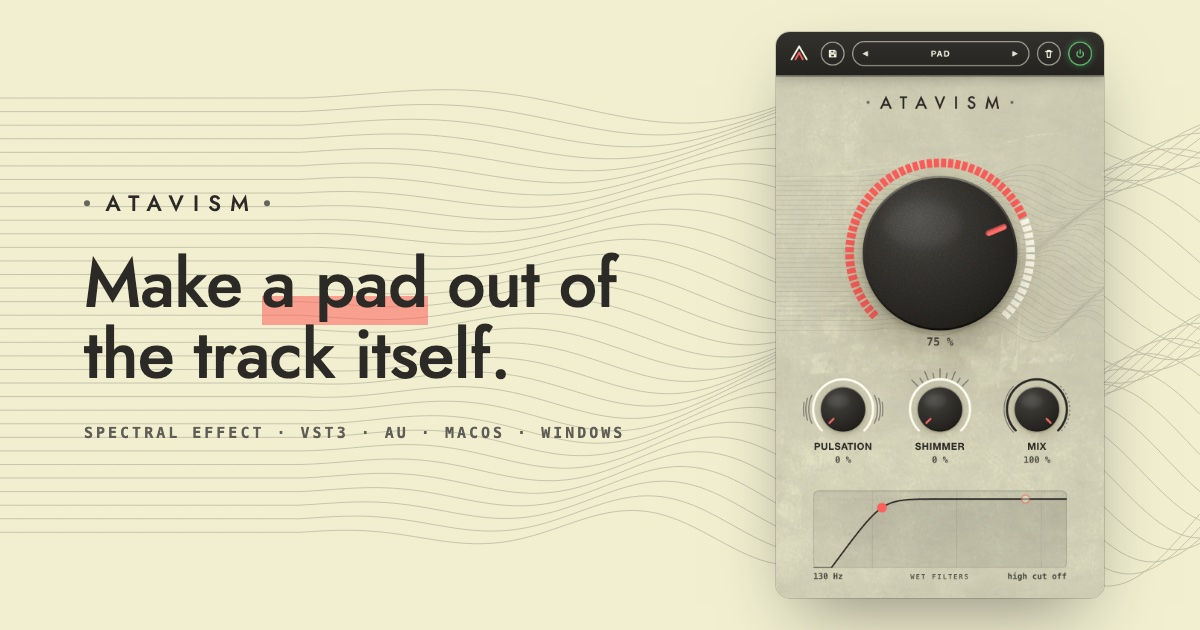
Atavism is a spectral effect plugin from Parallel Minds that turns a track into a pad made of its own harmony. You put it on a track, a bus or the master and turn one knob: the hits fade out, the notes that ring keep ringing, and the pad follows every chord change in time with the song. It costs $39, runs as VST3 and AU on macOS and as VST3 on Windows, and has eight presets and nine automatable parameters. This guide covers what each control does, how Atavism relates to Paulstretch, shimmer reverbs and freeze effects, how to use it in band music, and why we think a pad made from the take beats one added on top.
Parallel Minds is a one-person studio in Lyon, France, run by William Garrido. Its first release, Reverie, turns thirty seconds of any recording into long ambient pieces. Atavism, released in September 2026, takes the same spectral thinking and puts it inside the song, on the timeline, as an ordinary insert effect.
Atavism at a glance
What it is: a spectral effect that makes a pad out of whatever audio it sits on.
Price: $39 (€39) from Parallel Minds. One-time purchase, one licence for macOS and Windows. It launched at $29 (€29) until 24 October 2026.
Formats: VST3 and AU on macOS 11 or later (Universal), VST3 on Windows 10 and 11. There is no AAX version, so Pro Tools is not covered yet.
Controls: one main knob, then Pulsation, Shimmer and Mix, plus a low cut and a high cut that act on the pad only.
Presets: eight (Init, Pad, Wings, Halo, Breathing, Octave, Distant, Trace), and you can save your own.
Latency: around 300 ms, compensated by the DAW. Short mode brings it down to 170 ms.
Licence and demo: offline key, no account. The demo is the full plugin with a two-second mute at the end of every minute.
What Atavism actually does
Most ambient effects add something to a sound: a room, an echo, a frozen slice. Atavism works the other way round. It takes away the timing of a sound and keeps its harmony.
Parallel Minds describe the process in four steps. The plugin separates what rings from what hits, and lets the hits go. It keeps the notes that stand out and drops the noise underneath them. It smears each moment forward over the seconds that follow. Past 75% on the knob it does that smear a second time, until only the lines that persist are left.
Two details set it apart. The smear only goes forward, so nothing sounds before the note is played. And nothing is held or stretched. When the chord changes, the pad changes with it, and the song keeps its length and its place on the timeline. Stop the music and the pad swells for a few seconds, then goes out on its own.
That is why the developer insists on what Atavism is not: a reverb, a delay, a freeze, a time stretcher or a synth. There is no pitch tracking and nothing is triggered. The pad is made from partials that are already in the sound, which is why, in their words, "it cannot play a wrong note."
The controls, explained
The main knob: the distance from the track to its pad. At 25% the attacks are gone and the groove is only hinted at. At 100% only the sustained lines are left.
Pulsation: a slow, irregular swell, so a long pad does not sit still.
Shimmer: grows the octave above inside the pad. Because it is built from the pad, it stays in key.
Mix: dry to wet, always in time with the track. Fully wet gives you a pad on its own track. 35 to 60% sits it under the track it comes from.
Low cut and high cut: two filters on the pad only. The low cut keeps the pad away from the bass, the high cut takes the air off it. The dry track is never filtered.
Every knob learns a MIDI controller with a right-click, and a bounce with the same settings comes out the same every time, Pulsation included.
How to use Atavism in band music
Under the chorus: a pad that was already in the room
Put Atavism on the band bus or the guitar bus with Mix around 40%. The Wings preset is made for exactly this. Raise the low cut until the pad stays clear of the bass. What you get under the chorus is not a new instrument. It is the chords the band already played, held between the hits.
Outros and breakdowns: dissolve the drums
Automate the main knob from zero to full over the last bar of a section. The drums fade into the chord, and the band seems to melt instead of stop. It suits the end of a song or the bar before the last chorus.
Intros: start from the song itself
Bounce the first phrase fully wet and place it in front of the song. The intro is then made of the song's own harmony, so it leads into the first chord without a join.
Guitars and vocals: a held cloud on a send
A guitar chord, a vocal line or a room recording at full knob with Shimmer becomes a held cloud about an octave wide. Keep it on a send so the dry signal stays direct. If you want to play through it, use Short mode.
Live recordings: mind what you feed it
On a one-take recording, everything in the microphone is part of the source, bleed included. Start on a bus or a room microphone instead of a single close mic, and use the two filters to keep the pad out of the low end.
Why a pad made from the take matters
Our opinion: most ambient plugins make any input sound expensive, and that is the problem. The result belongs to the plugin, not to the band. Wash is easy. A song is hard.
What we like about Atavism is where the pad comes from. Most of what we do is bands in a room, one take, every microphone hearing every instrument. When a record like that needs something under the last chorus, the usual answer is an overdub: a synth or an organ that was never in the room. A pad made out of the take itself is a different thing. It is still the band, and it keeps the shared sound of the room that we wrote about in how we mix live recordings.
It also fits the kind of tool we like. We mix in a hybrid analog setup because hardware makes you decide early: a compressor you print on the way in, a tape echo you ride by hand, a pedal the guitarist plays through instead of an effect added later. The plugins we keep are the ones that behave the same way. One knob is a decision, not a menu. We would rather own a tool that does one strange thing properly than one that does forty normal things.
The rule is the same as with any strong effect. Use it on purpose, in one place, and commit to it. A pad under every song is wallpaper. A pad that arrives once, made from the chord the band is already playing, is an arrangement choice.
Atavism compared to similar plugins
Atavism has relatives, and knowing them makes it easier to see what is new.
Paulstretch: Paul Nasca's free extreme time stretch is the sound many people will think of first. Slow anything down far enough and it becomes a drone. Paulstretch makes the audio longer. Atavism stays in time with the song. Parallel Minds know that territory, since Reverie uses Paulstretch as one stage of its engine.
Shimmer reverbs: the octave-up reverb that goes back to Brian Eno and Daniel Lanois in the 1980s, and that Valhalla Shimmer made a standard. Atavism's Shimmer puts the octave inside the pad instead of on a reverb tail.
Freeze effects: an Electro-Harmonix Freeze, or the freeze button on a reverb, grabs one moment and holds it. Atavism holds nothing. It follows the chords.
Zynaptiq Adaptiverb: the closest relative in thinking. It builds a reverb tail from the harmonic content of the input instead of from room reflections, and keeps that tail in tune. It is a much deeper tool and costs several times as much. We have written about Zynaptiq's Wormhole before.
Eventide Physion Mk II: splits a sound into its transient and tonal parts so you can treat each on its own. Mute the transients on a guitar and you are in the same neighbourhood. Physion is a toolbox with hundreds of presets. Atavism is one decision.
Granular plugins: Output Portal and its kind chop a sound into grains and scatter them. You get clouds too, but they drift away from the song's timing. Atavism's stay locked to it.
How Atavism might fare
We think it has a real chance. You can say what it does in one sentence, and most plugins cannot manage that. The price is low enough to try on a hunch. The demo is the whole plugin, the key works offline and there is no account to create, which is how a small developer earns trust.
Film and game composers will probably get there first, because turning a cue into its own underscore saves them real time. For bands, the obvious places are intros, outros and the bar before the last chorus.
Two things hold it back for now. There is no AAX version, so studios on Pro Tools cannot open it. And 300 ms of latency is fine in a mix but too much for monitoring through an insert while you play, which is why Short mode on a send exists.
The harder part is the shelf it sits on. There are a lot of ambient plugins, and "not a reverb" takes a sentence to explain. But a plugin built around one clear idea tends to outlast a big one with none, and Atavism is all one idea.
Parallel Minds Atavism FAQ
What does Atavism do?
Atavism turns the audio it is placed on into a pad made from that audio's own harmony. Hits fade, sustained notes stay, and the pad follows the chord changes in time with the song.
Is Atavism a reverb?
No. There is no room and no decaying tail, nothing repeats, and nothing is frozen or stretched. It removes the timing of a sound and keeps its harmony.
How is Atavism different from Paulstretch?
Paulstretch makes audio longer by stretching it. Atavism does not change the length of anything. The pad stays on the timeline and changes with the chords.
Does Atavism work in Pro Tools?
Not at the moment. It is VST3 and AU on macOS and VST3 on Windows. There is no AAX version.
How much latency does Atavism add?
Around 300 ms, compensated by the DAW, or 170 ms in Short mode. For playing through it, put it on a send so the dry signal stays direct.
How much does Atavism cost?
$39 as a one-time purchase covering macOS and Windows. It launched at $29 until 24 October 2026. The free demo is the full plugin with a two-second mute every minute.
Keep reading
Made a record where the take is the point? We mix shoegaze, post-punk and indie rock for artists who want the performance kept, not replaced. Send us the rough mix.


