


Backmask by Freakshow Industries: What the Reverser Plugin Does, and Where Backwards Sound Came From
Updated: Aug 29
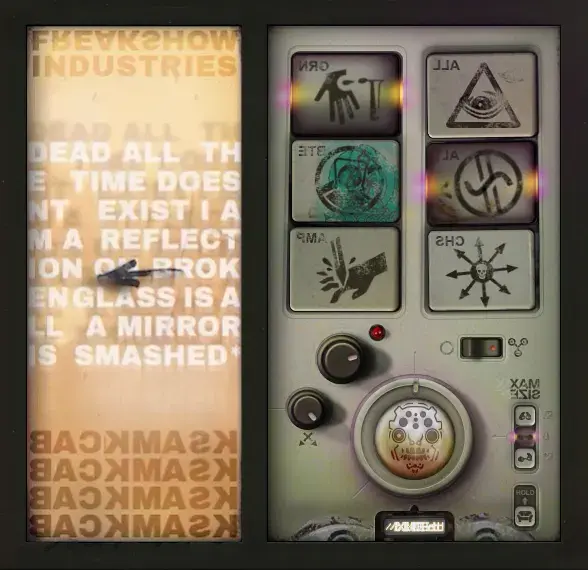
Backmask is a reverser plugin from Freakshow Industries that cuts incoming audio into slices and plays them backwards in real time. You choose what triggers a reversal (a time in milliseconds, a note value synced to your DAW, or the input level crossing a threshold), set the slice length with the Size knob, and decide whether every trigger, every second trigger or random triggers flip the audio. It costs $10 USD on freakshowindustries.com (checked 26 October 2026), runs as AAX, VST, VST3 and AU, and comes with a 14-day trial. Below we go through the real controls, the history of backwards sound on records, and how we would use it in a mix.
Backmask at a glance
What it is: a real-time reverser that, in Freakshow's words, "reverses discrete sections of audio based on various triggers".
The name: Backmask, one word, after the recording term backmasking. People often search for it as "black mask".
Made by: Freakshow Industries, the company behind Mishby. Synthtopia described the founders in 2017 as a pair of experienced audio developers.
Released: July 2017, at $20 USD.
Price: $10 USD on the Backmask product page, checked 26 October 2026. A Steal button lets you pay less, or nothing.
Formats: 64-bit AAX, VST, VST3 and AU. macOS 10.13 or later (Universal, native on Apple Silicon), Windows 10 or later.
Latency: zero by default; the optional Time Align mode adds a lot.
Manual: none as a file. The question mark button in the plugin opens a help overlay.
Presets: none listed by Freakshow.
How Backmask works
A plugin cannot play a sound backwards before the sound has happened. Backmask gets around that by holding on to a slice of the input and, when a trigger arrives, playing that slice in reverse. By default it runs at zero latency, so what you hear reversed is audio that has just gone past: the backwards slice lands after the original, closer to a reverse delay than to a flipped clip. Bonedo's German review in 2020 heard it on a synth loop as a delay combined with an envelope shaper.
Time Align mode changes that. It adds a large buffer of latency so Backmask can, as Freakshow puts it, look into the future and reverse what is happening now instead of what already happened. Your DAW's delay compensation moves the track back into place.
The controls
The interface labels are deliberately cryptic. Hover over a control or press the question mark and the help overlay shows names, units and values. From Freakshow's own feature list and the reviews we found:
Trigger mode: time in milliseconds, a note value synced to the DAW, or input level.
Trigger level: the threshold for the level trigger.
Reverse mode: All (every trigger flips the audio), Alternating (every second trigger) or Random.
Size: the length of each reversed slice.
Max Size and Time Align: Time Align shifts the signal by the amount set under Max Size. Freakshow's FAQ asks you not to automate either.
Mix: the balance of dry and reversed signal.
Stuck mode: Freakshow lists it ("Stuck mode, there is one") without saying what it does. The help overlay is the place to check.
Time Align and latency in practice
Freakshow's support FAQ puts Time Align at anywhere from 22,500 to more than 192,000 samples of latency, depending on your settings and sample rate. At 48 kHz that is roughly half a second to four seconds. Most DAWs compensate for it. Pro Tools tops out at about 16,000 samples, so Freakshow suggests AudioSuite (offline processing) there, or moving the track by hand.
Licensing and the Steal button
Next to Buy sits a Steal button. Freakshow asks you to underpay rather than steal, but a stolen license works fully; it just misses upgrade offers. After the 14-day trial an unlicensed copy, says the FAQ, goes into a chaotic state that is not very usable.
Backmasking and reversed sound on records
What backmasking means
Strictly, backmasking is a message recorded backwards onto a track that is meant to be played forwards (Wikipedia). In the studio the word gets used for any reversed sound. On tape, reversing meant physically turning the reels over so the tape ran the other way, and until 1990s audio software made it a one-click job, reversing at full quality needed a professional tape machine (our post on reel-to-reel tape recorders covers the machines). The first hit thought to contain a backmasked message is "Car Trouble" by The Eligibles (1959), which hid two reversed spoken lines and peaked at number 107 on the Billboard charts.
The Beatles, 1966: "Rain"
The Beatles recorded "Rain" at EMI Studios in London on 14 and 16 April 1966, and it came out as the B-side of "Paperback Writer" on 30 May in the US and 10 June in the UK. The coda runs part of John Lennon's vocal backwards: "sunshine", a drawn-out "rain", and the song's first line reversed (Wikipedia).
Two people claimed the idea. Lennon said he took the tape home, played it backwards by accident and liked it better. George Martin told Mark Lewisohn in 1987 that he lifted a piece of Lennon's vocal, turned it around and slid it into place himself. Lennon also called it the first backwards vocal on a record, but the Sydney band the Missing Links had released "H'tuom Tuhs" in October 1965. The Beatles had already used reversed tape loops and a backwards guitar solo on "Tomorrow Never Knows", recorded days earlier. Engineer Geoff Emerick later wrote that from then on almost every overdub on Revolver was tried backwards as well as forwards.
"I'm Only Sleeping": a solo written backwards
On "I'm Only Sleeping" George Harrison went further. In a five-hour late-night session with Martin on 5 May 1966 he worked out a guitar duet with the tape running backwards, so that it would fit the song's dreamy mood once the tape was turned the right way round. One guitar was recorded with fuzz and one without (Wikipedia). The song first came out in the US on Yesterday and Today on 20 June 1966, then on Revolver in August.
Harrison composed for the reversal instead of flipping a finished solo, so the backwards lines fit the song once they play forwards. A reversed part that belongs to the song usually starts there.
Jimi Hendrix, "Are You Experienced?" (1967)
The title track of the Jimi Hendrix Experience's debut album was recorded at Olympic Sound Studios in London on 3 April 1967, the last day of the album sessions. It has backwards guitar and backwards drums over a one-chord drone. The backwards guitar took four takes. Assistant engineer George Chkiantz recalled that they tried to build it as a tape loop, could not make the loop work, and Hendrix got impatient and simply played it in (Wikipedia).
Reverse reverb: the swell before the note
Reverse reverb, or reverse echo, flips the order of a sound and its tail. You turn the tape over, record the echo or reverb onto a spare track, then turn the tape back, so the reverb swells up into the note instead of trailing after it (Wikipedia). Jimmy Page says he came up with it to rescue the Yardbirds' "Ten Little Indians" in 1967, and he used it with Led Zeppelin on "You Shook Me", "Whole Lotta Love" and "When the Levee Breaks". Lee Mallory's 1966 single "That's the Way It's Gonna Be" may have it earlier. On vocals the classic move is a reversed swell into the first word or syllable of a line, and film sound uses it on voices for an unsettling, haunted feel.
Shoegaze: the reverse reverb program
Kevin Shields told Tape Op that the reverse reverb program on an Alesis Midiverb II and a Yamaha SPX90 was his "secret weapon", and pointed to "All I Need" from Isn't Anything. He also explained that the program reverses the envelope: the reverb swells up instead of decaying, nothing actually plays backwards, and anything with a sharp attack picks up a slightly rhythmic effect. The Midiverb II also turns up in our Valhalla Shimmer post, and reverse reverb is part of the texture layer in our shoegaze mixing guide.
The 1980s panic
From the early 1980s, Christian groups in the US claimed rock bands hid satanic messages in reverse, and records were burned. California passed a 1983 bill making undeclared backmasking an invasion of privacy. Arkansas passed a warning-sticker law the same year, but Governor Bill Clinton vetoed it. Freakshow's marketing copy plays on that era, hence the plugin's ghosts and demons.
Where Backmask earns a place in a mix
Swells after a vocal phrase
Try Backmask after a 100% wet reverb on a send, with a level trigger and Reverse All. Each tail comes back as a swell that rises into the gap after the phrase. For a true swell into the first word, do it the old way: reverse the vocal clip, print the reverb, then reverse the print. More on keeping long tails under control in taming reverb without washing out the mix.
A guitar that breathes backwards
Harrison's method still beats any plugin for a lead part: reverse the backing track, play over it, reverse your part. For a quicker texture, put Backmask on a duplicate of a clean guitar, trigger on a synced note value (an eighth or a quarter), set Reverse to Alternating and tuck it under the dry part. Every second slice runs backwards, so the part keeps its rhythm and gains a swell between strums.
Drums and loops
On a room mic or a drum loop under a live kit, a synced trigger with Reverse Random puts reversed hits in unpredictable places. Keep it low and use it for one section.
Post-punk tension
Our guide to mixing post-punk argues for a specific, slightly wrong space over a pretty hall. Reversed slices on one guitar, with the rest of the band dry, give you that wrong space without adding wash.
Our view: one reversed moment, printed
Reverse effects wear out fast. The first backwards swell makes a listener lean in. By the tenth they have stopped hearing it, and a song where every guitar and every vocal tail runs backwards sounds like the effect is the song.
We think an effect earns its place on one part at one moment. Pick the moment (the bar before the chorus, the last word of the bridge, one guitar in the outro), get the reversal right there, print it to audio and delete the plugin. Once it is audio you can trim the swell to land on the downbeat, keep the one slice that works and mute the rest, and Time Align's latency is gone from the session. Harrison spent five hours on one backwards part for one song, and you can hear the care. Mishby makes the same argument about tape damage, and the live-to-tape philosophy makes it about every decision on a record. Printed reverse parts also travel well as stems (track prep guide).
Other ways to reverse sound
Your DAW: every DAW can reverse a clip. Free, precise, offline.
Infiltrator 2: Devious Machines' multi-effect has Reverse and Varispeed modules that play audio backwards inside a sequenced chain (our Infiltrator 2 post).
Reverb plugins: some have reverse programs in the SPX90 tradition. For stranger reverbs, see 10 weird reverb plugins.
Delay plugins: a reverse delay gets close to Backmask's default behaviour. For stranger delays, see 10 unusual delay plugins and Unfiltered Audio Sandman Pro.
Hardware: the tape tricks above, and the echo units in rare tape echo units for studio recordings and vintage reverb and delay for retro tracks.
What an earlier version got wrong
An earlier version of this post contained invented details. We removed or corrected these:
Presets "Ghost Signal" and "Paradox Pulse": Freakshow lists no presets, and we found neither name anywhere. Removed.
"Controls for size and chaos": Size is real. We found no chaos control in Freakshow's feature list; the random behaviour comes from the Reverse Random mode. The only "chaos mode" on the product page is in a joke testimonial.
"Tweak the pitch shift": no pitch control appears in any description of Backmask.
"Use the randomizer": there is no randomizer button. Use Reverse Random.
The price: "$20" was the 2017 launch price. Freakshow lists $10 USD today.
Formats: the old FAQ said "VST/AU". It also runs as VST3 and AAX.
"Paradox processing that warps time and pitch": "paradox processing" is Freakshow's joke copy. The plugin reverses slices of audio.
The Aphex Twin line and a "related reading" pointer to a Glitchmachines Hysteresis post: no source for the first, and we never published the second.
Backmask FAQ
What does the Backmask plugin do?
Backmask is a reverser plugin from Freakshow Industries that plays slices of incoming audio backwards in real time. A time, a synced note value or the input level triggers each reversal, and the Size control sets how long each reversed slice is.
How much does Backmask cost?
Backmask costs $10 USD on freakshowindustries.com (checked 26 October 2026), down from $20 at launch in 2017. It comes with a 14-day trial, and a Steal button lets you pay less or nothing for a working license.
Does Backmask add latency?
Not by default: Backmask runs at zero latency. The optional Time Align mode adds 22,500 to more than 192,000 samples of latency so it can reverse what is happening now, which goes past Pro Tools' delay compensation limit.
What is backmasking in music?
Backmasking is a message recorded backwards onto a track meant to be played forwards. The term is often used for any reversed sound, from backwards guitar solos to reverse reverb swells.
What was the first song with backwards vocals?
The Beatles' "Rain" (1966) is the famous early example, and John Lennon called it the first. The Missing Links' "H'tuom Tuhs" came out in October 1965, and The Eligibles' "Car Trouble" (1959) is thought to be the first hit with a backmasked message.
Keep reading
Send us the rough mix
If your record has a backwards part that either disappears or takes over, send us the rough mix and tell us which moment it should change. How we approach the genre is on our shoegaze mixing and post-punk mixing pages. Everything else is on online mixing.


