Taming Reverb: Creating Depth Without Washing Out the Mix
Updated: Aug 29

When a dry, close-miked live multitrack lacks physical dimension, the amateur instinct is to heavily apply digital reverberation across the mix. The intention is to place the isolated instruments back into a shared, massive acoustic environment. However, the execution usually results in a catastrophic loss of definition.
Sending a highly dynamic lead vocal or a punchy snare drum into a dense digital reverb algorithm often creates "The Wash." The continuous, chaotic reflections of the reverb tail swallow the original transient impact, pushing the instrument to the back of the soundstage and burying it in a muddy, indistinct sonic soup.
The human brain perceives acoustic distance based on two primary factors: the ratio of direct sound to reflected sound (critical distance), and high-frequency degradation. When a digital reverb triggers instantly alongside a dry transient, the brain interprets the source as being incredibly far away. Furthermore, digital algorithms often recreate high frequencies perfectly, leading to a brittle buildup that masks human articulation.
Treat the acoustic space as a distinct instrument that must be managed. By calculating exact millisecond pre-delays to physically separate the dry signal from the wet reflections, and by implementing dynamic equalization (sidechain ducking) on the reverb return bus, an engineer can maintain an upfront, aggressive transient while simultaneously implying a massive acoustic space.
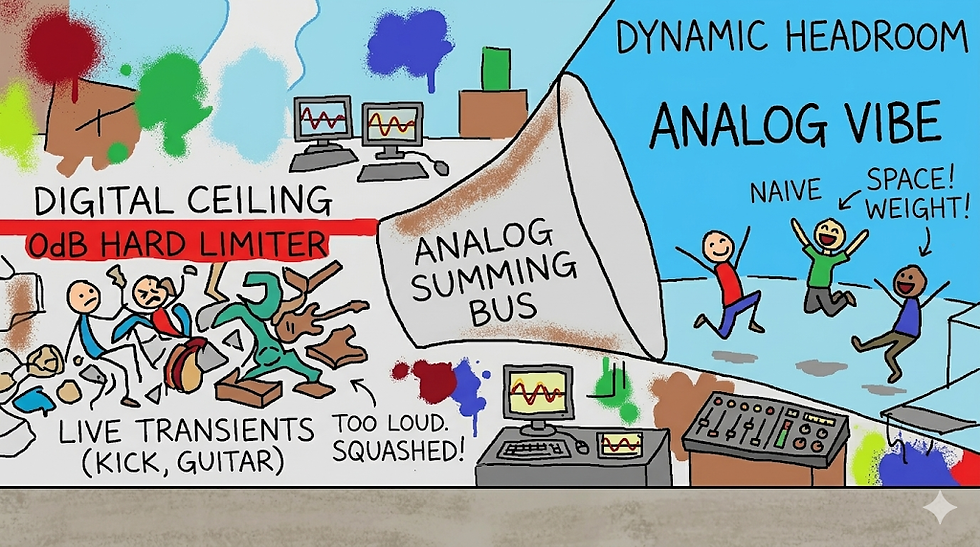
Bypassing mathematically perfect digital reverb tails by utilizing analog tape delays and physical hardware degradation. Introducing analog distortion into the spatial returns creates a darker, heavier, and more emotionally resonant acoustic environment that sits perfectly behind the live band.
The Physics of Critical Distance and Early Reflections
To control physical depth in a mix, an audio engineer must understand how the human ear localizes sound in a physical room. When an instrument produces a sound, the listener hears the "direct" acoustic energy first. Fractions of a second later, the listener hears the "early reflections"—the sound waves that have bounced off the nearest walls, floor, and ceiling. Finally, the listener hears the "reverb tail," which is the dense, chaotic buildup of thousands of delayed reflections decaying into silence.
The ratio between the direct energy and the reflected energy dictates the perceived depth of the instrument, a threshold known in acoustic physics as the critical distance. If the reflected energy is as loud as the direct energy, the brain calculates that the sound source is very far away.
In a dense rock or alternative mix, pushing the lead vocal or the snare drum far away completely destroys the driving energy of the track. The goal is to keep the source instrument physically close and authoritative, while implying that the room behind the instrument is massive. To achieve this, the engineer must manually manipulate the timing of the reflections, a fundamental process explored thoroughly in technical guides like Using Reverb & Delay.
Pre-Delay: The Psychoacoustic Separator
The single most important parameter on any reverb unit is the Pre-Delay. Pre-delay dictates the exact amount of time (measured in milliseconds) that the algorithm waits before triggering the onset of the early reflections and the reverb tail.
Sound travels through physical air at approximately one foot per millisecond. If an engineer applies a digital reverb with zero pre-delay to a vocal track, the artificial reflections trigger instantly. Psychoacoustically, this tells the listener's brain that the singer's mouth is pressed directly against a reflective wall. The vocal is instantly swallowed by its own reflections, pushing it to the back of the mix. This is a common point of confusion, heavily debated and clarified in technical forums discussing What does pre-delay do?.
To solve this, the engineer must calculate the pre-delay based on the tempo of the song. If a 30-millisecond to 50-millisecond pre-delay is applied to the reverb bus, the algorithm mathematically forces the acoustic reflections to wait. When the vocalist sings a word, the dry, uncompressed transient cuts through the center of the mix completely unopposed. The listener hears the pure, physical impact of the voice. Fifty milliseconds later, the massive reverberation blooms behind the vocal.
This time-based separation allows the instrument to remain aggressively in the foreground, completely intelligible, while the delayed reverb tail creates the illusion of a massive arena.
Frequency Sculpting: The Abbey Road Filter
Even with perfect pre-delay timing, a long reverb tail can quickly clutter a mix if the frequency spectrum is not heavily policed. Digital reverb algorithms are often coded to mathematically reproduce reflections with pristine, high-fidelity accuracy. In a dense live mix, this pristine accuracy is the enemy of clarity.
If a lead vocal contains sibilance (harsh "S" and "T" sounds), a digital reverb will capture those high frequencies and scatter them across the entire stereo field, creating a piercing, fatiguing wash of metallic static. Conversely, the low-frequency rumble of a live stage will be multiplied by the reverb, creating an overwhelming, muddy buildup in the 100Hz to 250Hz range that completely masks the bass guitar and kick drum.
The solution is severe subtractive equalization applied directly to the reverb return bus—a technique historically attributed to the engineers at Abbey Road Studios. The engineer must place an equalizer plugin immediately after the reverb unit on the auxiliary track. A high-pass filter is aggressively applied up to 500Hz, completely removing the low-end mud from the reverberation. Simultaneously, a low-pass filter is applied down to 4kHz or 5kHz.
By severely band-passing the reverb, the acoustic wash is restricted exclusively to the middle frequencies. Rolling off the high frequencies is acoustically accurate to the physical world; high-frequency energy dissipates quickly in the air, meaning distant reflections are naturally darker. This forces the reverb to sit deep in the background, allowing the crisp articulation of the dry vocal and the heavy sub-weight of the bass to exist entirely unaffected by the spatial effects.
Dynamic Triage: Sidechaining the Reverb Return
In highly aggressive, fast-paced live mixes, even filtered reverberation can occasionally overwhelm the rhythm. When the singer is delivering rapid-fire lyrics, a long reverb tail will stack on top of itself, blurring the words together.
To combat this, professional engineers deploy dynamic ducking. A compressor plugin is placed at the very end of the reverb return bus. However, instead of compressing the reverb itself, the compressor's "sidechain" input is routed to the dry, original vocal track.
When the singer begins to sing, the dry vocal signal instantly triggers the compressor on the reverb bus, aggressively turning the volume of the reverb down by several decibels. The space literally gets out of the way of the performance. The exact millisecond the singer stops singing (during a pause or at the end of a phrase), the compressor releases, and the massive reverb tail violently swells back up in volume to fill the silence. This creates a deeply rhythmic, breathing spatial effect that guarantees maximum intelligibility without sacrificing scale.
The Hardware Advantage: Analog Degradation and Depth
While digital pre-delays and dynamic equalizers provide clinical control, the actual texture of the space often requires physical imperfection. The pursuit of an idealized, emotionally resonant acoustic space is a philosophy championed by top industry professionals, as discussed in deep-dive interviews like Jens Jungkurth: Audio Engineering & Production Insights.
Pristine digital reverb plugins can sound artificial when applied to a gritty, distorted rock band. To create an organic, believable space, engineers often route the signal out of the digital domain. Instead of using a standard digital reverb, the dry signal is sent through physical analog delays (like a bucket-brigade device or a magnetic tape machine) before hitting a physical spring or plate reverb.
Analog components degrade the audio signal naturally. The tape mechanism introduces wow and flutter, microscopic pitch modulations, and heavy harmonic saturation. When this dark, saturated, and pitch-modulated delay feeds into a reverb, it creates a wildly complex, three-dimensional acoustic environment. The analog degradation naturally rounds off the harsh transients and sits the space heavily in the background. Tools that bridge this gap, allowing for bit-depth reduction and artificial degradation, are highly prized, as noted in evaluations of software like the Brainworx: bx_rooMS Reverb Plug-In. By abandoning pristine digital math and embracing the chaotic, harmonic degradation of analog workflows, an engineer transforms a sterile, washed-out mix into a deep, explosive, and believable live record.
References & Further Reading