


Freakshow Industries Mishby: Tape Abomination Without Making the Song Collapse
Some plugins try to sound expensive. Mishby sounds like the machine has developed a personal problem.
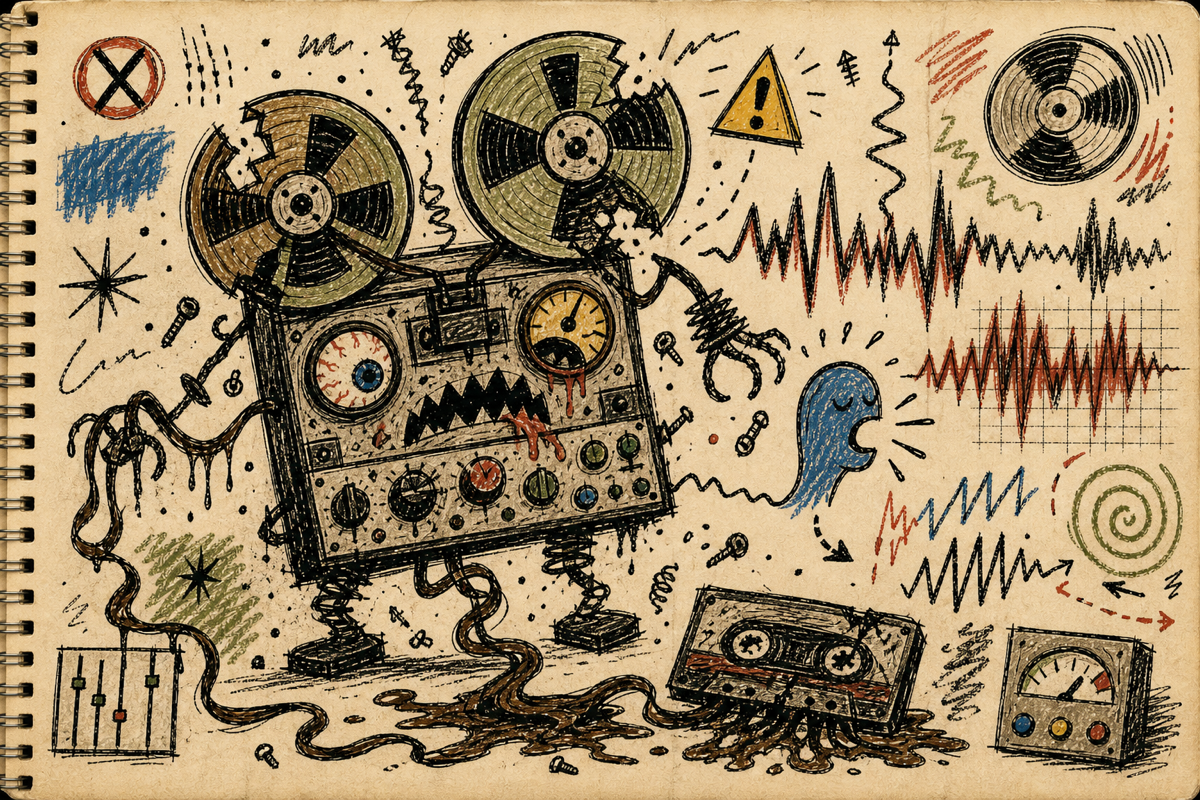
Freakshow Industries Mishby sits in that strange corner of audio tools where the interface, the attitude, and the sound all tell you not to behave. It is a tape-damage effect in the broad sense, but calling it a tape plugin makes it sound more sensible than it is. Mishby is about wobble, dirt, warping, collapse, unstable tone, and the feeling that the signal path is being punished for doing its job.
That can be exactly what a track needs. It can also ruin the thing that made the track good.
Mishby is strongest when the broken machine has a role. A keyboard becomes seasick for one verse. A vocal throw falls apart after the last word. A drum loop becomes a haunted piece of machinery under the chorus. A clean guitar loses its polite edges and starts sounding like it came through a half-broken cassette deck in a basement.
It is weakest when every part of the track gets dragged into the same theatrical collapse.
Why Mishby Is Cool
Mishby has cult appeal because it does not feel like a neutral studio utility. It has a point of view. The whole thing feels designed to make degradation feel physical, suspicious, and funny in a slightly uncomfortable way.
That matters because a lot of lo-fi plugins are too tasteful. They add a little hiss, a little wobble, a little dullness, and suddenly the track has the costume of age. Mishby feels less like nostalgia and more like a machine misbehaving in front of you. It can make a sound unstable enough that the listener notices the record is being bent.
This is useful when the music needs consequence. A clean synth pad can become too smooth to carry tension. A loop can feel pasted into the production. A vocal effect can sound like another stock delay or reverb throw. Mishby can push those parts into a more specific world.
The cool part is not just that it sounds broken. Broken is easy. The cool part is that it can make a part feel less trustworthy. That can be emotionally useful in indie rock, experimental pop, noise-adjacent productions, post-punk, left-field electronic music, and any arrangement where the polished version feels too obedient.
Where It Helps In A Track
Mishby works best on parts that are allowed to stop being clean sources.
A backing vocal is an obvious place. The lead vocal might need to stay present and human, but a phrase at the end of a line can be sent into Mishby and returned as a warped memory. That kind of move can give a track character without making the main performance hard to understand.
It can work on keys and synths when the part is too straight. A soft pad might be pretty but emotionally blank. A small amount of tape abuse can make it feel like it is sagging under the song. A simple chord part can start to move around the grid instead of sitting perfectly on top of it.
Drum loops are another good target. A loop that sounds too clean can become a low, damaged layer under real drums or programmed percussion. The trick is usually not to replace the groove. Let the clean drums do the timing. Let Mishby add the unstable underside.
Guitars can take it when the production wants a cheap, broken, off-axis feeling. Not every guitar should sound like a destroyed tape machine. But one printed layer, tucked under the real guitar, can make the track feel stranger without losing the amp or hand.
The plugin belongs close to the same family of creative damage as Tapetown's live post on Freakshow Industries Backmask. Backmask points toward reversal and unnatural motion. Mishby points more toward unstable tape-machine sickness. Both are useful when they create an event, not when they become wallpaper.
Where It Becomes A Gimmick
The bad Mishby move is easy: put it on something, laugh because the sound is ruined, and decide the track is now more interesting.
That works for about ten seconds. Then the song asks a harder question. Did the effect make the part mean more? Did it create contrast? Did it make the transition better? Did it reveal something in the vocal, rhythm, or arrangement? Or did it only announce that a weird plugin was used?
Weirdness is not depth. A plugin can be strange and still lazy.
The danger with Mishby is that it has such a strong personality. If too many parts go through it, the whole production can collapse into one shared texture. The vocal is unstable. The drums are unstable. The keys are unstable. The guitar is unstable. Nothing is stable enough for the broken parts to lean against.
The result can sound cool in a clip and tiring in a song. The listener needs an anchor. That anchor might be the dry lead vocal, the kick and bass, a clean guitar, a steady snare, or just a section where the effect disappears. Without contrast, damage has no scale.
This is close to the bigger Tapetown point in The Art of the Raw Edge. Roughness is useful when it belongs to the record. It becomes fake when it is painted over everything.
Printing The Damage
Mishby is the kind of plugin that often gets better when it is printed to audio.
That is not because printing is romantic. It is because the damage becomes something you can edit like a performance. Once the warped part is audio, you can cut it before the next vocal line. You can mute one ugly wobble and keep another. You can let the machine collapse only on the last repeat. You can reverse one fragment, distort the printed tail, or remove the original dry sound entirely.
The effect becomes less like a plugin setting and more like an arrangement object.
This is important with unstable effects. A live plugin return can keep changing in ways that feel exciting while you are working, but vague in the final record. Printing forces the question: which moment matters? Which piece of the damage should the listener actually hear?
It also helps the rest of the mix react. If the damaged keyboard is now a printed part, maybe the clean guitar can be drier. If the vocal throw is warped enough, maybe the reverb can be simpler. If the drum loop has Mishby movement, maybe the percussion should stop pretending to be clever.
That is where weird plugins become useful. They create consequences other parts have to answer.
The Clean Anchor
Mishby needs something near it that is not Mishby.
That sounds obvious, but it is the difference between character and fog. If a vocal throw is broken, the main vocal should probably stay readable. If a drum loop is melting, the kick or snare may need to stay more direct. If a synth pad is wobbling, another instrument may need to hold the chord shape without drama.
The clean anchor does not have to be boring. It just has to give the damage a frame.
This is why the plugin can work well in band music. A band recording already has human timing, bleed, rooms, amps, voices, and physical sources. One broken layer can sit inside that world and make it feel stranger. But if the whole band is forced through the same cartoon of decay, the performance may lose its body.
For Tapetown, the useful question is not whether the plugin is extreme. It is whether the extreme thing gives the record more identity. A strange effect should make the song feel more like itself, not less.
Mishby Versus Normal Tape Color
Mishby is not the same as adding a little tape warmth.
There are plenty of tools for subtle saturation, gentle wobble, soft top end, and tasteful cassette texture. Those can be useful, especially when a production feels too clean. Mishby lives in a more theatrical place. It is not only aging the sound. It is making the sound feel unstable enough to become a character.
That makes it less flexible and more memorable.
If the track needs a little softening, Mishby may be too much. If the track needs a part to become wrong in a way the listener remembers, it might be exactly right. That difference matters. Not every song needs the weirdest tool. Some songs need the boring move done well.
The tape-damage family can also connect to Tapetown's live-to-tape philosophy, but only if the idea is understood properly. Real tape commitment is not the same as fake tape damage. The shared lesson is decision-making. A sound changes, and the rest of the record has to live with that change.
Mishby is useful when that change is worth living with.
Where It Belongs In The Arrangement
The best Mishby moments usually happen at the edge of the arrangement, not across the whole middle of it.
Think of the places where a record can afford to become unstable: the last word before a chorus, the two beats before a drop, the background keyboard that nobody should hear as a keyboard, the noise after a guitar stops, the sample that enters for one section and never comes back. Those are good places for a broken machine because the listener has enough context to feel the interruption.
It can also work when the song needs a small ugliness to stop the production from becoming too tasteful. A pretty verse can take one warped texture behind the vocal. A tight chorus can take a damaged transition right before it opens. A clean bridge can briefly sound like the tape is folding in on itself, then return to the band with more force.
The point is to make the damage behave like a scene change. If the track is already messy, Mishby may not help. If the track is too clean, one unstable layer can give the clean parts more meaning.
The Tapetown Read
Mishby is a good weird plugin because it does not pretend to be invisible. It wants to mark the sound. It wants the listener to feel the machine bending.
That can be powerful. It can make a clean production less polite, turn a transition into an event, give a vocal throw a diseased little life, or make a loop feel like it came from somewhere less tidy than a sample folder.
But the tool is not the taste. The taste is deciding what gets damaged, how long the damage lasts, and what stays clean enough to make the damage readable.
Used well, Mishby gives one part a problem the song can use. Used badly, it makes the whole record perform weirdness without knowing why.
For artists thinking about mixing as a record-making decision, that is the useful lesson. A strange plugin is not a shortcut to personality. It is a way to create a problem that only becomes musical if the mix knows what to do with it.


