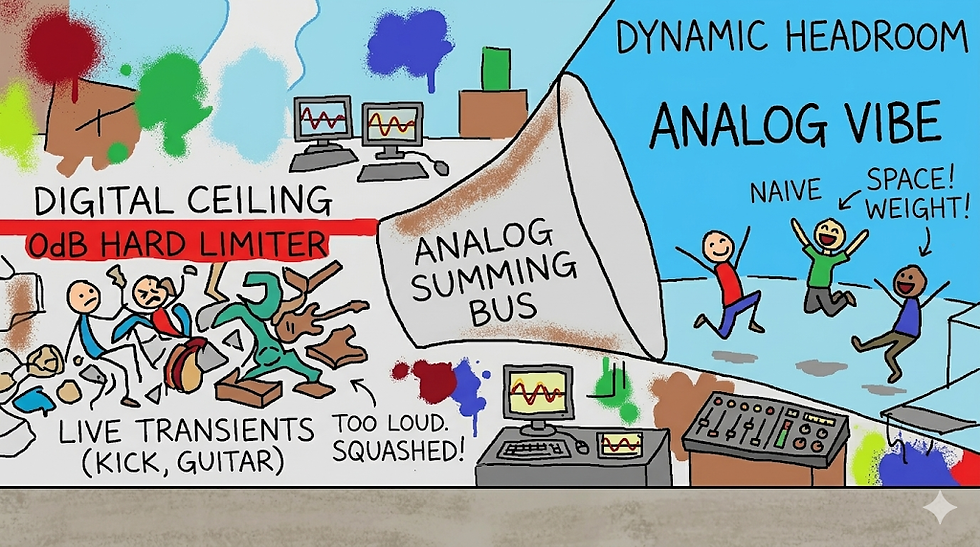
Indie Mixing in the AI Era: How to Make Your Song Sound Human

Indie mixing in the AI era is about more than making a song sound clean, loud, and balanced. It is about protecting the human character of the recording: the performance, the tension, the flaws, the room, the dynamics, the noise, the emotion, and the feeling that real people made something together.
AI can generate polished music quickly. But polish is not the same as identity. For indie, alternative, post-punk, shoegaze, punk, psych, noise rock, dream pop, and guitar-based music, the best mix is not always the most perfect mix. It is the mix that makes the song feel alive.
That is where human mixing still matters.
The new problem for indie artists
For years, the biggest challenge for independent artists was access.
You needed access to a studio.Access to expensive equipment.Access to experienced engineers.Access to mastering.Access to distribution.
Now a lot of that has changed. Bedroom recording is normal. Affordable interfaces sound good. Digital tools are powerful. AI music platforms can generate complete songs from simple prompts. Automated mastering can make a track loud in minutes.
The problem is no longer just: “How do I make something that sounds professional?”
The problem is becoming:
How do I make something that sounds like me?
When everyone can access polish, polish stops being rare. When everyone can generate something clean, clean stops being memorable. When the internet fills with music that sounds finished but anonymous, the real value moves somewhere else.
The value moves toward personality.
Indie music should not sound too perfect
A lot of indie music becomes weaker when it is mixed like commercial pop.
That does not mean pop mixing is bad. Pop mixing is an art form. But the priorities are often different. Pop mixing often rewards tight editing, bright vocals, controlled low end, perfect timing, clean separation, strong loudness, and instant impact.
Indie and alternative music often need something else.
They need friction. They need atmosphere. They need danger. They need width without sterility. They need a vocal that feels emotionally close, not just technically clear. They need drums that feel played, not assembled. They need guitars that have mass, not just fizz. They need a low end that supports the song without turning it into a plastic product.
A good indie mix does not remove the human element. It frames it.
What makes a mix sound human?
A human-sounding mix is not simply a messy mix. It is not a bad recording. It is not an excuse for poor quality.
A human mix is a mix where the emotional information survives the production process.
That can mean:
Keeping small timing differences that make a band feel like a band.
Letting room sound and bleed create glue.
Choosing a vocal tone that reveals the singer, not just the microphone.
Avoiding over-editing drums until they lose movement.
Using compression for energy rather than just control.
Letting guitars occupy a physical space instead of flattening them into a wall of identical frequencies.
Allowing quiet sections to be quiet, so loud sections actually feel loud.
Making decisions based on feeling, not only meters.
The human part of a record often lives in the details most automated systems are trained to smooth out.
AI can imitate genre. It cannot understand your intention.
An AI system can imitate the surface of indie music. It can generate jangly guitars, washed-out vocals, post-punk basslines, shoegaze textures, lo-fi drums, or nostalgic synths.
But a genre is not an identity.
Your identity is in the reason the song exists. It is in the lyric you almost did not write. It is in the drummer pushing the chorus slightly harder. It is in the guitarist’s ugly tone that somehow makes the whole song work. It is in the moment where the vocal cracks and suddenly the line becomes believable.
A human mix engineer listens for those moments.
The job is not just to make every element “better.” Sometimes the job is to know what should not be fixed.
The danger of the “perfect average” mix
A lot of modern production tools push music toward the same center point.
Cleaner tuning.Tighter timing.Less noise.More brightness.More loudness.More separation.More low-end consistency.More instant clarity.
Those things can be useful. But if every decision moves the song toward the same version of “professional,” the result can become emotionally average.
This is especially dangerous for indie music.
Indie music often works because it has a point of view. It is not trying to be everything to everyone. It is trying to feel specific. A slightly strange snare, a dark vocal, an overdriven bass, a noisy guitar, or an uncomfortable room sound can become the thing that makes the song memorable.
A human mix protects that.
What an indie mix engineer actually does
A good indie mix engineer is not just a technician. They are a translator.
They translate the raw recording into a finished record without losing the original reason the song mattered.
That means asking questions like:
What is the emotional center of the song?Should the vocal feel intimate, aggressive, buried, dreamy, exposed, or confrontational?Should the drums feel tight, explosive, trashy, roomy, dry, or unstable?Should the guitars feel wide and beautiful, or narrow and dangerous?Should the bass be clean and supportive, or distorted and physical?Should the song feel modern, nostalgic, raw, cinematic, claustrophobic, or live?
These are not just technical questions. They are identity questions.
Why analogue and hybrid mixing still matter
Analogue gear does not automatically make a song better. A bad decision through expensive equipment is still a bad decision.
But a hybrid analogue workflow can be powerful for indie music because it introduces physical behaviour into the mix.
Analogue saturation, compression, EQ, tape-style movement, transformer colour, room re-amping, and hardware gain staging can make a track feel less flat and less plastic. They can add density, movement, harmonic complexity, and emotional weight.
The important thing is not nostalgia.
The important thing is resistance.
Digital tools often allow infinite correction. Analogue tools force decisions. You listen, commit, react, and move forward. That kind of process can be good for music that depends on instinct and character.
How to make your indie song stand out
If you are making indie or alternative music now, the question is not simply: “How do I compete with AI?”
The better question is:
What can my music do that generated music cannot?
Here are the areas worth focusing on.
1. Make the performance matter
A song feels more human when the performance carries information.
Do not record everything as if it can be fixed later. Rehearse the arrangement. Decide where the energy rises and falls. Let the drummer, bassist, guitarist, and vocalist respond to each other. Even if you record at home, think like a band.
The mix can enhance performance, but it cannot invent chemistry that was never there.
2. Keep some real dynamics
If every section of the song has the same intensity, nothing feels dramatic.
AI-generated and over-produced music often feels impressive at first because everything is constantly full. But human listeners connect with contrast. Let verses breathe. Let choruses arrive. Let breakdowns feel smaller. Let the last chorus earn its size.
A good mix does not just maximize volume. It shapes movement.
3. Choose emotion over perfection
The best vocal take is not always the cleanest take. The best guitar tone is not always the most expensive tone. The best drum sound is not always the most isolated drum sound.
Ask what makes the listener believe the song.
If a technically imperfect element makes the song feel more real, it may be worth keeping.
4. Build a sonic world
A strong indie mix creates a world around the song.
Is the song happening in a basement?A huge room?A club?A dream?A rehearsal space?A broken radio?A cinematic landscape?A dry and confrontational close-up?
The mix should not feel like separate tracks placed next to each other. It should feel like a place the listener can enter.
5. Avoid generic reference chasing
References are useful. But copying references too closely can erase identity.
Use reference tracks to communicate energy, low end, vocal level, width, or attitude. Do not use them as a recipe. Your song might need a different kind of darkness, brightness, dirt, or space.
The goal is not to sound like your favourite record.
The goal is to understand why you love that record, then find the version that belongs to your song.
6. Let the mix have a point of view
A memorable mix has opinions.
Maybe the vocal is buried because the track should feel mysterious.Maybe the snare is too loud because the song needs violence.Maybe the bass is distorted because the low end should feel dangerous.Maybe the guitars are washed out because the lyric needs distance.Maybe the room mics are exaggerated because the band should feel larger than life.
A safe mix rarely becomes a loved mix.
When should you hire a human mix engineer?
You should consider hiring a human mix engineer when:
The song matters enough that you do not want a generic result.
You have a strong rough mix but cannot make it feel finished.
Your home recording has good performances but lacks depth and weight.
Your drums sound flat or disconnected.
Your guitars sound smaller than they felt in the room.
Your vocal is either too exposed or too buried.
Your song sounds technically fine but emotionally wrong.
You are making an EP or album and need a consistent sonic identity.
You want the track to feel like a record, not just a file.
Automated tools can be useful for demos, quick tests, and rough releases. But if the song represents your artistic identity, human mixing is still one of the most valuable stages of the process.
The future of indie music is not anti-technology
The point is not to reject AI, plugins, editing, or digital tools.
The point is to know what they are for.
Technology can help artists work faster. It can remove barriers. It can clean up problems. It can open creative doors. But it should not replace taste, intention, performance, and emotional judgement.
The future of indie music will not belong to the artists who sound the most perfect.
It will belong to the artists who sound the most unmistakable.
Indie mixing in the AI era is not about fighting machines. It is about remembering what machines are bad at.
They are bad at meaning.They are bad at commitment.They are bad at knowing why the wrong sound is sometimes the right sound.They are bad at protecting the fragile, strange, human thing that made the song worth recording in the first place.
That is the job of a human mix.
Not just to make the song sound better.
To make it feel more like itself.
Related reading
If you want to go deeper into the ideas behind this article, start here:
The Live-to-Tape Philosophy - about making bold sonic decisions instead of relying on endless digital safety nets.
About a Studio: Sound City - about one of the most legendary recording studios that ever existed
The Cardboard Kick Drum - a technical look at rebuilding low-end authority in live mixes.
The Ghost Snare - a technical look at restoring transient attack and energy in live drum recordings.