Choosing a Mixer for Psychedelic Rock and Guitar-Led Indie
A good psychedelic rock mix gives the guitars somewhere to go. You should be able to follow the interaction between parts, feel the rhythm beneath the texture and notice when the song changes direction. When choosing a mixing engineer for a psychedelic or guitar-led indie EP or album, listen for those relationships across a whole performance. A few impressive seconds of reverb tell you much less.
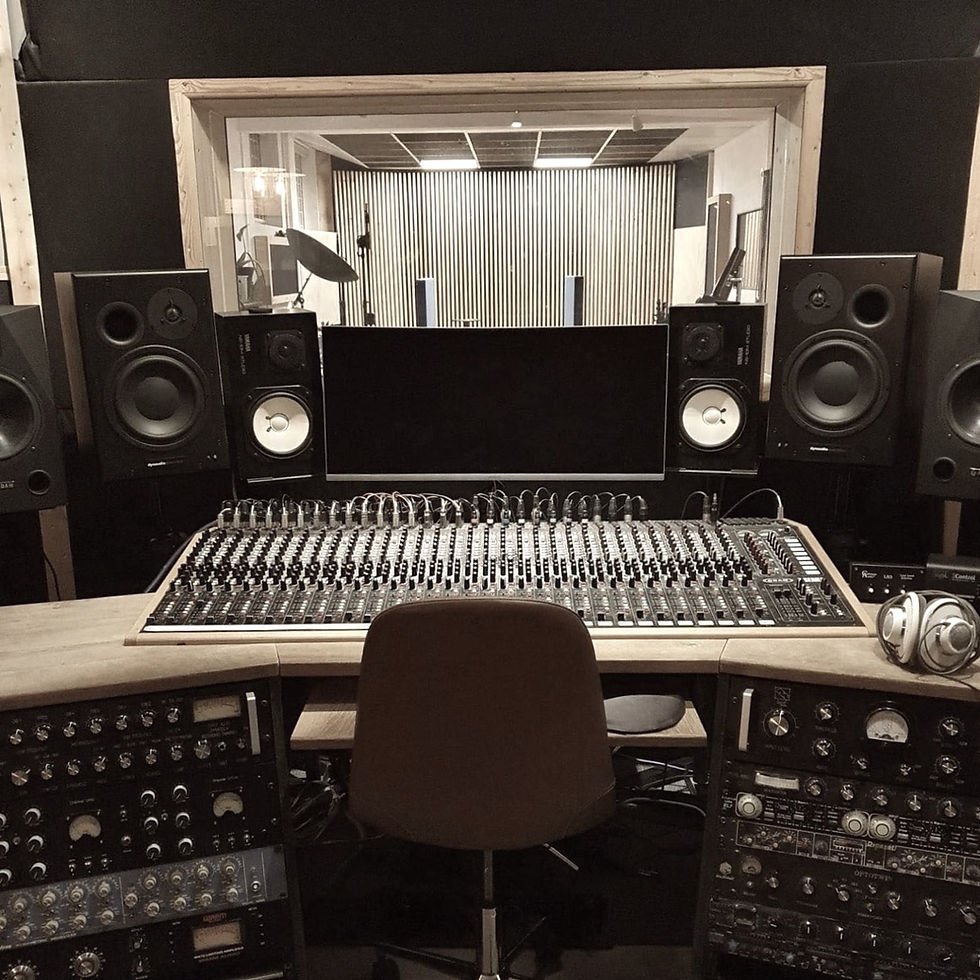
At Tapetown in Aarhus, Denmark, our session catalogue includes Ulrika Spacek, Les Big Byrd and The Fresh & Onlys. These are useful listening examples for bands thinking about layered guitars, repetition and space. Below are the exact sessions and credits, alongside a practical way to turn your influences into a mixing brief.
Start with the relationship between the guitars
Two guitar parts can be compelling because they pull against each other. One might repeat a figure while another interrupts it; a sustained sound might hold the harmony while a more percussive part gives the song its movement. Making both equally prominent throughout can weaken that relationship.
Before you book a mixer, describe what each part does. Which one carries the recognisable phrase? Which creates tension? Which should be felt without attracting attention? If the answers change halfway through the song, mark that change in your rough mix notes.
This also helps you judge a portfolio. Listen to a complete passage and ask whether you can follow a musical idea through the dense sections. Separation is useful when it reveals the arrangement. Some parts are meant to merge into a single texture, and a mixer should be comfortable discussing that too.
Ulrika Spacek, Sonic Youth and a personal point of reference
Rasmus Bredvig, Tapetown's recording and mixing engineer, says the two Ulrika Spacek tracks recorded here reminded him strongly of Sonic Youth's guitar work. Sonic Youth's Murray Street was a major personal inspiration. That is a listening connection and an influence on Rasmus; it is not a Tapetown production credit for Sonic Youth.
The useful conversation starts with what you admire in that guitar work. Is it the interaction between players, the way a repeated figure develops, or how a song can make room for an extended instrumental passage? A reference becomes much more helpful when you identify the quality you want your own recording to retain.
Ulrika Spacek's “Everything, All the Time” and “Mimi Pretend”, released as Tapetown Sessions in 2017, were both recorded and mixed by Rasmus Bredvig at Tapetown in Aarhus. Their guitar work is a useful point of reference for this discussion of indie and psychedelic arrangements.
Listen: Ulrika Spacek — “Everything, All the Time”, Live at Tapetown. Recording and mix: Rasmus Bredvig. The companion session, “Mimi Pretend”, gives you a second performance to compare.
Destroy//Exist's coverage of the session praised both the live performance and the songwriting. For your own brief, use the video to identify the guitar relationships you care about and describe how they connect to your arrangements.
Les Big Byrd: listen through the repetition
A repeating part can give a song its centre. When you compare mixers, listen beyond the first cycle: does the performance keep pulling you forward, and can you still register the small changes around it?
The Tapetown Sessions of Les Big Byrd's “A Little More Numb” and “Geräusche”, both released in 2019, were recorded and mixed by Rasmus Bredvig. Use them as a pair of references when discussing how much attention should go to the repeated foundation and how much should go to the parts moving around it.
Listen: Les Big Byrd — “A Little More Numb”, Live at Tapetown. Recording and mix: Rasmus Bredvig. Find both videos in the Tapetown session credits, and the collected original coverage in the Les Big Byrd press archive.
If you want a hypnotic passage in your own record, tell the mixer how it should develop. Perhaps the repeating part should stay steady while the background grows. Perhaps the whole band should become more urgent. Those are different intentions, even if both are described casually as “more psychedelic”.
The Fresh & Onlys: keep the song in the picture
The Fresh & Onlys' “Wolf Lie Down”, released as a Tapetown Session in 2017, was recorded and mixed by Rasmus Bredvig. It provides another point of comparison for a guitar-focused brief, alongside Ulrika Spacek and Les Big Byrd.
Watch “Wolf Lie Down” live at Tapetown. The session's press archive links the original coverage.
Try listening once for the song and once for the texture. Where does your attention go during the vocal? What keeps the instrumental sections connected to the song? Use your answers to describe your priorities. An influence can guide the relationship between instruments without becoming a request to copy another band's sound.
Give each layer a purpose before adding another
Rasmus's approach to guitar layering begins with the nuances of the parts. Simply stacking guitars without intent can work against the music. For a layered indie recording, that means deciding whether an extra performance introduces a new role or obscures something you already like.
You can make that decision before sending files. Keep a rough mix that shows your preferred balance. Identify the parts you regard as essential and the alternatives you have not committed to. If two tracks are options for the same role, label them as options so the mixer does not assume both belong in the arrangement.
Effects need the same clarity. A delay that answers a phrase may be part of the composition. A reverb you added temporarily to make a demo less dry may be open to change. Tell the mixer which is which, and agree whether a processed version, an unprocessed version or both will be useful.
Write a brief that explains movement and space
An effective brief can fit on one page. Include your rough mix and two or three references, then explain the following:
The foreground: the part listeners should follow in each important section.
The guitar relationships: which parts should stay distinct and which should merge.
The development: where repetition should feel steady, where tension should grow and where the song should open up.
The effects you are attached to: sounds that belong to the arrangement, with timestamps.
The uncertainty: one or two problems you want the mixer to help solve.
For example: “Keep the repeating guitar steady through the middle section. Let the second guitar become more noticeable near the transition, but keep the vocal close in the final verse.” That gives the mixer a musical direction without prescribing a chain of processors.
Questions before booking a psychedelic or indie mix
Does the engineer need to have worked with my reference artists?
No. Relevant recordings and a useful conversation matter more than a matching name. Ask which examples show the kind of guitar interaction or long-form development you want. Check the engineer's exact role on the version you hear.
Can Tapetown mix tracks recorded elsewhere?
Yes. Tapetown offers online mixing for recordings made elsewhere. Start with a rough mix, references, the number of songs and your intended release date. File delivery and the scope of the work can then be agreed for the project.
Should every song on the EP have the same guitar sound?
Discuss the record as a whole. A recurring sense of space or vocal perspective may help songs belong together, while individual tracks keep different textures. Send the proposed sequence and flag any song that needs to feel like a departure.
Talk to Tapetown about your record
Send a rough mix and tell us what draws you to the guitar work in your references. If Ulrika Spacek, Les Big Byrd, The Fresh & Onlys or Sonic Youth helps explain your direction, identify the particular quality you mean. We can then discuss how that intention relates to the material you have recorded.
The session credits above refer to the named live versions, not the artists' studio albums. Full recording and mixing roles are listed in the Tapetown session catalogue.