Ulrika Spacek’s recording history: from KEN to EXPO
Ulrika Spacek’s recording history begins in a shared house and eventually reaches a shared bank of digital samples. Between those settings are touring performances, a difficult change of studio, an album set aside and recovered, and a live recording made directly to tape. The continuity lies in how the musicians assemble their work: they keep returning to recorded material, finding another way to organise it, and deciding together what it should become.
That history gives a more precise account of the band than a single production label. “Home-recorded”, “live”, “self-produced” and “electronic” all apply somewhere, but they describe different records and different stages of making them. Following the releases and the musicians’ published accounts shows what changed, what remained, and where a Tapetown performance fits into the larger picture.
KEN: a house, a working space and a first album
The artist’s account of The Album Paranoia places the project’s beginnings in 2014. Rhys Edwards and Rhys Williams conceived Ulrika Spacek while in Berlin, then began developing the record after returning to KEN, their shared house in Homerton. The building had previously been an art gallery.
The initial demos used a drum machine. Three other musicians subsequently joined them, and the material was re-recorded as the group developed its live form. The debut therefore already involved a passage between a smaller recording project and a working band. Its ten songs were released on 5 February 2016 through Tough Love and Lefse.
The same release notes connect this early period to Oysterland, the band’s curated nights combining live performances and art installations. KEN supplied a place to record; Oysterland brought the music into a setting shared with visual work. Recording, developing the live group and presenting the project were connected activities.
Modern English Decoration and the work of construction
Modern English Decoration followed on 2 June 2017. Its published account places recording, production and mixing with the band at KEN. Work on artwork, photographs and videos also happened around the house.
The notes describe a deliberate process of construction. Edwards presents the band’s interest in the album as a complete form and in assembling music through collage. That distinction helps explain why sharing a home and making a record there need not mean simply documenting whatever happened when everyone played together. The space supported repeated decisions about parts, arrangements and the finished object.
Two songs provide a route through the surrounding releases. “Mimi Pretend” opens the album and “Everything, All the Time” appears fifth. The latter also has an individual release dated 23 September 2016. Its history therefore extends beyond one album listing, even before the later performances enter the picture.
KEN brought the music and its visual presentation into the same working environment. The record's identity could develop across those activities, with the house accommodating repeated work on the songs and the objects that accompanied them.
The album on tour: two Tapetown recordings
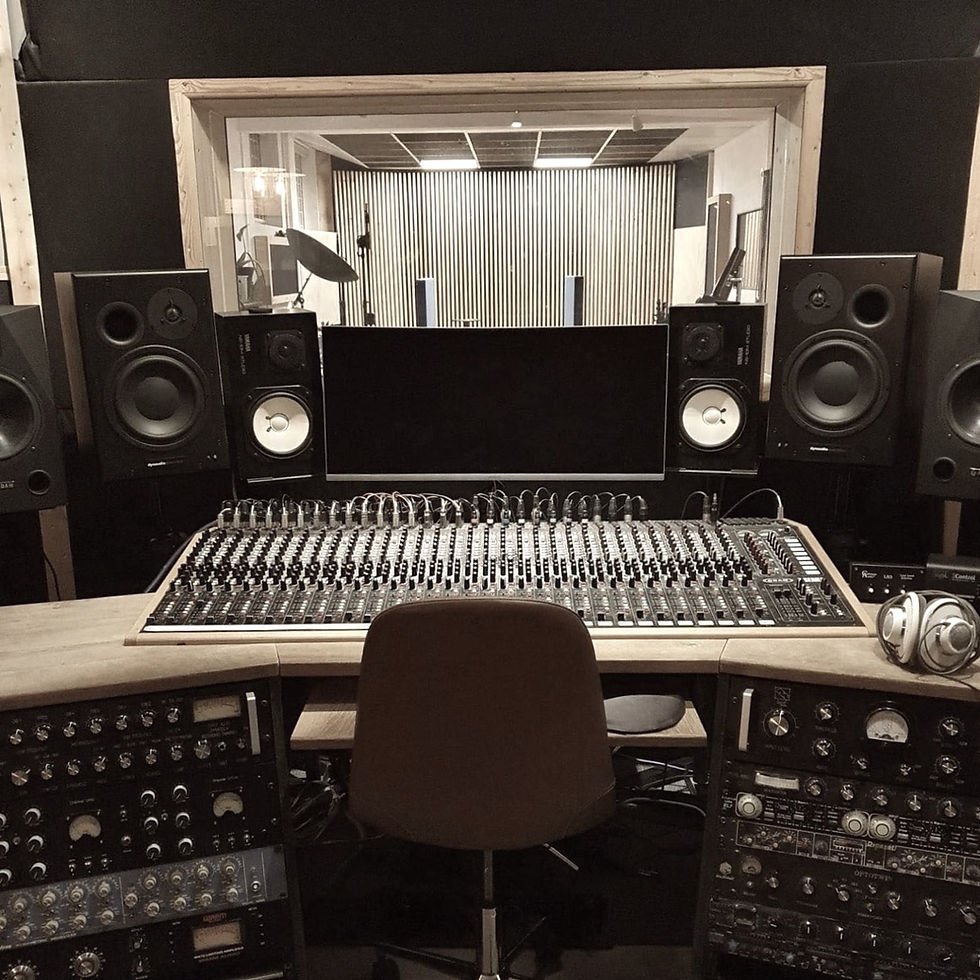
Ulrika Spacek recorded at Tapetown on 26 September 2017 during the Modern English Decoration tour. Two videos preserve the visit: Everything, All the Time, published on 9 October, and Mimi Pretend, published on 9 November.
Both descriptions name Rasmus Bredvig for recording and mixing at Tapetown and Emil Thomsen at ET Mastering for mastering. The album’s production history remains with the band at KEN; the session has its own contributors and recording occasion.
This is where the distinction between an album and its touring life becomes useful. The songs connect the documents, but a performance made while touring is another event. It brings the musicians together to play material that already has a place in the catalogue, then creates a new recording with separate technical work and a separate publication history.
The two upload dates are also distinct from the September visit. Their appearance a month apart does not indicate two studio visits. The original video descriptions identify the shared session, allowing the songs, the recording event and the public releases to be followed without merging them into one date.
Losing a room, keeping a record
The next studio album took much longer. The artist’s Compact Trauma notes describe work beginning in 2018, the loss of KEN, a move into a professional recording environment and a project interrupted before completion. The album eventually appeared on 10 March 2023.
A 2023 conversation with Section26 adds the musicians’ perspective. Edwards explained that the group stopped despite having much of the record made, then returned to songs they still wanted to finish. Kemp described KEN as a house in which they had recorded in many rooms and recalled the uncertainty surrounding their departure.
The move also changed what could happen to a recording after its first capture. In that interview, the musicians discussed assembling sections, listening separately and adding to existing material. Edwards described working on short passages; Kemp pointed out that hearing a passage again could also reveal that it needed no further bass part.
Those accounts make the delay more informative than a simple gap between release dates. Some of the material existed well before the finished album reached listeners. The band’s work included returning, reconsidering and completing, with the pause changing their relationship to recordings already made.
A live album with its own production history
Live to 388, NYC documents a different form of assembly. Its release account describes a New York performance recorded directly to tape on a Tascam 388. Songs from earlier albums sit alongside shorter “Insert” tracks and improvised connecting passages.
“Mimi Pretend” and “Everything All the Time” both reappear, joined by material including “Full of Men”, “Ultra Vivid” and “Wave To Paulo, He’s Not There”. The song titles create connections to the studio catalogue, while the sequence makes this a release with a shape of its own.
The artist states that the record had previously been available as a tour-only vinyl edition of 388 copies. The Bandcamp edition followed on 26 June 2024, bringing the previously limited release to another audience.
Taken beside the Tapetown videos, the live album shows two different ways a band’s performances can enter its discography. One visit became separately published song videos. Another performance became an album whose presentation includes transitions and a deliberately sequenced run of material.
EXPO: moving collaboration into a sample bank
EXPO, released on 6 February 2026, makes another production method explicit. The artist’s notes describe the band creating its own sample bank, with recorded material becoming the starting point for new construction. Electronic and acoustic elements were brought into the same process.
In a 2026 interview with Dansende Beren, Edwards explained that the musicians were now dispersed. Working alone, in pairs and together online gave them a different way to exchange and reconsider ideas. He described a shared collection to which everyone could contribute and respond.
The connection to KEN is therefore a working relationship rather than a requirement to recreate the old building. At KEN, proximity made contributions available to the others. The shared files created another means of access once the musicians could no longer rely on living in one place.
Rockambula’s published conversation gives a concrete example. The musicians described placing small recordings in a shared Dropbox folder. A rhythm Brown had recorded separately became part of “Build a Box Then Break It” when combined with other ideas. The sampled material came from the group’s own playing, including moments that were not initially approached as complete songs.
That example provides an important link between the technological change and the writing. A shared folder did more than transport finished parts. It made incomplete gestures available for someone else to recognise as the beginning of a composition.
A studio can be shared without being a shared home
The remote work did not remove the recording room from the process. In a March 2026 interview with POPnews, Joseph Stone described combining individual work at home with more spontaneous work together in a studio. Kemp identified Total Refreshment Centre as a place where the group kept equipment and regularly worked.
Kemp compared its role to KEN while making a practical distinction: it was a recording place rather than somewhere the band lived. Stone and Kemp also explained why self-production remained important. Production techniques were embedded in their writing, so handing over that work would affect how the songs themselves were made.
An interview with Still Listening connects the record to the live band. Stone described exchanging ideas from home before bringing them together at rehearsals. Edwards discussed how a recorded section might take another form when played live.
The record and the performance can thus continue to develop in relation to one another. The studio construction does not have to become a set of instructions that the live group follows unchanged; the musicians’ own account leaves room for another arrangement to emerge when they play it together.
Letting other artists rearrange the material
EXPO, REMIXED, released on 31 July 2026, opened that material to people outside the band. Its notes describe the full album being reordered and reworked by invited artists, including members of YHWH Nailgun, caroline and Good Sad Happy Bad, alongside Able Noise and more eaze.
For a group that had spent years constructing its own records, this created a further stage in the material’s life. Layers previously combined within Ulrika Spacek’s songs became building material for other musicians. The artist’s account presents the decision as a deliberate contrast with the band’s usually inward working process.
Across the decade, the catalogue contains several distinct forms of recorded work: house-made albums, song performances captured during a tour, a live tape album, collaborative construction from self-recorded samples and an invited remix project. Their relationships become clearer when each retains its own production account and dates.
Document | Published date | Recording or production context |
|---|---|---|
The Album Paranoia | 5 February 2016 | KEN recordings developed from demos into a band record |
Modern English Decoration | 2 June 2017 | Recording, production and mixing by the band at KEN |
Two Tapetown videos | October and November 2017 | Performances recorded on 26 September; recording/mix by Rasmus Bredvig, mastering by Emil Thomsen |
Compact Trauma | 10 March 2023 | Work resumed after a change of room and an extended interruption |
Live to 388, NYC, Bandcamp edition | 26 June 2024 | A live tape recording following an earlier tour-only vinyl edition |
EXPO | 6 February 2026 | Self-recorded samples, remote exchange and shared studio work |
EXPO, REMIXED | 31 July 2026 | The album’s material reworked by invited artists |
The central thread is the group’s ability to reorganise how it works together. A home, a studio, a rehearsal and a collection of files each make different things possible. Ulrika Spacek’s published history shows the musicians repeatedly changing those arrangements while keeping collective decisions about the record at the centre.