The Hard Pan: LCR Mixing and the Psychoacoustics of the Live Soundstage
Updated: Aug 29

After applying surgical equalization and dynamic compression to a raw live multitrack, the individual elements may sound powerful, but the overall mix can still feel claustrophobic. When capturing a band on a live stage, the instruments naturally bleed into every microphone, inherently pulling the perceived audio toward the middle of the room.
Amateur mix engineers attempt to create a stereo image by panning instruments incrementally (e.g., placing a guitar 30% to the left and a keyboard 40% to the right). This results in a blurred, narrow soundstage where frequencies overlap chaotically, completely masking the lead vocal and the snare drum in the center channel.
The human brain localizes sound through microscopic time and volume differences between the left and right ears. When identical frequencies from different instruments are placed near each other in the stereo field, the brain struggles to separate them. Furthermore, the acoustic delay of stage bleed introduces the Haas effect, which can either widen a mix or collapse it entirely depending on phase coherence.
Implement LCR (Left-Center-Right) panning. By restricting panning decisions to only three physical positions—100% Left, 100% Center, or 100% Right—an engineer forces maximum physical separation between the instruments, clearing the critical center channel for the rhythmic foundation and the lead vocal.
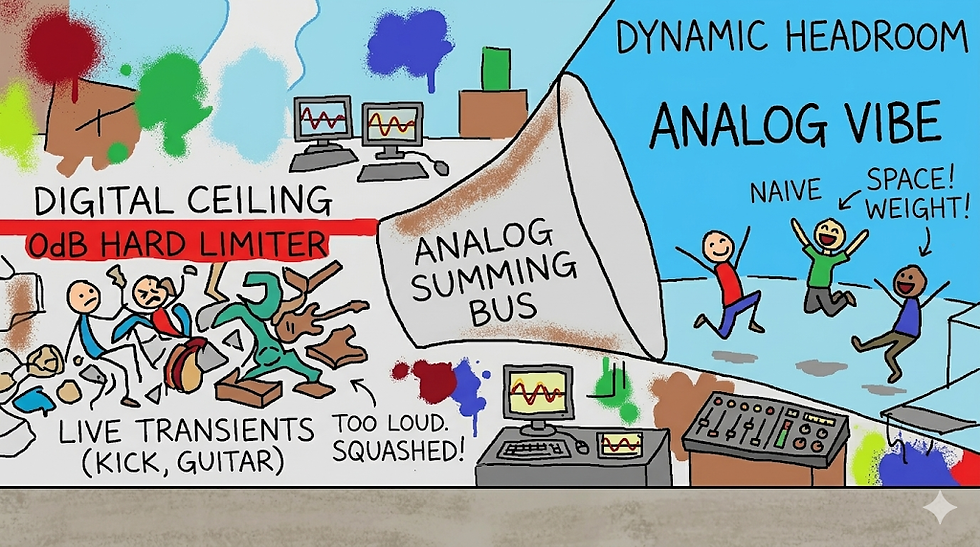
Bypassing sterile digital panning algorithms by routing the LCR mix through a physical analog console. The natural, microscopic electrical crosstalk between the left and right channels on an analog board acts as an acoustic glue, preventing the hard-panned instruments from feeling disconnected.
The Cluttered Center and Frequency Masking
The center of the stereo field is the most valuable real estate in an audio mix. It is where the most physical energy resides, and it is where the listener's ear naturally focuses. In rock, alternative, and punk music, the center channel must be reserved exclusively for the core driving elements: the kick drum, the snare drum, the bass guitar, and the lead vocal.
When an engineer pans a distorted rhythm guitar to the "10 o'clock" position and a synthesizer to the "2 o'clock" position, they are not creating true width. They are simply moving massive blocks of mid-range frequencies slightly off-center. These instruments will still acoustically overlap with the lead vocal and the snare drum, causing severe frequency masking. As detailed in foundational guides like Improving Your Stereo Mixing, attempting to create separation through incremental panning often destroys the focus of the mix, leaving the soundstage feeling undefined and cluttered.
The Physics of LCR Panning
To achieve a truly massive, three-dimensional soundstage, professional mix engineers rely on LCR panning. The LCR philosophy dictates that the mix pan pots should only ever be set to three distinct positions: hard left, dead center, or hard right. There are no intermediate positions.
By forcing all electric guitars, keyboards, and stereo drum overheads to the absolute 100% extremes of the left and right speakers, the engineer physically removes them from the center channel. This creates a massive acoustic void in the middle of the mix. Suddenly, the kick, snare, bass, and vocals have infinite headroom. They no longer have to fight through a wall of distorted midrange to be heard.
The resulting mix sounds unfeasibly wide. The rhythm section hits with physical authority in the center, while the harmonic instruments wrap entirely around the listener's head. It is a bold, uncompromising mixing decision that immediately elevates a track from a demo to a professional, arena-sized record.
Live Bleed and the Haas Effect
LCR panning is highly effective in a pristine studio environment, but it requires deep psychoacoustic understanding when applied to a live recording. On a live stage, a guitar amplifier placed on the left side of the room will inevitably bleed into the drum microphones placed on the right side of the room.
Because sound travels through the air at roughly one foot per millisecond, the sound of the guitar will arrive at the right-side microphones several milliseconds after it arrives at the left-side microphones. When the engineer hard-pans these tracks left and right in the mix, they trigger a psychoacoustic phenomenon known as the Haas effect.
The Haas effect (or the Precedence Effect) dictates that when a human hears two identical sounds separated by a very short delay (typically under 35 milliseconds), the brain does not perceive them as a sound and an echo. Instead, it fuses them together into a single, massive sound, localizing the source toward the ear that received the sound first. In a live mix, this delayed acoustic bleed can artificially widen the stereo image, creating a hyper-realistic sense of the physical room. This phenomenon is frequently discussed in advanced engineering forums, such as the spatial analyses in Haas and panning.
However, if the stage bleed is out of phase, the Haas effect will cause the low-end frequencies to cancel out entirely, making the mix sound hollow and nauseating. The engineer must ensure sample-accurate phase alignment across the entire drum kit before implementing extreme panning maneuvers.
The Tapetown Advantage: Analog Crosstalk
The primary criticism of LCR panning in the digital domain is that it can sound too isolated. Panning a guitar 100% to the left in a digital audio workstation results in absolute mathematical silence in the right speaker. This unnatural isolation can make the band feel disjointed, as if the musicians are no longer playing in the same physical space.
This is where the deployment of physical analog hardware provides a critical advantage. When a hard-panned digital mix is routed through a physical analog mixing desk such as the legendary large-format consoles detailed in About a studio: Sound City absolute mathematical silence is impossible.
Analog circuitry inherently possesses "crosstalk." Due to the physical proximity of the electrical wires, transformers, and summing resistors inside the desk, a microscopic percentage of the left channel's voltage naturally bleeds over into the right channel, and vice versa. This extremely subtle, analog signal leakage acts as a physical acoustic glue. It subtly tethers the hard-panned instruments together, filling the digital voids with warm, low-level harmonic noise. The mix retains the massive, explosive width of the LCR technique, but regains the believable, organic cohesion of a live rock band playing in a shared physical room.
References & Further Reading