The Signal Path: The Science of Analog Weight and Sonic Authority at Tapetown
TL;DR:
The Chain: We optimize every electrical link from source to converter to preserve the natural energy and transient response of the music.
Transformer Saturation: The physical iron cores in our outboard gear create the "glue" and perceived weight that define world-class records.
Impedance Matching: How the electrical relationship between the microphone and the preamp dictates your fundamental tonal color.
Analog Summing: Why we mix tracks physically as electrical currents to achieve a three-dimensional soundstage and superior depth.

1. Introduction: Defining Sonic Authority
In the modern music industry, it is remarkably easy to achieve a sound that is "clean" and "quiet." However, there is a vast gulf between a recording that is merely clean and one that possesses Sonic Authority. Authority in sound describes how a track commands the listener’s attention—it is about weight, texture, and the palpable sense that instruments occupy a physical space.
At Tapetown, we don't seek this authority through digital shortcuts or artificial "enhancer" plugins. Instead, we achieve it by mastering the fundamental principles of analog electronics. Every time a sound signal passes through a vacuum tube or a transformer, it is shaped by the laws of physics. Below is an in-depth exploration of the signal path designed to give your music the necessary weight to cut through in a global, saturated market.
2. The Microphone Membrane: The First Electrical Transduction
The journey begins where sound waves are converted into electrical voltage. Microphone selection is our most vital tool for defining the fundamental character of a recording. We don't view the microphone as a neutral tool, but as an instrument that interacts dynamically with the acoustic energy of the source.
The Importance of Mass: A large-diaphragm condenser microphone possesses a specific mass that makes it react differently to transients than a small-diaphragm mic, often resulting in a smoother, more flattering top end. By selecting microphones with tube-based circuitry, we introduce Harmonic Richness at the very source. The tube creates subtle second-order harmonics and soft-knee compression that bring the intimate details of a vocal or an acoustic guitar to the forefront of the mix.
The Texture of Ribbon Technology: For sources with harsh transients, such as guitar amplifiers or brass sections, we often employ ribbon microphones. Their ultra-light aluminum ribbons react to the velocity of air particles rather than pressure, providing an unparalleled Analog Texture that closely mimics the natural way the human ear perceives sound.
3. Impedance and the Preamp: The Critical Interaction
A frequently overlooked factor is the electrical relationship between the microphone and the preamplifier. This phenomenon is known as Impedance Matching. When we select a preamp at Tapetown, we analyze how it loads the microphone’s internal circuitry. A preamp with low input impedance can "darken" a microphone’s tone, while a high impedance setting allows it to breathe and provide more detail.
We utilize preamps equipped with oversized, high-quality transformers. A transformer is essentially an iron core wrapped in copper wire. When the signal is driven "hot" into the transformer, Magnetic Saturation occurs. This is the bedrock of Analog Weight. It creates a subtle rounding of the harshest peaks and adds a specific "heft" to the low-mids, making instruments feel more massive and solidly anchored within the stereo field.
4. Analog Outboard: Shaping During the Tracking Phase
We believe in the power of commitment. Rather than recording a sterile signal and trying to "find the sound" later in the box, we use our analog outboard gear actively during tracking. By inserting an analog EQ or compressor into the signal path before conversion, we shape the sound while it is still a continuous electrical wave.
Phase Integrity: Analog EQs (such as our Pultec-style units) shift phase in a way that feels natural and musical. This provides an "air" and a low-end foundation that digital minimum-phase filters often struggle to replicate without sounding artificial or "plastic."
Dynamic Control: By using optical or tube-based compressors (like the LA-2A or Variable-Mu styles), we can tame the signal's dynamics without "choking" its life. This ensures we send an optimized signal to our converters, maximizing digital resolution and preventing the thinness often associated with purely digital gain staging.
5. Conversion and Master Clocking: Digital Precision
When the analog signal must finally be translated into the digital realm, precision is paramount. We use mastering-grade converters to ensure that the Sonic Authority we have meticulously built in the analog chain is not lost during the transition to 0s and 1s.
A critical, often ignored factor here is Jitter (timing instability in the sampling process). By utilizing an ultra-precise external master clock, we ensure that every single sample is captured exactly when it should be. This results in a wider, deeper stereo image and a much more defined transient response. This is where analog weight meets digital clarity.
6. Analog Summing: The "Glue" of the Mix
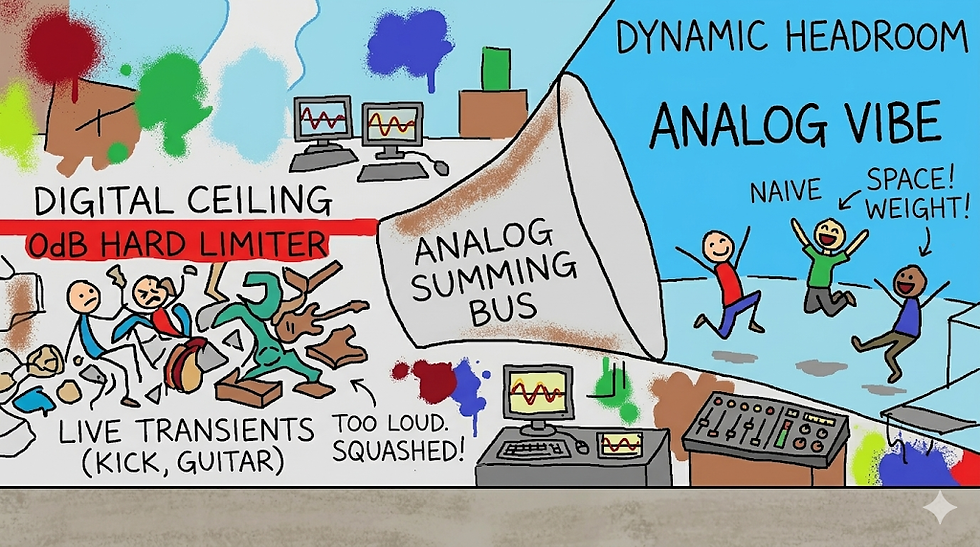
The final stage in our signal path is analog summing. Rather than letting a computer’s summing bus add tracks together through a mathematical algorithm ($1 + 1 = 2$), we route our main stems through an analog summing bus.
In this stage, the signals are mixed physically as electrical currents. This creates a unique Three-Dimensional Depth, where instruments don't just sit side-by-side but exist in a front-to-back perspective. It adds the final "glue" that makes a production sound like a cohesive record rather than a collection of isolated files. This is where the full potential of Analog Weight is realized.
7. Conclusion: Your Music Deserves Authority
The signal path at Tapetown is not merely a collection of expensive gear; it is a philosophy of respecting sound as a physical phenomenon. By combining the laws of physics with modern precision, we provide the framework for your music to achieve its full Sonic Authority.
Whether you are an established act or an ambitious solo artist, our signal path is engineered to give your work the weight and character required to make a lasting impact. At Tapetown, electricity becomes emotion.