


Room Mics as Evidence of the Performance
Room mics behave differently from reverb.
That sounds obvious, but a lot of mixes treat them as if they are just another ambience return. Push up the room mics when the drums feel small. Compress them when the kit needs excitement. Darken them if the cymbals hurt. Mute them when they get messy.
All of that can be valid. But it misses the important part: a room microphone is evidence of an event. It tells you what happened in the air after the drummer hit the kit, after the guitar amp pushed into the walls, after the band played loudly enough for the room to answer back.
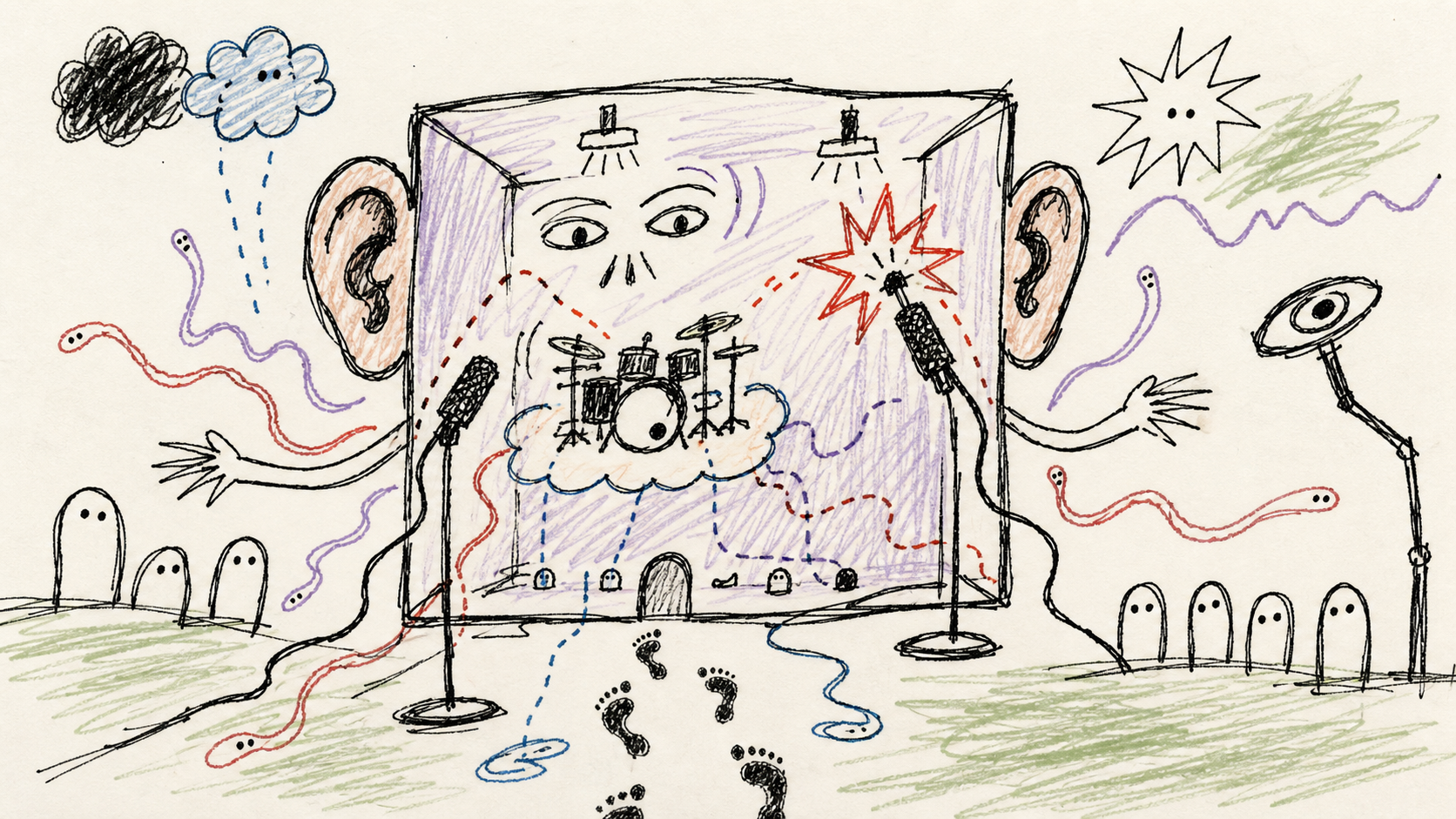
Sound On Sound's recording drums guide is useful for technique. Placement is only part of the decision. Some recordings need the room to testify.
The room changes the performance
A real room does not wait until mixing. It changes the musician while the take is happening.
A drummer reacts to the way the kit blooms. A guitarist plays differently when the amp fills the space. A vocalist changes pressure when the band feels loud in the room. Even if everyone is wearing headphones, the body still feels vibration, distance, and spill.
Room mics are tied to the performance. If the band played into the room, the room mics may contain part of the reason the take worked. Muting them can make the track cleaner and smaller at the same time.
Tapetown's article on recording a band live in a room makes this point from the performance side. A live room recording is not simply a collection of isolated instruments captured at the same time. It is a relationship between people, instruments, microphones, and air.
Room mics are where that relationship becomes audible.
Ambience and proof feel different
A reverb plugin can create a beautiful space. A convolution response can give a track a convincing room. A plate can give a vocal density. A chamber can make a snare feel classic. None of that is the same as a microphone hearing the actual event.
A room mic contains all the inconvenient facts. The cymbals are too loud. The snare hits the wall strangely. The kick does not sound as big ten feet away as it does in the close mic. The floor resonates. The guitar amp is bleeding into the drum picture. The room has a frequency problem that nobody noticed while setting up.
Those facts can be ugly. They can also be the thing that prevents the recording from feeling assembled after the fact.
This is why room mics require judgement. If the room signal only adds smear, it can go. If it adds the physical truth of the performance, it may be worth shaping instead of deleting.
Compression turns room into behavior
Room mics often become interesting when they are compressed because compression changes the room from a picture into behaviour.
An uncompressed room mic might tell you where the kit is. A compressed room mic can tell you how hard the kit is fighting the space. The snare pulls the compressor down. The cymbals raise the noise floor. The decay comes forward. The room starts breathing in time with the performance.
That can be amazing. It can also ruin the groove.
If the release is wrong, the room pumps against the tempo. If the attack is wrong, the snare loses its punch or the cymbals spit in a way that makes the track feel cheap. If the compressor is too excited, the room becomes more important than the drummer.
Tapetown's Ghost Snare article is a useful related piece because transient attack is exactly what room compression can either support or bury. A room mic should not automatically become a crushed ambience layer. Sometimes it should stay quiet enough to make the close mics believable.
Phase is part of the room's personality
Room mics arrive late. That lateness is the point. But late microphones create phase relationships with close microphones, and those relationships can either give size or take it away.
Move the room mic, and the snare changes. Flip polarity, and the kick might get larger while the cymbals get stranger. Delay the room mic, and the kit can feel wider or more artificial. Leave it alone, and the timing might feel natural even if the frequency response is imperfect.
There is no universal correct answer. A room mic is musical distance.
A room mic that is technically aligned may lose the feeling of depth. A room mic that is technically messy may make the track feel more real. The mixer has to decide whether the phase problem is a problem or part of the record's body.
Phase still needs attention. Listen to it as tone, impact, and distance, not only as a warning light.
Bad rooms can still say something
A beautiful room makes this easier. A great live room gives the kit size, decay, and balance. It flatters the recording without turning it bland.
Most rooms are not that. Many rooms are low, boxy, reflective, uneven, noisy, or just not designed for music. That does not automatically make them useless. A difficult room can still give a recording an identity if the engineer understands what it is doing.
Tapetown's piece on On-Location Recording is relevant here. A difficult room is not a neutral problem waiting to be corrected. It is a condition. The recording has to decide whether to fight it, hide it, exaggerate it, or work around it.
Room mics in bad rooms can be small and ugly. Sometimes that is wrong. Sometimes the ugly room is exactly what makes a performance feel like it happened somewhere instead of nowhere.
Room mics in mixing
When a mix arrives with room mics, the first job is figuring out why they are there.
They can add size. They can add danger. They can glue close mics together. They can make drums feel less edited. They can make a guitar track feel like it shared air with the kit. They can also blur the low end, turn cymbals into weather, and make the whole track smaller by filling every gap with mush.
This is where Tapetown's studio perspective matters. The studio is more than a room with equipment. It is a place where decisions about distance, bleed, and commitment happen before the mix ever starts.
If the room mics are printed badly, the mix has fewer options. If they are printed with intention, they can become one of the most valuable parts of the recording.
Mono rooms can feel larger than stereo rooms
Stereo room mics are not automatically bigger. They are wider, but width and size are not the same thing.
A mono room mic can make a drum kit feel brutally centered. It can sit behind the snare like a shadow. It can be crushed, distorted, filtered, and tucked under the close mics until the kit feels more physical without obviously sounding roomy. Because it does not spread everything across the stereo field, it can leave guitars and vocals with more space.
Stereo rooms can be beautiful when the room itself has a balanced image. They can also make the kit feel vague if the sides are full of cymbal smear and low-mid fog. The listener hears width, but not impact. The snare gets larger in a way that does not hit harder.
The choice is not technical fashion. It is posture. Should the room wrap around the kit, or should it punch from one strange point behind it? Should it create atmosphere, or should it make the close mics feel less fake? A mono room may look less impressive in a session, but it can be the more decisive sound.
Room mics expose cymbal discipline
Cymbals are where room mics often tell the truth nobody wants.
A drummer with heavy hands on cymbals can make the room unusable. The shells may sound powerful, but the room mics become a wash of metal. Compress that signal and the problem gets louder. Brighten it and the mix becomes painful. Darken it and the whole kit gets cloudy.
This is not only an engineering issue. It is performance balance. The drummer decides how much of the room belongs to cymbals and how much belongs to shells. A good room mic makes that decision obvious.
Sometimes the solution is mic placement. Sometimes it is compression. Sometimes it is editing. Sometimes it is asking the arrangement to leave more space for the kit. But often the lesson is simpler: the room mic heard the drummer more honestly than the close mics did.
That honesty can be uncomfortable. It is also why room mics matter.
The room can be muted and still matter
Sometimes the best room mic is barely audible.
It may only appear in a chorus. It may sit under the snare and toms but disappear in the verse. It may be filtered until it sounds less like a room and more like pressure. It may be automated around fills. It may be muted for the first half of the song so the moment it appears feels like the wall moved backward.
That does not make it less important. It means the room is being arranged.
A common mistake is treating room mics as a static layer. Pick a level and leave it. But rooms respond to sections. A dry verse can make a chorus room feel huge. A loud room in the bridge can make the final chorus feel more desperate. A completely muted room can make a vocal entrance feel closer.
Room mics let the mix decide how much of that evidence the listener gets at each moment.
The close mics should not win by default
Close mics often win because they are easier to control. They give attack, separation, and the illusion of certainty. That does not mean they are telling the better story.
A close snare mic can make the drum hit hard but remove the space around the drummer. A close kick mic can give point and low end but say nothing about the kit moving air. Close tom mics can make fills huge and disconnected. The room mic may be the only signal that explains how those pieces belong together.
The mistake is letting control decide the record. Sometimes the close mics should dominate. Sometimes they should only give definition to a sound whose real size comes from farther away.
When that balance works, the snare stops feeling pasted to the front of the speakers. The kit feels like one person hitting one instrument in one room.
What the room leaves behind
Room mics leave evidence.
They tell the listener that the sound happened in air. They reveal how the room reacted, how loud the performance was, how the drums moved, how the cymbals filled space, and how messy the recording really is.
They can be ugly, phasey, cloudy, and wrong. When they carry the performance, replacing them with clean reverb can make the take feel scrubbed clean in the wrong places.
The useful room mic often sounds slightly inconvenient. A bit of cymbal wash, a floor resonance, a late snare reflection, some low-mid trouble from the walls. That is the room reminding the mix that the performance had a body.


