


How to Finish a Song When the Demo Is Fighting You
A demo can fight back.
It starts as a quick idea with a pulse. The vocal is rough, the drum loop is too loud, the bass is half wrong, the guitar is only a placeholder, and somehow the thing works. Then the real production begins. Better sounds arrive. Cleaner takes arrive. More parts arrive. The chorus gets bigger. The bridge gets clever. The session gets heavier.
Two weeks later, the song is technically improved and emotionally weaker.
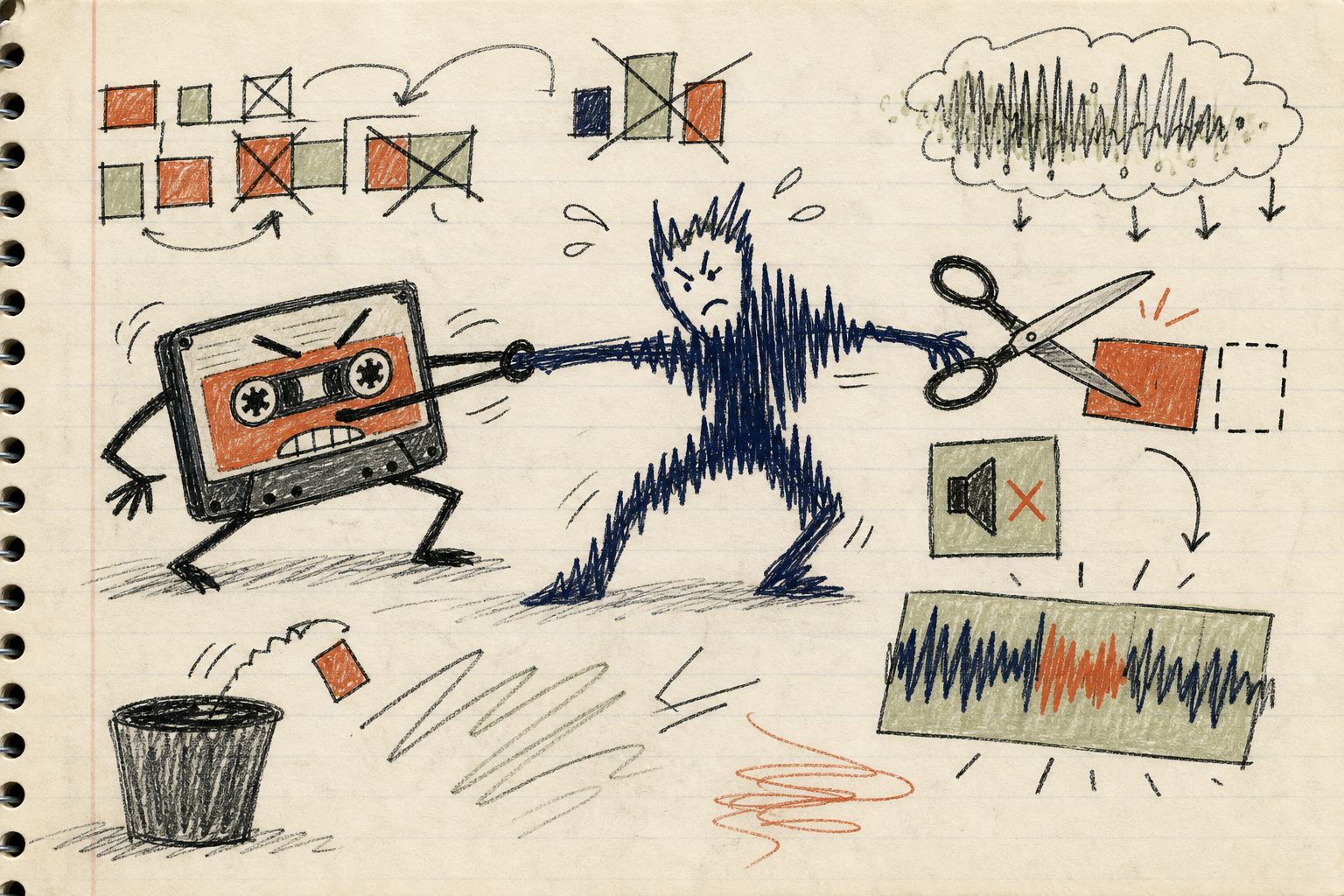
Finishing a song often means finding the original pressure before the demo disappears under all the work done to improve it.
The demo had a job
A demo is rarely good by accident. It may be badly recorded, poorly balanced, and full of temporary decisions, but something made people keep listening.
That thing may be the vocal rhythm. It may be the drum loop. It may be the ugly guitar sound. It may be the fact that the chorus enters too early. It may be the contrast between one dry element and everything else being messy. It may be a mistake that gave the song a shape nobody planned.
Before adding more production, identify the job the demo was doing.
Ableton's Arrangement View manual is useful because it treats the song as a timeline of decisions: clips, sections, automation, edits, and structure. The emotional version of that is simpler. Where does the song actually move? Where does it sag? Where does it start pretending?
If the demo had a job, the finished production has to keep that job covered.
Attachment can sound like arrangement
Demo attachment is real. A part can feel essential because it was there first.
The first synth pad. The first scratch vocal effect. The drum loop that helped write the verse. The extra guitar that made the room feel exciting on day one. The harmony recorded at 2 a.m. that now appears in every chorus because nobody wants to mute it.
Attachment can disguise itself as arrangement. The part feels emotionally important to the person who made it, but the listener only hears another layer. The song becomes crowded with private history.
One of the most useful finishing moves is muting parts without deleting them. Let the song play with the part gone. If the lyric gets clearer, the groove gets taller, or the chorus arrives with more air, the part may have been a memory rather than a decision.
Tapetown's article on the raw edge connects here. Keeping a rough thing can be powerful. Keeping everything rough because it was there early makes the track lose its outline.
The chorus may need less before it
People often try to finish a chorus by adding to the chorus.
More guitars. More vocals. More drums. More distortion. More top end. More room. More width.
Sometimes the chorus is fine. The problem is the section before it. The verse is already too wide. The pre-chorus already has too much motion. The vocal effect already gives away the big space. The drums already hit like the final chorus. The song spends its money before the chorus arrives.
A chorus can feel bigger when the verse gives it somewhere to go.
Make the verse narrower. Mute the second guitar until later. Keep the bass simpler before the lift. Pull the room down. Leave the vocal drier. Delay the harmony. Let the pre-chorus become a hallway instead of another room full of furniture.
Finishing often means creating contrast, not adding size.
Rough sounds can be placeholders or identity
The hardest demo decisions are the rough sounds that everyone loves for unclear reasons.
A clipped drum loop. A cheap keyboard patch. A distorted scratch vocal. A guitar sound recorded too close to the amp. A mono room mic from a phone. A bad reverb that somehow makes the verse feel lonely.
Some of those sounds are placeholders. They carried the writing session and now need to be replaced. Others are identity. Replacing them makes the song normal.
The difference is usually behavior. If musicians performed around the sound, it may be identity. If the vocal phrasing leaves space for the delay, that delay matters. If the guitar part was written because the bad tone made the riff meaner, the tone matters. If the drum loop forced a certain bass rhythm, the loop may still have authority even if it needs rebuilding.
If the rough sound only fills a gap, replace it. If it changed the song's behavior, be careful.
Finishing needs a hierarchy of problems
Unfinished songs often create a fog of problems.
The vocal is not final. The bass tone is wrong. The chorus feels small. The bridge is too long. The snare is annoying. The second verse needs something. The ending is awkward. The rough mix is muddy. The song feels flat.
Trying to fix all of that at once usually creates more work.
Pick the problem that changes the most other problems. If the arrangement is crowded, mixing moves will lie. If the vocal melody is still uncertain, the production cannot know what to support. If the chorus has no contrast, a new guitar tone will not save it. If the tempo feels wrong, every part will keep needing repair.
Tapetown's piece on technically fine mixes that still feel dead is relevant because many dead mixes started as undecided productions. The mix can help, but it cannot always create a center after the song has avoided one.
Fix the highest problem first. Then listen again. The list usually changes.
The bridge might be the wrong kind of clever
The bridge is where many demos start fighting.
It was added because the song needed somewhere new to go. Then it became a second song. New chords, new rhythm, new vocal register, new production idea, new texture. All of it may be good. The listener may still be waiting for the original song to return.
A bridge should change the light on the song, not prove the writer has another song available.
Sometimes the bridge needs to be shorter. Sometimes it needs fewer chords. Sometimes the vocal should stay in the same emotional room while the instruments change around it. Sometimes the best bridge is a breakdown, a held chord, a wrong drum fill, or a line that sounds almost unfinished.
Finishing a song means finding which ideas made the main idea stronger.
The mix should not be asked to finish the writing
Mixing can create movement, depth, excitement, and focus. It can reveal a chorus. It can make a vocal feel close. It can control clutter. It can make a small recording feel more serious.
It should not be asked to decide the song's basic shape.
If the chorus melody is still fighting the chord change, the mix will only decorate the fight. If the second verse has no reason to exist, production tricks may keep it alive for eight bars and still leave the listener drifting. If the ending has no gesture, the mix fade will feel like giving up.
The mix can finish the sonic argument. The song has to bring an argument worth finishing.
This is where online mixing often exposes the truth of a production. Fresh ears hear the rough mix as a record, not as a history of effort. That distance can be uncomfortable. It is also useful.
The first line can tell you what to remove
When a song is fighting the finish, listen to the first vocal line with everything muted except the smallest possible support.
If the line already has the song in it, the production may be over-explaining. If the line collapses without the full arrangement, the song may need a stronger musical floor. Either answer is useful.
The first line usually reveals the scale of the track. Some songs want to enter with confidence. Some need to creep in. Some need the band to answer immediately. Some need a strange sound before the lyric so the listener knows what kind of room they have entered.
Many unfinished productions ignore that first gesture. They keep adding later sections while the opening still does not know how to hold the listener. Fixing the entrance can make the rest of the arrangement easier to judge.
The song tells you quickly whether it wants more furniture or more space.
Print a version and live with it
Endless options keep a song unfinished.
Print a version. Put it away. Listen outside the session. Listen once without touching anything. Notice where attention drops. Notice which part you wait for. Notice which part makes you tired. Notice whether the first thirty seconds still make sense when you are no longer looking at the arrangement.
Do not fix while listening. The session will invite you back into the fog.
A printed version turns the song into an object. It lets the weak parts show themselves without the drama of the screen. The vocal either carries. The chorus either arrives. The bridge either earns its space. The ending either leaves a mark or walks out quietly.
That kind of listening is slower than adding another track. It is usually faster in the end.
It also shows which problems are real after the room changes, the screen disappears, and the session stops flattering itself.
Stop changing the target
Some songs stay unfinished because the target keeps moving.
One day the track is supposed to be raw and close. The next day it should be bigger. Then it needs a more danceable low end. Then the chorus should feel more live. Then the vocal should be more intimate. Every version can be defensible, but the song starts serving moods instead of becoming a record.
Pick the center and let it disappoint a few other possibilities.
A finished track always leaves alternate versions behind. There might be a heavier version, a cleaner version, a stranger version, a more commercial version, a smaller version. The useful question is which version makes the first idea more undeniable. Once that answer is clear, the remaining options become noise.
The demo fights hardest when every door stays open.
Close one door and the arrangement usually starts breathing differently.
When the song stops fighting
A finished song rarely feels perfect. It feels stable enough to move forward.
There may still be a rough vocal edge. A guitar may still sound cheap in solo. The drum loop may still have a little ugliness. The chorus may be smaller than the fantasy version. The ending may be blunt.
But the song stops asking for random additions. The parts have jobs. The contrast works. The rough mix has been honored where it deserved trust and challenged where it was hiding clutter.
That is the moment worth noticing. The demo no longer needs to win. The finished track has kept enough of its first pulse to stand on its own.


