Talent Across Borders: Building Sustainable Music Careers and Resilience Across Europe
A field guide for young musicians and the people who support them.

A handbook from Talent Across Borders - a Tapetown (Aarhus) and Lake Woozoo (Groningen) partnership, supported by Erasmus+. Access the original PDF handbook HERE
Front matter: How to read this handbook
A note on where this comes from, because it changes how you should weigh it.
This handbook is not a research report, and it does not pretend to be one. Over a year, we sat down with twelve people who work at different points in the European music industry, venue directors, bookers, festival programmers, label managers, a psychologist, an artist manager, a collective founder, and we asked them, plainly, how it actually works and what they wish young artists understood. What you are reading is the distillation of those conversations, together with what we learned from running the project around them.
That has a strength and a limit, and you should hold both. The strength is that this is first-hand testimony from people who make these decisions for a living, and that a striking number of them, sitting in different chairs and different countries, arrived at the same conclusions without ever comparing notes. When that happens, it is worth more than any single expert's opinion. The limit is that twelve conversations are twelve conversations. This is not a statistically representative survey, our guests came largely from Denmark and the Netherlands, and much of the wisdom here is practical rather than proven. Where we lean on hard numbers, they come from published research, and we point you to it in the chapter called What We Found, and What the Research Says About It, and in the reading list at the end. Where a figure came only from a conversation, we have either sourced it properly or left it out.
Read it, then, as a field guide written from experience, not a study. Take what fits your situation, test it, and discard what does not. The most useful thing in these pages is rarely a single fact. It is the shape of how the whole thing works, seen from the inside by people who were once exactly where you are now.
Part One — The Project
Chapter 1 — Why this project exists
Nobody teaches you how to have a music career.
You learn your instrument. Maybe you study production, maybe you go to a conservatory. And then you stand there with your songs and discover that the actual job is something else entirely: booking, touring logistics, release strategy, social media, funding applications, contracts, mental stamina. You have to do everything yourself, and worse, you have no network telling you what you don't even know to ask about.
Here is the strange part. Most people in the music industry are helpful when you ask them. Bookers, label managers, promoters and managers answer questions, and they remember what it was like. The willingness is there; the difficulty is reaching it. If you are 22 and playing your fourth show in a rehearsal-space venue, you do not know any bookers, and you do not know that the booker at the venue you dream of playing reads 40 to 50 band emails a week and has around 80 slots a year to give. You do not know the arithmetic you are up against, and you do not know the person who could explain it to you.
Talent Across Borders was built to close that gap. We did not set out to run a course or a lecture series, but to build something simpler: a persistent, low-threshold community in which young artists and independent industry people share the same room, and a series of honest conversations in which the people on the other side of the table explain how it actually works. This handbook is where we gathered what those conversations taught, so that the knowledge outlives the project that produced it.
The second idea in the project is in the name. Careers get stuck inside borders. A Danish band plays the same five venues at home and doesn't know that a Dutch band their size is facing the exact same wall, and that the two of them could swap: you book Holland, we book Denmark, we split Germany. That trade is how I toured when I was doing it myself, and it works, but it depends on knowing someone on the other side of the border, which is precisely what most young artists do not have. So TAB was set up as a Denmark–Netherlands exchange, with the explicit aim of making those connections ordinary rather than lucky.
The logic behind that is hard to argue with. Europe's borders are open, people cross them for a weekend without a second thought, and many of its music scenes resemble one another closely. Yet an emerging artist who stays inside a single country has a much harder time building an audience large enough to sustain a career, and touring abroad is one of the few reliable ways to widen it. That is far easier when you have a counterpart on the other side who knows their own venues and will share the work. For a continent this closely connected, an artist not crossing borders is a little like refusing to leave one city, and the whole point of TAB was to make leaving feel possible.
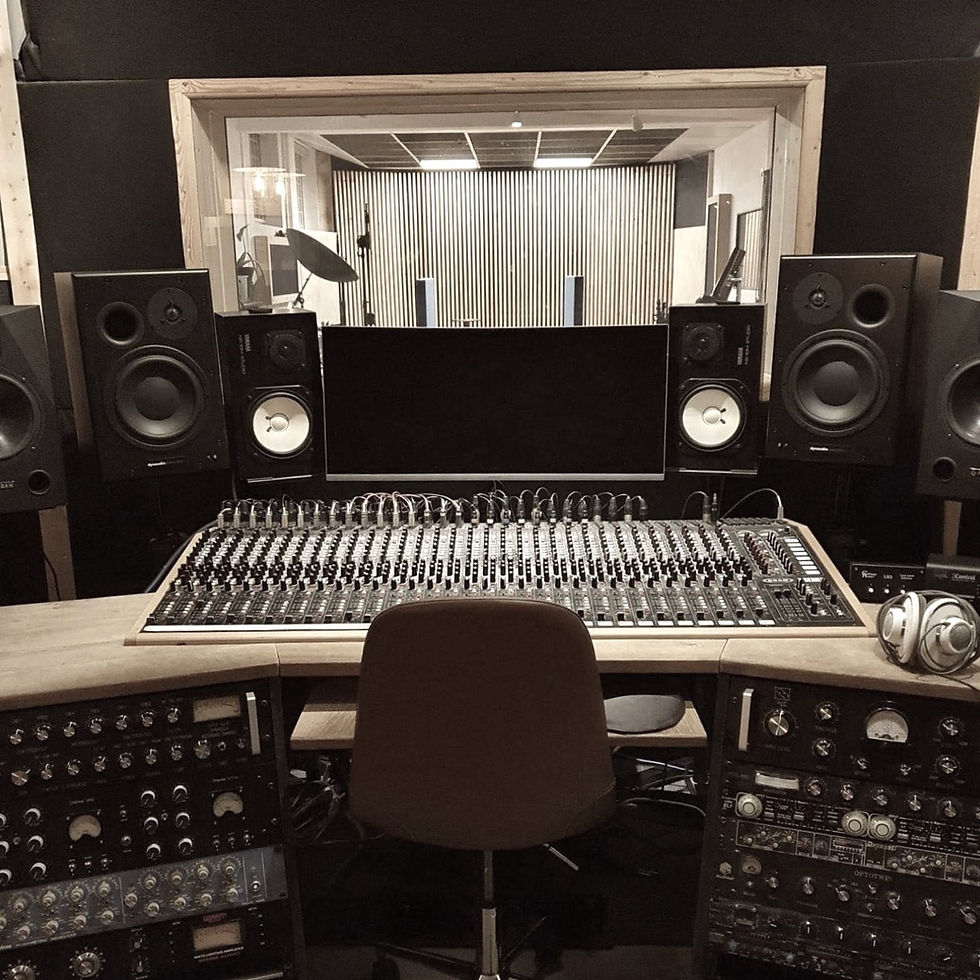
TAB is supported by Erasmus+ across 2025–2026, and run as a partnership between two organisations: Tapetown, a recording studio and music community in Aarhus, Denmark, and Lake Woozoo, a Dutch partner in Groningen. That a studio leads it is not incidental. A studio sits in the middle of the ecosystem: artists come through every week, and so do the people who record, release, book and promote them. We didn't have to build a network from zero. We opened the one we had, and Lake Woozoo opened the Dutch side of it, which is how a project run out of Aarhus ended up with half its guests and one of its two live workshops in the north of the Netherlands.
What we believe, and why this handbook exists
Before anything else, I want to set out the idea the whole project rests on, because everything that follows grows from it.
Most discussions of musicians and mental health concentrate on how to withstand the strain. Rest, boundaries, breathing, knowing when to ask for help. That work matters, and some of this handbook is given over to it. Over the years, though, I have come to believe that much of what wears young artists down begins further upstream, and that it has less to do with managing stress once it arrives than with a deeper sense that they have very little say in where their own career is heading.
When you do not understand how the industry works, your career becomes something that happens to you. You wait to be discovered, wait for an agent to call, wait for the algorithm to take an interest, and the waiting itself is corrosive, because it places your future in other people's hands and leaves you with nothing to do but worry about it. I believe that sense of powerlessness causes real harm, and that a good deal of what the mental-health statistics record is a generation of musicians who feel they are not the ones steering.
The premise TAB was built to test is a straightforward one. If you give a young artist a genuine understanding of how the industry works, together with peers to build alongside, you return to them a measure of control over their own future. An artist who understands how a booker reaches a decision, who knows that applying does not require an agent, who holds a rough two-year plan and has a few counterparts across the border to exchange shows with, tends to carry themselves more calmly, largely because their career has begun to feel like something they can act upon rather than something they must wait for. Knowledge and network together produce agency, and agency, I am convinced, is where a great deal of resilience originates. It is far easier to withstand a demanding industry when you believe you can shape your position within it.
This is what allows a handbook full of booking emails and release plans to serve, at the same time, as a handbook about mental health. Everything practical in Part 2 amounts, in its own way, to a measure of that control being handed back. I make no claim that knowledge softens the industry, because it does not, but it changes your relationship to the difficulty. A problem you understand and can work at steadily is one you can live with, where a difficulty that remains a mystery, and to which you feel subject, sits far more heavily.
I want to be candid about a conviction that runs underneath all of this, because it shapes the whole approach and it is easy to misread. There is a good deal of encouragement at the moment to sit with how hard things are, to dwell on the difficulty and study how it feels. I do not dismiss that. Feelings are real, and suppressing them helps no one. My concern is with what happens when the study of the difficulty becomes the whole of the response. Any competitive field looks unfair from the newcomer's vantage point, and the natural instinct is to ask how the difficulty itself might be reduced. I understand that instinct, but in my experience it changes remarkably little, because the difficulty does not disappear so much as move. Music is the clearest illustration. Once anyone could release a record without a label, the barrier did not vanish; it relocated, and the new struggle became visibility inside an ocean of releases. This is simply the nature of a field in which supply so far outstrips demand, and music is an extreme case of exactly that. When there is far more supply than the ecosystem can absorb, it becomes difficult for everyone in it, and much of the behaviour that follows, undercutting, playing for too little, is not malice but survival. Most people are trying to do well inside a structure that is genuinely hard.
So the more useful response, to my mind, is to equip people to meet the difficulty rather than to argue it away, to move from "this is hard, therefore I cannot" toward "this is hard, therefore I will act." None of this excuses the parts of the industry that ought to change. Gatekeeping, exploitation and the conditions that should not exist deserve to be named and improved, and I have no wish to diminish their seriousness; we should always be working to make the industry a fairer place for everyone. But for the individual artist standing at the beginning, I believe the surer path, to both a career and a settled mind, is agency: the understanding, the tools and the means to steer their own course rather than to stand as an observer of their circumstances. In my experience, a person who feels more in control of their life is a happier one, and that is as much a claim about mental health as it is about careers.
There is one further conviction in these pages, and it may be the one I most hope carries. Almost everything here works better when people share. A young artist can begin to feel in control only because those ahead of them were willing to explain how things work, and a scene grows only because its members exchange shows, contacts and honest counsel rather than guarding them. Gatekeeping, I think, grows out of a scarcity instinct, the quiet fear that there is only so much to go round. Nearly everything we saw pointed the other way. Knowledge held tightly is stored energy, and energy is of more use in motion than at rest; those who give the most tend, over time, to receive the most in return, and a scene through which knowledge moves freely lifts everyone within it, the giver included. The path through music is a hard one however you walk it, which is all the more reason to make friends along the way and to hold on to why you began, since that is what sustains the energy to keep going when it turns difficult. If there is a single disposition this project hopes to encourage, it is that one: that there is enough to go round, that helping the next person costs you nothing you truly needed, and that an open hand is, in the long run, both the more generous and the more durable way to move through a career in music.
So this handbook is written for two readers at once. The first is a young artist who never took part in our sessions, somewhere in Europe, who needs the knowledge itself, and who I hope will close it feeling not only better informed but more genuinely in charge of their own future, and steadier for it. The second is anyone who leads, or hopes to lead, a project of this kind, and who can take from our experience whatever proves useful for their own. If you are the first reader, treat Part 2 as your toolkit and Part 3 as a look behind the curtain. If you are the second, read it in the other order. You are meant to be holding the same book.
Chapter 2 — What we built, and why it looks the way it does
The project has three components, and the order matters.
The community is the spine. A dedicated Discord server connecting artists and independent industry people, aimed at musicians roughly 15 to 30 years old. Over the year it grew to close to 400 members, from the two partner countries and well beyond. We mention that number once, and only for what it tells you: there is a real, unmet appetite among young musicians for a place like this. Discord because it is persistent and already where young musicians live. No login friction, no platform to maintain, no reason for the community to die when the project's funded period ends.
The sessions are the engine. A run of online sessions with independent industry people: venue bookers, a showcase-festival communications lead, label managers, DIY-touring specialists, festival programmers, an artist manager. Plus two physical workshops where the community meets in person. These conversations are what this handbook distills.
The matchmaking is the point. A forum where members post what kind of contact or collaborator they are looking for, and the team actively connects them. This is the cross-border exchange working in practice rather than in a project description.
The format decisions were deliberate, and if you are an organisation thinking about running something similar, they are probably the most useful thing in this chapter.
Voice-only, no slides, no lecture. Sessions run as conversations in a Discord voice channel, with nobody on camera. This came from a hunch that proved correct: guests reflect more honestly when there is no camera on them. Martin Aagaard, our first guest, said plainly that the format made it easier to think out loud. For the audience, the threshold drops to almost nothing. You can listen while doing the dishes, because a session is not an event to dress up for but a conversation to drop into. The informality is doing real work here, and it is a large part of what makes people show up and speak freely.
A chat, not an interview. Sessions run as a conversation between colleagues, not a journalist interviewing a subject. The difference is audible. I hosted the early sessions as someone who has also toured, written the funding applications and been broke in a van. Eryn, who took over hosting from inside the community, brought the opposite seat, just as useful: the emerging artist asking the questions everyone listening actually has. Either way, the guest stops performing and starts talking.
Chapter 3 — What happened
Over the year the project ran a series of online sessions with people from every seat at the industry table, two physical workshops in Groningen and Aarhus (both livestreamed so nobody was shut out by distance), a matchmaking forum, and this handbook. The community around it grew to close to 400 people, which is the one figure worth holding onto, because it is the clearest sign of how much a resource like this was wanted.
But the value shows up better in stories than in figures.
The network closed its own loops. In session 5, Koen from Subroutine Records told us how he started as a volunteer at Vera in Groningen and built a twenty-year DIY-touring network from there. Two sessions later, Peter Dijkstra, who books Vera today, told the other half of the same story, including how he and Koen together carried the band The Homesick from a Frisian cassette release to a Sub Pop signing. Two guests, recruited independently, describing the same scene from two seats. For the young artists listening, this was the whole thesis made visible: the industry is not a wall, it is a web, and the people in it already know each other. Your job is to become known to any one of them.
The community fed the ecosystem it came from. Green Tea Bitches, a band in the community, asked sharp questions in sessions 5 and 6, and by session 6 were planning to record at Tapetown. A member became a client, and, presumably, in time a future guest. This is the model working exactly as intended: a community with real industry people inside it produces real work.
A volunteer became the host. Eryn's arc (member, volunteer, interviewer, host, and now someone with a music-industry career forming around this work) is the single clearest piece of evidence that the project does what it claims. TAB's stated goal is helping young people build sustainable careers in music. One of them built the start of it inside the project itself.
Guests became contacts, not content. Oscar O'Shea, our session 12 guest, manages artists out of Aarhus and was already doing live sessions with Tapetown before he ever joined us. Peter at Vera is now a direct booking contact in Groningen for the Danish side of the community. The sessions functioned as introductions, made at scale in front of a few hundred people, rather than as podcast episodes to be filed away.
Everyone we asked said yes. This is the part that surprised me least and moved me most. We reached out through our own network, guest by guest, and person after person said yes, several of them unprompted suggesting others we should ask too. Nobody treated it as a favour they were doing us. They treated it as something worth their time. What came through in every one of those conversations was the same thing: these are people who remember exactly how hard and confusing it was to find their own way in, and who genuinely wanted to hand what they'd learned to someone coming up behind them. There was real empathy in it, and a real belief that a project like this matters. More than one of them said so directly. I had a version of this confirmed to me by a guest, Wytse, mid-session, when he said he had almost never met anyone in the industry who would not give advice if you asked them nicely. That is the quiet engine under this whole handbook. An industry that looks from a distance like a wall of gatekeepers turns out, up close, to be full of people who would gladly hold the door if you ask. By the end there were more people and projects wanting to take part than we had room for in a single year, and several of those conversations have carried on into collaborations we are still shaping. How we found them, and why it was so easy, is the replication lesson, so the method lives in Part 3.
And the room found it valuable. We are wary of grading our own homework, so I will keep this to what people told us afterwards, unprompted. What came back most often was not about any single piece of advice. It was about the feeling of the thing. People said the sessions were genuinely insightful, and that the laid-back, chat-between-friends atmosphere made what the guests shared feel more personal and more honest than a lecture or a panel ever does. And a few said something that matters more to me than any of it: the conversations put the whole endeavour into perspective, because it turned out the path was often less mysterious than they had feared. Frequently it came down to something quite simple, putting in the time and the care for something you genuinely love, and hearing that, from people who had actually done it, was reassuring in a way that surprised them.
The partnership held under pressure. The project was two organisations: Tapetown in Aarhus and Lake Woozoo in Groningen. The clearest test of it came when Lake Woozoo's own studio, the planned venue for the Dutch workshop, was still mid-renovation as the date approached. Rather than cancel or postpone, the partners moved the event to Simplon, an established Groningen venue, and it went ahead as planned, with a warmer and more international room than we expected, including people who weren't even in the online community yet. That is the small, unglamorous kind of thing that decides whether a project delivers: a venue falls through and the partnership just relocates it.
One more thing happened, and it is the reason this handbook exists. Across twelve conversations with people in very different seats, a venue director in Aarhus, a label man in Amsterdam, a booker at Europe's biggest showcase festival, the same advice kept returning, unprompted and in much the same shape. When a series of people sitting in different chairs, in different countries, arrive at the same conclusions without ever comparing notes, it stops being opinion and becomes something closer to evidence. Part 2 sets out that evidence.
Part Two — What We Learned
The conversations
Twelve sessions, one per week, in a Discord voice channel. No slides, no cameras, no lectures. A host, a guest, and a chat full of musicians asking the questions they never had anyone to ask.
Before the compiled learnings, meet the people who gave them. Read the profiles in order and you will notice something: they keep appearing in each other's stories. A volunteer at one venue becomes the booker at another. A label man puts out the first cassettes of a band another guest manages for a decade. That web is no coincidence; it is one of the findings this handbook keeps returning to.
Session 1 - Martin Aagaard
Director, RADAR (Aarhus, DK)
Runs one of Aarhus's most important venues for upcoming music, and opened the series with the numbers every young band should know: RADAR receives 40 to 50 relevant band emails a week and has roughly 80 slots a year. That math is not a reason to give up, it is a reason to pitch properly. Martin's core advice: frame a booking request like an investor pitch, not a plea ("we already have X, playing here gets us to Y"), and remember that a no often means "maybe next year." He also said something venues rarely say out loud: the venue shares responsibility for the pace and wellbeing of its scene, not just its program.
Session 2 - Jesper Borup
Co-founder, Motiv (DK)
Twenty-plus years in the music business without ever being a musician: always the person alongside the artists. Ran the SOLO project for ROSA, sending musicians into spaces where young people with wellbeing challenges already gather, about a hundred concerts a year. Now runs Motiv, an association using art as a tool for better health. Jesper is proof of a career path most young people never consider (the industry needs organisers as much as it needs artists), and his origin story became one of the book's recurring points: he got his break by offering to book a festival for free.
Session 3 - Ivo Schot
Subterranean Street Society / Moon Audio Productions / VCTN (Utrecht, NL)
Bassist, producer, studio owner, union board member, and for eight years the organiser of an EU-funded exchange programme between Europe, Russia and Ukraine, until the war ended it. Toured Holland, Germany and Belgium for years as the connecting node between bands in different countries. Ivo's session is the backbone of the mindset chapter: the boring 30 percent, compounding, the one-breath band description, and his band's TikTok experiment (zero to 14,000 followers in six months, and the polished clips were not what worked).
Session 4 - Mille Raabye Jensen
Communications lead, SPOT Festival (Aarhus, DK)
The Danish answer to Janneke's Dutch seat. SPOT is Aarhus's showcase festival, more than 200 acts a year, and Mille handles the seat where artists first make contact. Two things from her session matter most for this book. First, she named the exact machinery TAB is built on: SPOT and Eurosonic run a swap, a Danish act to Groningen, a Dutch act to Aarhus, and SPOT treats the other Nordic showcases as "colleagues rather than competitors" instead of rivals. Second, she confirmed from the Danish side everything Janneke said from the Dutch: they book unsigned, unreleased, agent-less artists if the vision is there ("if the talent is there, we are all for it"), follower counts are not how the lineup gets decided, and the window stays open even after the deadline, an artist emailed the week before her session and got a serious read. Her wellbeing advice is some of the sharpest in the series: be honest about how much pressure you actually want to carry, because "a career can take many different forms," and stop forcing a TikTok presence that isn't you, because "we see it."
Session 5 - Koen Ter Heegde
Subroutine Records / Yugo Futurism (NL)
Label man (Subroutine: 80-plus bands, around 160 releases, deliberately Dutch) and Europe's quietest touring infrastructure in human form. Started as a volunteer at Vera in Groningen, co-founded an NGO running Central and Eastern European youth exchanges, ran festival series on the ethnic borders of ex-Yugoslavia, and built a personal network from Tallinn to Istanbul over twenty years. Represents the band Tramhaus. His session became the DIY touring chapter, and one hosting note belongs in the record: this was the first session hosted end to end by Eryn, who had joined TAB as a volunteer.
Session 6 - Bina Rosenvinge
Label manager, Gateway Music (Aarhus, DK)
Distribution and release strategy from the person who actually pitches playlists every week. Gateway Music sits under the Danish Musicians' Union, and Bina's whole stance follows from that seat: closer to the musician, sceptical of algorithm-chasing, patient. Her session became the releasing chapter, including the line that deserves a poster: "Once you're sick of your own product, that's when people are going to start noticing it."
Session 7 - Peter Dijkstra
Booker, Vera (Groningen, NL) / Queer Factory
Music journalist turned promoter, roughly fifteen years in. Came up through an independent venue in a former prison in Leeuwarden, co-developed two festivals, and now books Vera, the storied 450-capacity, volunteer-run Groningen venue whose walls list the best concert of every year since 1981. Managed the post-punk trio The Homesick for a decade, through a Sub Pop signing and out the other side, and told that whole story with unusual honesty: a major label can find you and still not be able to save you. Owning your rights and a touring-built audience matter more than the logo.
Session 8 - Wytse Dijkstra
The Beatrix / Noord (Leeuwarden, NL)
Drummer and singer in Velocity Make Good, and founder of The Beatrix: a 150-capacity, all-volunteer venue in a 17th-century former prison (the same room Peter came up through, revived). Flat €10 tickets whatever plays, a local support act every week, no social media, just a newsletter, and 60-plus volunteers in the first season. Also works for Noord, the Dutch talent-development collaboration around Eurosonic Noorderslag. Wytse gave the book its sharpest idea: the industry is linear, the community is circular. You can come back, because you made friends.
Session 9 - Eva Waterbolk
Zeevonk Records (Groningen, NL)
Musician and founder of Zeevonk Records, a DIY label and collective in Groningen — open, genre-free, and deliberately without gatekeeping. She started making music at 18, shy, in a city small enough that people connect easily, and built the thing she was missing: Zeevonk began from a feeling of loneliness and lack of opportunities and became a collective where the heavy parts of being an artist (booking, admin) are done together — at someone's home, over food, side by side on a shared spreadsheet everyone contributes to. Her advice ran on trust: ask for help, because being honest about what you don't know is stronger than pretending; trust your intuition, because music is people and emotions, not numbers; and don't wait to be perfect — just start. [The recording of this session was lost to technical issues; this profile draws on the community's session recap rather than a transcript.]
Session 10 - Hanneke Dijkstra & Dirk Barth
Simplon (Groningen, NL) / EKKO + Into the Great Wide Open (Utrecht, NL)
A double session, two programmers. Hanneke is head of program at Simplon: two rooms, a young audience, 80 to 90 volunteers, and the Thursday UP night where local talent gets its first proper stage. Dirk books EKKO in Utrecht and the Into the Great Wide Open festival, and describes EKKO as the middle ground between the underground where things start and the professionalised layer above it. Together they gave the clearest answers in the series to the two questions every band asks: how does a booker actually decide, and when am I ready?
Session 11 - Janneke de Boer
International booker, Eurosonic Noorderslag / Explore the North (NL)
Punk musician turned booker, and the seat that sees the whole European funnel: around 4,000 applications a year for 250 to 300 slots at Europe's biggest showcase festival. Her path is the ladder the Dutch scene builds on purpose, from her own event series at Vera, to programming Simplon's UP night, to ESNS. She confirmed two things every independent artist should know: you do not need an agent to apply to Eurosonic, and what she books for is not technical skill but credibility. Her question watching a live act: "Am I believing this performance?"
Session 12 - Oscar O'Shea
Okay Management (Aarhus, DK)
The series came home. Oscar is a 26-year-old Aarhus operator who deliberately works every side of the table at once: artist management, a label, festival booking, stage and hospitality management at Roskilde and Northside, and a venue and documentary film school under construction. He contributed the single most actionable tool in the book, the two-year plan (a strategy document he calls the new EPK), and its companion idea, the special sauce: the one non-negotiable thing an artist has that everything else gets built around.
What twelve conversations add up to
We didn't plan this as research. We booked twelve guests, one at a time, from different countries, generations and jobs: two venue directors, four bookers and programmers, two label people, a touring specialist, a manager, a health-project founder, a collective founder. Nobody saw anyone else's answers. And across a year of Sunday conversations, the same picture kept assembling itself, from different seats, in different accents.
This chapter is that picture: not the advice of any single guest, but the points the whole series agreed on. One person saying something is an opinion. A Danish venue director, a Dutch label man and a 26-year-old manager, none of whom have met, arriving at the same thing unprompted is closer to a description of how the world actually works.
Before the ten findings, one instruction on how to read them. It is tempting to treat what follows as a to-do list, and you can. But something more important is happening underneath it. Every one of these findings takes a part of your career that felt like weather, out of your hands, decided by other people, and turns it into something you can actually work on. How a booker decides stops being a mystery. "Being ready" stops being a feeling and becomes a checklist. Getting a foreign show stops being luck and becomes a trade you can set up. That shift, from a career that happens to you to one you steer, is the real product here. It is also, we think, the thing that makes an artist more able to survive this industry with their head intact, because nothing wears a person down like feeling they have no control over their own future. Read the ten findings as career knowledge. But notice, as you go, how much steadier each one is quietly designed to make you feel.
1. The door into music is marked "volunteer"
Line up the origin stories and the pattern is almost embarrassing.
Wytse was fourteen, too young to pour beer, so he spread posters to earn tickets at a venue in a former prison: "and I basically never left." Koen started as a volunteer at Vera in Groningen and built a network from Tallinn to Istanbul out of it. Dirk started as a volunteer assistant programmer at EKKO. Janneke came up through her own event series at Vera. Peter wrote about music for free on his own blog until a venue pulled him in. Jesper went deliberately unemployed for a year to work at ROSA, then got his real break by walking up to the boss and saying: "Who's going to book next year's festival?" "We don't really know." "I can do it. I'll do it for free." Oscar's entire career began with the sentence "Okay, I can help out," two months before he was in Abbey Road with the band. And Eryn, who hosted most of these sessions, entered TAB as a volunteer wanting to do interviews.
Nobody in twelve sessions got in through a job posting. The industry's front door is unpaid, informal and held open by scenes, not companies. That has two faces, and the guests were honest about both. The generous face: volunteering is a real ladder. At Vera you can go from bar shift to wardrobe to lights to production to a career, and the venue's own booker was interviewed by a volunteer representative he was more nervous about than the staff. The ugly face, named by Jesper: "there's so many people doing that, just working for nothing," and an unpaid door filters for people who can afford to work free. If you run an organisation, that tension is yours to manage. If you're an artist or a future industry person, the practical takeaway stands either way: the way in is to show up and be useful where the music already happens.
2. Industry is linear. Community is circular.
The single sharpest idea of the series came from Wytse, and once he said it, you could see every other guest had been describing it all along.
The music industry is linear: every year it picks new talent to run through the machine, and drops last year's. The music community is circular: you can come back, because you made friends. Peter's ten years with The Homesick is the linear story told in full: found by Sub Pop through a Spotify algorithm, signed on their own terms after a lawyer gutted the contract, flown to Seattle, album out one week before the pandemic, dropped, and their publishing trapped at the label for a three-album obligation that blocked every new deal. A major found them and still couldn't save them. What survived was everything community-built: the touring audience, the relationships, and eventually a small Austrian label Peter discovered by chance in a conversation at a showcase festival.
Koen calls the industry "an exploitative system which is constantly looking for new ingredients to take through the machine," and he doesn't say it bitterly; he says it the way you'd describe weather, and then builds accordingly. His band Tramhaus doesn't have one commercial agent; it has eight dedicated local bookers across Europe, people whose couches he has slept on. Wytse's venue charges ten euros flat because the PA company and the security firm believe in the place. Eva built Zeevonk because she was lonely, and now its members do their booking admin together at someone's kitchen table, over food, on a shared spreadsheet.
None of these people are anti-industry romantics. They use the industry when it serves them. But they all treat the community as the load-bearing structure and the industry as weather. Build in that order.
3. Nobody is waiting for you, and that's the good news
Every guest said a version of this; Wytse said it best: "Nobody's looking for you. You actually need to do everything yourself. And not all parts of it are fun, but it's also empowering."
The empowering part is the point. The guests who watch selection processes from the inside all described the same failure mode: artists who finish a talent-development program and then wait for an agent to call. The waiting is the mistake. Janneke confirmed you don't need an agent to apply to Eurosonic. Wytse's advice when the industry drops you (it will; it's linear) is that if you learned to book yourself first, "you can remain in charge of your own process." And when you eventually do add an agent, the relationship is balanced, because you understand the job you're delegating.
The companion rule, from Jesper: "You have one chance" is bullshit. You have many chances. And the follow-up discipline, from Oscar, turns persistence from a feeling into a system: expect a 5 percent reply rate, keep a sheet of who you contacted and when, use every gig as a reason to update people rather than beg them to come, film the show on an iPhone if that's what you have, and send it afterwards: "Hey, you didn't show up. This was dope. Next time." Wytse's phrase for the required attitude: persistently annoying, as long as you don't get bitter. And ask for feedback on every rejection, because "then it doesn't feel like a loss anymore." The band that finally won his Spot Festival open call had lost it before, asked why, and come back more specific.
4. The other side of the table is drowning. Help them.
Put together what the bookers told us about their inboxes and a booking pitch stops being mysterious.
Martin at RADAR gets 40 to 50 relevant band emails a week for about 80 slots a year: "if you just react to every great idea, you have booked a full year's program within two weeks." Janneke's festival gets 4,000 applications for 250 to 300 slots. Dirk is surprised weekly by acts with hundreds of thousands of streams he has never heard of. Hanneke can't keep up either, and both of them said so without embarrassment: it's structurally impossible.
So every practical pitch rule the guests gave is really one rule: reduce the booker's work.
A subject line that earns the click. Short, specific, links, where you played, what you sold. Ask for a named thing ("support for this act in March"), never "can we play your venue?", because a person can say yes to a concrete request. Follow up after a week without shame; Martin: the coffee machine breaks, the fire alarm goes off, and the email he loved is forgotten. Know who you're writing to; Janneke deletes the mass-CC "we're touring this summer" mail sent to a booker with no summer program: "I don't speak with robots." Wytse's upgrade: build the pitch mail like a small newsletter (Stripo, Mailerlite), with a player and a live clip, because "the mails who stick out are the ones from booking agents," and they all look like that. And for your local room, skip email entirely: Peter remembers the person who talked to him about music at a show, not the perfect email, and never the phone call.
Then there's the one investment every booker independently begged for: a real live video, early. Not a phone clip from the back of a cafe. It answers the only question they can't answer from recordings (Janneke: "sometimes something sounds so well recorded, but then live it's just not quite there yet"), and it's also, as Dirk pointed out, the actual promotional asset the venue needs to sell your show on Instagram once they book you. One video, both problems.
5. Have a plan longer than the next gig
The most common career shape the bookers see, in Hanneke's words, straight from the application pile: "we want to release our album, then play Noorderslag, and then blank."
Neither the showcase nor the release show is a goal in itself. Dirk's warning was the most concrete in the series: you get maybe one or two shots at a headline show in a given venue, and a Noorderslag slot only pays off if there's music and shows lined up after it; otherwise "it can really fall flat." Plan five to ten steps ahead, if only for yourself.
Oscar industrialised this instinct into the single most actionable tool in the book: the dense two-year plan, part dream ("you also get to lie a little bit"), part concrete, singles and campaigns and target festivals in order. He calls it the new EPK. He books festivals two years out by putting them in the plan and telling the booker they're the top of the iceberg of an album run, then sends a half-year update when the first steps land: "the ball is rolling now." The same document raises funding and recruits collaborators. And it proves the thing every booker said is missing: an overview of your own career.
The release calendar obeys the same logic. Bina: don't rush; people need weeks just to notice a song exists, and Spotify physically allows one pitch at a time with a five-week deadline, so releasing fast costs you pitch slots. Koen: the tour is part of the release, booked from the moment recordings exist, so that every new asset decorates the same Christmas tree. A song that misses launch week isn't dead: "if someone hears it in a year, it's still a new song to them."
6. The network is personal, and it trades in favours, not fees
Big agencies literally ask Koen to send them an Excel sheet of his Balkan contacts. It doesn't work, because the sheet isn't the network; twenty years of growing together is the network. You can't buy it. You can only grow your own, and the series left a remarkably complete manual for how.
Start as a fan: go to shows, help touring bands in your own city, and your circle widens with each round; Koen calls it drops in the lake. Ask for warm introductions, because "if I'm introduced by someone I really trust, I will read the email"; his Tomek-Tomek-Tomek story stands for the whole principle that any DIY organiser knows who runs shows in every neighbouring city. Use showcase festivals as pressure cookers: SHARP, MENT, Tallinn Music Week, Spot, the Great Escape; read the delegates list beforehand, invite people to your show, have coffees. Trade across borders: you book Holland, we book Denmark, we split Germany; Ivo said the logic plainly (a German band that can't get Dutch shows and a Dutch band that can't get German ones is just an exchange waiting to happen) and Dirk gave it arithmetic: two acts who aren't ready alone become one viable night together. "One and one is free."
And when you meet someone who could matter, follow up like a human. Oscar's distinction: a potential manager is a personal relationship, so text them the next day and watch a show together; a potential booker is a professional one, so send the concrete results of the weekend and an offer to help close what you opened. Either way, "they're also just people," and the whole game is showing you're easy to work with.
7. Money: respect it, and don't ask your art to pay for everything
Nobody in twelve sessions promised anyone a living. In Denmark roughly one musician in ten lives from music alone, and the guests treated that as a design constraint, not a tragedy.
Ivo gave the rule: art and money are not good friends. If money stresses you, earn it somewhere else, enough that you stop thinking about it, and make the art with the time that's left. "That's also valid." Jesper gave hobbies their dignity back: a hobby can be professional, and the best art usually comes from a life that isn't hostage to it. Janneke, from the seat that watches the whole European funnel, located the danger zone precisely: the middle of the pyramid, the almost-breaking-through acts doing both jobs at once, which is exactly who her festival books. Know which layer you're standing in.
The tactical money rules were unanimous. Peter: play everything, but never lose money doing it; "you're worth more than that." Dirk applied the same test to international support slots: if you're losing money to play a city, it only makes sense if that city is part of a longer plan. Merch is the cheapest brand-building you have. And funding, where it exists, responds to one reframe that surfaced early in the sessions: stop asking for a handout and start pitching an investment. "We've achieved X, we want to achieve Y, support us and here's what comes back." Culture money exists to strengthen culture; show the return. Jesper widened the frame to its logical end: Danish culture funding is around 5 billion kroner a year, health is 296 billion, and art that demonstrably serves health, youth and wellbeing can drink from the bigger pool. Look at what you do as something that creates value for other people, and say so.
8. The only real differentiator is the thing you refuse to negotiate
Every selector in the series was asked, one way or another, what makes an act stand out. None of them said technical skill. All of them, in different words, described identity.
Oscar's version is the keeper: the artists worth signing have something that is not up for negotiation, a sound, a poetry, a stance: "we are this, and don't fucking push it." He calls it the special sauce, the family recipe no one else can cook, and his advice is to understand yours first, because everything else (promotion, tools, money) can be learned or hired, "but that special sauce, if you lose that..." His horror story is the signed artist who starts sounding like their producer, something popular elsewhere pulled down over their head. Janneke's version, watching 4,000 applications a year: not proficiency but credibility; her test in the room is "am I believing this performance?" Peter's version: sincerity over spectacle; an introverted band that owns its mood beats an over-performed one, "as long as it hits you in the heart in whatever way." Wytse's version, from the Popronde selection seat where your profile image is 60 to 70 percent of the first impression: don't shape yourself into what you think the committee wants; "lean into the stupid." Ivo's version: you might play like John Mayer for five years, but nobody will love you for playing like John Mayer. And Eva's, via the recap: education can shape you too much; don't lose your own voice in it.
Bina added the release-side corollary: never bend the music to the algorithm, because AI will out-algorithm you anyway, and that is precisely the reason to do the opposite. Identity is the one asset the machine can't generate.
9. The boring 30 percent is where the edge is
Ivo's number: about 30 percent of the work is stuff you won't enjoy, "the musical equivalent of doing taxes," and the irony is that the edge lives exactly there, because most musicians won't do it properly. The most talented people from his conservatory got the least far; the less talented had to want it more, and "talent loses to the person willing to walk twenty times faster."
The compounding math runs through every session. Ivo's pedalboard took fifteen years, one pedal at a time. Touring ran on two hundred emails to get ten shows. Oscar's sheet, Koen's year-in-advance lead times, Bina's post-until-you're-sick-of-it ("once you're sick of your own product, that's when people are going to start noticing it"), Ivo's TikTok experiment where six months of daily raw clips did what eight years of polished footage couldn't: zero to fourteen thousand, and the closed doors in Berlin opened. None of it is glamorous. All of it accumulates. The only warning attached, from Bina's own listening habits and Eva's recap alike: don't let the strategy eat the joy, because the joy is the product.
10. Nothing is worth your mental health
The series opened and closed on this, and it wasn't a disclaimer; it was engineering.
Ivo: no goal in life is worth your mental health, and if you want the top, treat it like an Olympic sport: sleep, eat, exercise, don't drink too much. Know thyself; some people thrive juggling ten projects, some burn out copying them. Janneke played a 4 a.m. showcase once and couldn't work properly the next week; touring costs the body. Koen's whole touring method is mental-health engineering disguised as logistics: info sheets for every show so the unexpected has a floor under it, one or two long drives maximum, free days between, shared driving, and someone (usually the vegan) doing the morning groceries, because "it makes everything a little bit easier if there is enough hummus in the van for everyone."
And the structural half of the same point, from Martin, which is where artists' wellbeing becomes organisations' responsibility: the venue shares responsibility for the tempo of its scene, not just the bookings. Say out loud that it's hard. Ask the venue for help with what you can't cover. The honest version of you is the one people want to work with anyway.
Why all of this is really about resilience
Stand back from the ten findings and consider what they share, because it is the point of the whole handbook.
None of them is a shortcut. What each one does is take a part of a career that felt beyond the artist's control and turn it into something they can work on. The volunteer door establishes that the way in is already open, and asks no one's permission. The circular nature of community means an artist is not disposable in the way the industry's annual cycle makes them feel. "Nobody is waiting for you," read the other way round, means that very little actually stands between an artist and the act of starting. Learning to lighten a booker's load reveals that the figure who seemed to be a wall is in fact reachable. A two-year plan gives a career a shape its owner has drawn. A network turns opportunity into something an artist cultivates rather than awaits. Guarding what is distinctive in the work protects the one asset no one else can copy or take away. Even the discipline around money is a matter of control, keeping the art from bearing a weight that was never its to carry, so that it remains the artist's own.
Taken together, these findings arrive, every time, at the same idea: agency, the sense that a person can make something happen for themselves. And agency, I would argue, does more to protect a young artist's mental health across a career than any single wellbeing technique. The research later in this handbook sets out how hard the industry is on the people inside it, and none of these findings make it any less hard. What they change is where the artist stands within the difficulty. Two artists may meet the same run of rejections and lean months, and the one who understands how the field works, and has people to move through it with, tends to experience those setbacks as problems to be worked at, while the other experiences them as a judgement on their worth. A great deal of the real damage lives in the distance between those two responses.
This is why we never treated TAB's career half and its wellbeing half as separate concerns. To us they were always the same concern approached from two directions. The knowledge in this chapter and the mental-robustness material later in the book are one medicine. A breathing technique helps an artist through a difficult week, which is worth a great deal. An understanding of how the industry works, together with a few people to build alongside, gradually removes some of the reasons the difficult weeks arrive at all. Both belong in the work. It is only that the knowledge-and-network side is rarely recognised as mental-health work, and it is, I believe, the side that does the most to keep a young artist standing over the long run.
I want to be honest about the limits of what we can claim. TAB ran for a year, and the period in which the actual learning took place was only six to eight months of it. That is nowhere near long enough to watch someone absorb all of this and build a career upon it, and I will not pretend we witnessed such a thing. What a project of this length can realistically do is plant something, sending people back out better informed, more willing to attempt things for themselves, and readier to share what they know, so that the ground becomes more fertile for everyone. The transformation itself is not yet ours to claim, though its beginnings may be.
I will also share the most instructive thing we got wrong, because it carries a lesson. We had assumed that a few hundred young artists who clearly wanted this would naturally begin talking to one another. In the open channels, for the most part, they did not. Interest in the project was steady and genuine, but the willingness to be the first to speak in a public forum was not. People are understandably wary of standing out, of asking a question that meets silence, of appearing foolish in front of their peers. It is worth dwelling on, because it is the same hesitation, seen from another angle, that keeps an artist from writing to a booker. It tells us that the trust required for people to speak openly is built slowly, and needs far more deliberate care than a single year allows. A fuller version of this work would pair the learning sessions with smaller, more curated settings, working groups, facilitated introductions, rooms in which people feel safe enough to be seen, sustained over a longer period. Communities cannot be hurried into that kind of trust.
Control, then, remains the ground in which resilience grows, and everything above is that control returned a piece at a time. My one caution is that returning it is a slower and gentler undertaking than a year can complete. The fairest measure of a project like this is found less in how many people it transformed than in how many it encouraged to begin.
The one-paragraph version
Get in the room by being useful; the door says volunteer. Build in the community, use the industry, and never confuse the two. Nobody is waiting for you, so run your own pipeline: a two-year plan, personal pitches that reduce a drowning booker's work, one good live video, feedback on every rejection, a 5 percent reply rate priced in. Grow a network that trades favours across borders, because the Excel sheet isn't the network. Don't lose money playing, don't ask the art to pay every bill, and pitch funding as an investment with a return. Protect the thing about you that isn't for sale, do the boring 30 percent that everyone else skips, and keep enough hummus in the van. That's it. That's what twelve seats at every table in the European music world, asked separately, agree on.
Nobody is waiting for you: twelve things everyone told us
Twelve sessions, guests from every seat in the industry: venue directors, label managers, touring specialists, festival bookers, artist managers, health-project founders. Different countries, different generations, different jobs. And the same handful of points kept surfacing, unprompted. When a Danish venue director and a Dutch bassist-producer who have never met give you the same advice in the same shape, pay attention. This chapter is that advice.
1. Just start. Do the thing before you're ready.
Ivo Schot never advertised himself as a composer. Every paid composing job he ever got came from work he had already made for the fun of it: his own radio plays, theatre pieces, albums. Jesper Borup got his break by offering to book a festival for free. The pattern is always the same: make the thing, show it to as many people as possible, in as many ways as possible. If it works, you might get paid. If not, the desk job will still be there.
2. Frame funding as investment, not a handout.
Jesper Borup described the change that turned his own funding around. Early on he would tell funders, in effect, that his band made cool music and deserved some money to release it, and it rarely worked. What worked was a different sentence: we have achieved X, we want to achieve Y, and here is the value that comes back if you support us. Culture money exists to strengthen culture, so the task is to present what you do as something that creates value for other people rather than as a rescue for a broke musician. Martin Aagaard frames a venue pitch the same way, we already have X, and playing your room takes us to Y. Whether you are approaching a booker or a fund, it helps to think as an investor would, with a return you can point to.
3. The boring 30% is where the edge is.
Ivo calls the admin "the musical equivalent of doing taxes": accept that around 30 percent of the work is stuff you don't enjoy but that gets results. The irony is that this is also where the advantage lives, precisely because most musicians won't do it properly. His sharpest observation: the most talented people from his music school often got the least far. The less talented ones had to want it more, and worked harder. Talent loses to the person willing to walk twenty times faster. Jesper's version: artists are brilliant at the expressive, courageous part and freeze at budgets and spreadsheets. So that is exactly the part to learn, or to partner out deliberately.
4. Compounding is massively underestimated.
One hour a day, every day, accumulates into something most people never reach, largely because most people work in scattered bursts instead. Ivo's pedalboard took fifteen years, one "oh, that's cool" pedal at a time, and there is no way to shortcut it. The same arithmetic runs under everything: write for an hour a day, send the emails, post daily. Touring obeys it too, where two hundred emails might get you ten shows and five emails get you none.
5. Work with as many people as you can. It snowballs.
One version of this reached us secondhand from a producer who had worked with Madonna, and it is as good a summary as any: work with as many artists as you can, because something will eventually pan out and you gain experience along the way regardless. Record your friends' first records cheaply, or for free, though not forever, do it well, and they will tell everyone. Play the show with five people in the room, because four more shows can grow out of a night like that when the right person happens to be one of the five. You never know who is listening.
6. Social media is the advertising you control, but only the authentic version works.
Post-COVID, venues take fewer risks and increasingly want numbers before booking, so this is not optional anymore. Ivo's band resisted social media, then went all in: zero to 14,000 on TikTok in six months. What didn't work: cutting their polished professional footage into clips. What did: filming themselves hanging out at lunch outside the rehearsal space, one raw 15-second moment, a hook overlaid. Those went viral and fed everything else: Spotify listeners, newsletter, crowdfunding. His line: "It's like doing your own advertisement in a world where everybody's shouting at everybody." Raw and human beats polished, every time.
7. Nothing is worth your mental health. Know thyself.
No goal in life is worth your mental health. People are wired differently: some can juggle ten projects and thrive on ten chances, some burn out trying to copy them. The honest question is not "what should I do" but "what kind of person am I." Don't compare yourself to the friend doing everything. And the basics are not optional if you're aiming high: sleep, exercise, eat, don't drink too much. Getting to the top of music is closer to an Olympic sport than anyone admits. Martin added the venue-side mirror of this: the venue shares responsibility for the pace of a scene, not just its bookings.
8. Don't force your money to come from your art.
Art and money, as Ivo put it, are not good friends. If money stresses you, earn it somewhere else, enough that you stop thinking about it, and spend the time that remains on the art. That is a perfectly valid way to build a life in music. In Denmark roughly 10 percent of musicians live solely from music, and the other 90 percent do something else as well. A hobby can be professional, and success has never required paying every bill with your songs. A life well lived counts as success, and the best art tends to come from there in any case.
9. Find what's unique about you. It's the only real differentiator.
Nobody can tell you where to go, because nobody is you. The quicker you accept that you are responsible for your own path, the quicker you can show what is unique about you, and that uniqueness is the thing people eventually love. You might play like John Mayer for five years first. Nobody will love you for playing like John Mayer. They will love you for playing like you. Reinvention counts too: Bowie, Gaga, Sabrina Carpenter all ran through versions of themselves before one landed. You are troubleshooting a version of yourself.
10. Be able to explain your band in one breath.
It is your responsibility to make someone want to listen, and "I can't really explain it" is a refusal to do your job. Ivo's example for his own band: "a mix between Mumford & Sons and Nirvana. Good songwriting and loud guitars." Ten words, and you already know if you want to hear it. His bonus tip: pick a distinctive, un-Googleable name. Subterranean Street Society is the first hit on every platform in the world.
11. Community and exchange beat going it alone.
This is the core TAB thesis, and the sessions confirmed it from every angle. Shared touring is the clearest illustration: a Danish band and a Dutch band team up, one books the Netherlands, the other books Denmark, and they split Germany between them. Koen built two decades of cross-border touring on precisely that principle. The Groningen collective Eva founded is, at bottom, a group of bands who decided to team up, meeting weekly to book shows and write applications together. Jesper's whole organisation began as frustrated freelancers gathering to vent, and the creativity followed the venting; he could not have done it alone, and he says so plainly.
12. Merch is the cheapest brand-building you have.
Peter Dijkstra's closer. T-shirts, buttons, anything wearable: the cheapest way to sell the band as a brand and turn a fan into walking advertising that reaches people you never will. His two companion rules: play as many shows as you can but never lose money doing it ("you're worth more than that" applies to driving somewhere to lose €200 and not even get fed), and think without borders, because there are none in music. Tour internationally, build the network, bring the inspiration home.
Getting booked: the view from the other side of the table
Across the series we did something unusual: a run of people who receive the pitches. Peter Dijkstra books Vera in Groningen. Wytse runs The Beatrix in Leeuwarden and works for Noord. Hanneke Dijkstra programs Simplon in Groningen. Dirk Barth books EKKO in Utrecht and the Into the Great Wide Open festival. Janneke books international acts for Eurosonic Noorderslag, where around 4,000 artists apply for 250 to 300 slots. Oscar O'Shea manages artists and books festival stages out of Aarhus. And earlier, in session 4, Mille from SPOT Festival in Aarhus gave the Danish version of the same seat, the showcase that runs the exact Eurosonic exchange TAB is built on.
Seven different seats, two countries. Nobody compared notes. And they said strikingly consistent things. When that happens, you should treat it as a map of how the door actually opens. Here is the compiled version.
Personalise the outreach or get ignored
The most repeated practical complaint, from every single one of them.
Janneke spots the mass email instantly: "we're touring this summer" sent to a booker who does no summer festivals, or her own name buried in a CC field. Those go nowhere. "It is really like applying for something," she says. Know who you are writing to, when their event is, what they actually book. Her joke when the topic came up says exactly how the receiving end feels about generic outreach: "I don't speak with robots." Hanneke and Dirk described the email that works: a subject line that earns the click, short and specific, links to your music, where you have played and how many tickets you sold. And, crucially, ask for something specific. Rather than "can we play your venue?", try "we'd fit as support for this act in your spring program." A booker can say yes to a concrete request in a way that is simply not possible with "consider us."
Then follow up after about a week, because things get buried. A follow-up reads as professional rather than desperate.
Wytse, who receives pitches as a promoter, added an upgrade most bands never think of: build the pitch email like a small newsletter. A Spotify player, one live clip, a scannable layout (tools like Stripo or Mailerlite are free). The emails that stand out to him look like that. Everyone else sends a wall of text.
Invest in a good live video early
Said independently by Hanneke, Dirk and Janneke.
A booker cannot see everyone live. Dirk said he is surprised weekly by acts with hundreds of thousands of streams he has never heard of. So what sells you is a quality live registration, because recorded tracks can sound great and fall flat on stage, and every booker has been burned by exactly that. The live video is your proof.
It is also what the venue uses to promote your show once you are booked. Instagram ads need live footage, not your polished music video. So the same asset gets you the gig and then sells the tickets.
Not a phone clip from the back of a cafe. A real one, as early in your career as you can afford it. If you spend money on one thing this year, the bookers themselves are telling you: spend it here. And a clarification Janneke gave in person at the Groningen workshop, which should relax anyone without a gig history: a proper live session counts. You don't need an audience in the frame. You need good sound, a good image, and an honest picture of what you do live. Long or short doesn't matter. Send it as a link (YouTube or similar), never as an attachment or a WeTransfer.
"Ready" comes fast for supports, slow for headlines
Support slots and multi-band nights come quickly. Bookers like giving chances there; the risk is low and the level of upcoming acts is high. Your own headline or release show is the hard step, because it needs an actual following, even if that following is friends and family filling a small room.
Dirk and Hanneke's warning is the part to write on your wall: don't make the release show or the showcase slot the end goal. You get maybe one or two headline shots at a given venue. Playing a showcase like Eurosonic only pays off if you have music and shows lined up after it. Otherwise the moment lands and nothing catches it. Plan five to ten steps ahead.
Mille, at SPOT, put the same warning in prep terms. Before you play a showcase, sit down as a band and decide what you actually want out of it, "otherwise you can become overwhelmed and overstimulated by all the possibilities... and reach the other side of the festival without having acted on what mattered most." The goal can be small, twelve new followers, one new booker, or just a good first live experience. But decide it in advance, and then use the machinery: most showcases, SPOT included, give performing acts the visiting professionals' contact details so you can email a delegate and invite them to your set directly. The opportunity is built into the festival. Most acts never open it.
The two-year plan
Oscar's signature tool, and the single most actionable idea in the whole series. He calls it the new EPK.
Write a dense two-year strategy for your project. Part dream, part concrete: the releases, the tours, the festivals you want, in order, with rough dates. Then use it. You start the conversation about a festival two years out by putting it in the plan and telling the booker: this slot is the top of the iceberg of this album run. Half a year later you send a short update: the first two steps already came through. Now the booker is watching a plan unfold instead of reading a cold pitch, and momentum is visible on paper.
The same document works three ways: it is your pitch to bookers, your case to funders, and your recruiting tool when you want a manager or agent ("here is the plan, help me execute it"). And it proves the one thing bookers say is missing in almost every act: an overview of your own career.
Find your special sauce
Every guest in this run said a version of this, which earns it a place here even though it sounds like a poster in a guidance counselor's office.
Oscar's version: the artists worth signing have something that is not up for negotiation. A sound, a poetry, a stance that is theirs. Understand what your non-negotiable thing is first; everything else (promotion, money, tools) is learnable, but if you lose the sauce you have lost the thing itself.
Janneke's version, from the seat that watches 4,000 applications a year: what she looks for is completeness and credibility rather than technical proficiency. "Do I believe this performance?" Her example was Joshua Idehen: spoken word over electronics, instrumentals she called unremarkable, total command of the room. Confidence, not arrogance.
Wytse's version is the bluntest: on a selection profile, lean into the stupid. Don't shape yourself into what you think the committee wants. The image is 60 to 70 percent of the first impression, so own your weird one.
Persistence, tracked like a pipeline
Wytse: be persistently annoying. Keep applying, and above all, ask for feedback on every rejection. A lost open call becomes a sharper plan. The band that won the Spot slot he was involved with did exactly this.
Oscar puts numbers on it: expect around a 5 percent reply rate, so keep a sheet of who you invited, who answered, who you followed up with. Use every gig as a reason to update your contacts rather than just inviting them. Film the show, even on an iPhone, and send it as the follow-up: you didn't come, this was great, next time. And read your own sheet: if your ramp for next spring is not filling in, the plan is telling you to change the plan.
Agents help, but they are not a gate
Janneke was categorical, and this kills a myth that stops a lot of bands from applying to things: Eurosonic books independent artists. You do not need an agent to apply. Most booked acts have one, but it is not a requirement. The practicals, from her Groningen talk: applications open in March and close September 1 at esns.nl, around 4,000 acts apply, booking is done per country, any genre qualifies, cover bands don't, and every serious application gets at least one booker's listen. She reads applications knowing the game is stacked: "not every artist is a branding manager and I don't expect anyone to be." So apply.
Mille confirmed the same thing from the Danish showcase side, which matters because it shows this to be how the whole showcase layer works rather than a quirk of one festival. SPOT's debutant round is open to everyone "whether they already have a booker or label or are completely independent," everything you submit is confidential, and, in a line every anxious artist should read twice, they book acts who have not released music or played live yet "if we can see that they have a vision." There are no agency deals: "we do not have business deals with booking agencies... 'we need to book four of your artists this year.' That is not the case." And the window does not slam shut at the deadline, an artist emailed her booking team the week before her session, past the round, with an EP, links, a press kit and a motivation, and got a serious read. Follower counts are not how the lineup gets decided: "I may get in trouble with other communications people for saying this, but that is not the main reason we book anyone." Two showcases, two countries, the same message: apply, agent or not.
When you do want an agent: small is fine if the network is real. Find one by looking at who represents artists like you, then invite them to a gig or a coffee. Be choosy, because you are adding someone to your team, not winning a prize. And Wytse's point: learn to book your own shows first. When you already can, the eventual agent relationship becomes a collaboration rather than a rescue.
Local scene first, then out
Dirk and Hanneke, asked what a bedroom producer with no live history should do: start locally. Team up with similar artists and co-promote a night together. It takes the pressure off any single act, and you promote from inside a community, which is also what makes the show actually sell. Use non-obvious rooms: a church for ambient music, bars with jam sessions. Ask a local promoter for referrals even when you don't fit their room; they know who you do fit.
Scene clusters scale this up. A national circuit of, say, shoegaze bands touring into each other's cities, each headlining at home, is the same trade at country size. Then aim at a showcase festival near you before you attempt an international tour, because bookers scout all of them. Dirk's arithmetic on bands teaming up across a border: one and one is free.
Community, not industry, is the sustainable route
Wytse's central idea, and a fitting close, because it reframes everything above.
The music industry is linear. Every year it picks new talent to run through the machine and drops last year's. The music community is circular: you can come back, because you made friends. Passion-driven underground scenes abroad will host you, feed you and put you on couches, because the promoter's motive is a good night, not a margin. Build your audience there, and the industry at home suddenly takes you seriously.
Nobody is waiting for you. Every guest said it warmly, and they meant it as encouragement: the way in is to do it yourself, alongside others doing the same.
Touring without permission
Nobody in twelve sessions had a booking agent when they started touring. Most never got one. Koen, who has spent twenty years building the DIY touring infrastructure of half a continent, put the agent question in its correct order: get one because you don't want to do the work, never because you think you need one. Small tours have no fees worth a commission anyway, and an agent doesn't solve the thing that actually matters, which is that your relationships with the people who put on shows are yours or they are nothing.
So this chapter assumes you're doing it yourself. Here is the compiled method.
Start a year in advance, then calibrate
The single most repeated practical point. A feasible tour in the Netherlands or Germany needs about a year of lead time; if it's mid-March, there will be no pre-summer tour, and that's true everywhere. But a year is a rhythm, not a law. Koen: email North Macedonia or Kosovo a year out and it doesn't connect, that's far too early for how those scenes work. Every region has its own clock. Part of building a network is learning what time it is there.
The tour is part of the release
Koen's Christmas tree, and the frame that changes everything. Don't finish the album, release it, and then think about touring. Start booking the moment recordings exist. Announce the single with the tour already up, and then every new asset (the live session, the photos, the poster) decorates the same tree, and every local promoter on the route feeds it to their own audience. Momentum windows are short for an emerging artist; connecting everything is how you make one window do the work of five.
Drops in the lake
You don't find a network, you grow one, in widening circles. Be a fan first: go to shows, meet touring bands, put on a show for one of them in your own city. Every round widens the circle. The DIY ecosystem depends on somebody starting the dynamic, and it might as well be you. Wytse's version, from the venue-founder's chair: stop looking for the industry part of the music world and start looking for the local, physical community part, "you'll find it almost automatically."
This is also why you cannot shortcut it. Big agencies literally ask Koen to send them an Excel sheet of his Balkan contacts. It doesn't work that way. These are people he has known for twenty years, whose couches he has slept on, who grow together with the bands they host. The sheet isn't the network. The years are the network.
The Tomek, Tomek, Tomek rule
In 2012 Koen was a month out from a tour and couldn't land Berlin, normally the easiest city on the map. He mentioned it to a Polish organizer on one of the following dates, a guy named Tomek. Within half an hour he was chatting with two more organizers in neighbouring cities, both also named Tomek, and Berlin was solved.
The rule underneath the joke: any DIY organizer in any city knows who does shows in every city around them. They don't have to book anything for you; they can tell you who to write to. And always ask them to introduce you, because a warm introduction changes everything: "If I'm introduced by someone I really trust, I will read the email."
Trade across borders
The oldest move in the book, and it still works because it's structural. Ivo said it as arithmetic: a Dutch band that can play five Dutch shows but no German ones, and a German band with the opposite problem, is just an exchange waiting to happen. In practice it is as simple as it sounds. Two bands in different countries pair up, each one books the shows at home, and they share the territory in between, a Danish and a Dutch band splitting Germany between them. Dirk scaled it up: two acts who aren't ready to headline alone become one viable night together ("one and one is free"), and a cluster of bands from the same national scene, touring into each other's cities with each headlining at home, is a circuit that promotes itself from inside the community. A community like TAB exists to make finding your counterpart ordinary instead of lucky.
Go where the passion is
The stereotype says Central and Eastern Europe is underdeveloped touring territory. Koen's booking sheet says otherwise: the band he represents now plays bigger, more professional venues for better fees in Bulgaria, Romania and Greece than in Germany. Sofia today is unrecognizable from fifteen years ago.
And there's a deeper reason to go: the economics of the underground there run on passion, not margin. Wytse toured the Balkans sleeping on promoters' couches, unpaid, and calls it the best thing his band did, because "it's a music community instead of a music industry... there's way more possible." You come home with an audience abroad, and, as he found, "all of a sudden the story of your band also changes" at home. The industry that ignored you starts calling. Peter's closing advice was the same idea at maximum compression: think without borders, because in music, there are no borders. His band The Homesick's Balkan run was the best experience of their ten-year career.
Respect the geography
The romance stops at logistics. Ex-Yugoslavia means non-Schengen borders (sometimes three or four crossings in a drive), mountains, and distances Google Maps lies about. Koen keeps a group chat with Balkan organizers where they share posters of impossible tours booked from Western Europe by agents who have never sat in the van. His cautionary tale: a Dutch band booked Vienna, Warsaw, Berlin, Copenhagen in four days. Eight-plus hours of driving a day, no time to soundcheck properly, eat properly or sleep. The tour collapsed before it finished.
The counter-example is Central Europe done right: Berlin, Dresden, Prague, Brno, Bratislava, Katowice, Wrocław, Kraków, Warsaw are all three to five hours apart, dense with student towns and small venues. Leave at eleven, arrive for soundcheck and a proper dinner. Route with one or two long-drive days maximum and free days in between, and the free days are not luxury. Touring is physically brutal, and the schedule is a mental-health decision you make months before the tour starts.
Preparedness is self-care
Koen's most unglamorous advice, and some of his best. Make an info sheet for every show: address, who's organizing, phone numbers, where you sleep, whether there's food. Preparedness gives the unexpected a floor to land on. Share the driving. Put one person on groceries in the morning (in Tramhaus it's the vegan) so the tour doesn't run on greasy gas-station food: "it makes everything a little bit easier if there is enough hummus in the van for everyone."
He frames his whole practice as a counter-narrative to an industry he describes as "an exploitative system which is constantly looking for new ingredients to take through the machine." The DIY way is more sustainable almost by definition, because the band stays in control. But only if the band treats itself like something worth maintaining.
Showcase festivals are the pressure cookers
The fastest way to compress years of network-building into days. Compact showcase events (SHARP in Bratislava, MENT in Ljubljana, Tallinn Music Week, Spot in Aarhus, and there is probably one near you) gather every organizer from a whole region in one place. The method, from Koen and confirmed by every booker in the series: check the delegates list beforehand, write to people before you arrive, invite them to your show, and have coffees. That is how the mental map of venues and organizers gets built. Hanneke's advice to ambitious acts runs the same direction: aim for the showcase festival near you before you attempt an international tour, because the bookers scout all of them, and they travel to each other's festivals.
One more reason to care about these events, from Koen: SHARP is run, in a politically hostile funding climate, by a group of mostly women who make it happen anyway. "The festival, in every sense of the word, is a protest." When you show up to play these places, you're not just touring. You're keeping infrastructure alive.
Never lose money playing
Peter's rule closes the chapter because it governs all of it: play as many shows as you can, but don't drive somewhere to lose 200 euros and not even get a proper meal. "You're better than that. You're worth more than that." Dirk applies the same test from the buyer's side: an international act taking a low-fee support slot far from home usually loses money, and it's only worth it if that city is part of a longer plan. Between free couches in Skopje and calculated losses in Utrecht, the line is the plan. Know which one you're on.
Releasing music that stays alive
Bina Rosenvinge pitches playlists for a living. Every week she sits between artists and the editorial inboxes of Spotify and Apple Music, which makes her opening statement worth taking seriously: playlist pitching should never be your strategy.
Not because playlists are worthless. Because they're a bonus on top of the only thing that compounds, which is people who actually listen to you. A playlist spot lasts a week; a listener who stays feeds the algorithm forever, because organic plays are what get the algorithms going. And the artists who chase the placement end up writing two-minute tracks with the chorus five times because "that's what the algorithm wants," which is exactly backwards. AI will out-algorithm you faster than you can out-algorithm anyone, and Spotify already pads its own mood playlists with fake artists. That is not a reason to despair. It is the reason to do the opposite: identity is the one asset the machine can't generate, and Bina has a hard time advising anyone to change their music to get on a list.
With that in the right place, here is the practical craft of releasing, compiled from everyone who touched it.
Don't rush. The math forbids it.
The most common release mistake is speed. People need time to even notice a song exists. You know this from advertising: nobody buys on the first exposure, and nobody becomes a fan on the first listen either. Bina hasn't gotten around to the new Foo Fighters album yet, and she works in music.
So: rather two months than one between singles. Two singles and an album over three to four months minimum. And there's a hard mechanical reason underneath the psychological one, which almost nobody outside a distributor's office knows: Spotify allows one editorial pitch at a time, with roughly a five-week deadline, and you can't pitch the next track until the current one is out. Release fast and you literally burn pitch slots. This is also the real argument for singles before an album: every release is a pitch opportunity, and an album-only drop gives you exactly one. (Genre caveat from Bina: for some instrumental and classical work the album is one piece; don't chop a masterwork into content.)
Plan something for after the album too, an acoustic version, anything, so the momentum has somewhere to land. If you release a single every two weeks and then the album, the audience's experience is: "what happened?"
The release and the tour are one thing
Koen's rule from the touring chapter applies with equal force here, seen from the other end: a tour is part of the release, not separate from it. Book from the moment recordings exist; announce the single with dates already attached; let every asset that follows decorate the same tree. Bina says the same thing in venue-agnostic form: match the release with the real world. A release should have something physical attached, a show, a session, anything outside the digital space, because a song that only exists online only competes online.
Oscar builds this into the two-year plan at the campaign level: each single gets its own focus (this one aims at radio, that one carries a run of live videos), so the plan reads as a sequence of aimed shots rather than a pile of releases.
Post until you're sick of it
The best marketing advice Bina ever got: "Once you're sick of your own product, that's when people are going to start noticing it."
Artists systematically under-promote out of embarrassment, and the embarrassment is based on a false picture. The algorithm shows each post to a fraction of your followers; the person you're afraid of boring has seen maybe one post in five. And a song doesn't die because launch week was quiet. "The song is just out. If someone hears it in a year, it's still a new song to them." The despair move (it didn't chart in week one, so it's dead to me) is the only thing that actually kills it.
Ivo's TikTok experiment is the proof from the artist's side, and also the instruction manual. His band spent years refusing social media, then went all in. What didn't work: cutting their professional, expensive footage into clips. What worked: filming ten minutes of themselves hanging around at lunch outside the rehearsal space, cutting fifteen raw seconds, overlaying a hook ("if you're seeing this, you have an excellent taste in music, where are you listening from?") with the music underneath. Zero to fourteen thousand followers in six months, ten thousand new Spotify listeners, newsletter signups, crowdfunding backers, and the Berlin venues that had demanded "concrete numbers" opened their doors. His verdict, half resigned, half liberated: "It's like you're doing your own advertisement in a world where everybody's shouting at everybody." Raw and human beats polished. Every time.
The waterfall, and the cheaper trick
The waterfall release, since everyone asks: single one comes out alone; single two carries track one behind it; single three carries one and two; then the EP. Same ISRC codes, so play counts carry over, and whoever clicks your new single link ends up hearing the older tracks too.
Bina's limits: maximum three tracks. Beyond that it looks messy in your discography, and the content guidelines only tolerate about five releases of the same track anyway. And know the cheaper trick that achieves the same thing with none of the clutter: keep a playlist of your own music on your artist profile, put the new single on top, and share the playlist link instead of the single link. Press play, don't touch anything, and they're listening to your catalogue.
Choose a distributor by model, not by brand
Distribution itself is a commodity. In Bina's own words, it's "just moving files from my computer to Spotify." What differs is the business model and the humans.
Pay-per-release plus a streaming percentage (Gateway's model) suits artists who work in album cycles with touring gaps. A monthly subscription (the DistroKid model) suits high-volume labels; if you drop ten singles in two months, per-release pricing is way too expensive. Neither is better. One of them fits you.
Then the humans. Find a local distributor with actual people: local banking, someone you can call, and, most valuable of all, a pitcher who hears everything and develops an instinct for where your track can land. That instinct is what you're really buying. Two warnings from inside the trade: beware "one person with a DistroKid account playing aggregator" and charging you for what's free; and don't expect the giant aggregators to want you, since the free doors are closing (The Orchard is selective, Spinnup shut down) because artists who don't stream cost aggregators money.
And one liberating fact: your distributor does not affect the algorithm. "Once it's on Spotify, the algorithms take over and that has nothing to do with where it came from." Switching distributors to chase streams is cargo cult. The only distributor question that touches reach is where their pitching relationships live, and even that only matters if you'll physically follow up in that territory. A Nordic pitcher can land a Dutch act on Scandinavian playlists, but as Bina says, it's the same as wanting to break America: pointless unless you're going there.
Oscar added the structural footnote that makes independent distribution more than a convenience choice: in Denmark, nearly every distribution channel with real power is now owned or co-owned by a major label, and the last independents are up for sale. Where you route your music is, quietly, a political act.
Shopping to labels: don't spend the news
If you want a label push later, don't release publicly first. Once a song is "out," the news value is spent, and the label's promotion team has nothing to announce. The standard move: a closed SoundCloud link, clearly marked "unreleased, don't share," sent privately. (Bandcamp sits outside normal distribution and works as your shop, but a public Bandcamp release still burns the news for most purposes.) The quiet upside of the private-link route: if no label bites, you've lost nothing, and you run your own release strategy afterwards with everything intact.
Borrow ears that don't work in music
Bina once picked three singles from a jazz album she'd been sent, blind. The artist almost hadn't included her top pick on the record at all; he'd had a rough time recording it and was emotionally done with the track. It became their biggest streamer, months on the big jazz playlists. Her explanation: "They don't listen to it with their work ears."
You are the least reliable judge of your own singles, because you hear the recording session, the argument in the van, the take that almost worked. Play the record for civilians, listeners with no stake in it, and ask one question: which one would you play again? Then believe them. It is a habit worth borrowing from the producers who do it as a matter of course.
The long game: your head, your money, your years
TAB was funded to do two things: help young musicians build sustainable careers, and build mental robustness. Most music-industry advice treats those as separate topics, career tactics in one book and self-care in another. Our guests didn't. Across twelve sessions, the people who have lasted in this industry described sustainability and mental health as the same engineering problem. This chapter is that engineering.
First, the data, because if you're struggling you should know it isn't a personal defect. Denmark sits near the top of the World Happiness Report; 91.9 percent of the Danish population is thriving. Among Danish musicians it's 58.6 percent, and for musicians under 40, 22.8 percent are classified as suffering and 35 percent as struggling. A musician is roughly four times more likely to be in poor mental health than the average Dane. Those figures come from When Music Speaks (2023), the largest study of musicians' mental health in Scandinavia, 1,865 participants, and the annual Dansk Musikliv i Tal reports back them up: 17 percent of Danish musicians describe themselves as unhappy against 3 percent of the general population. The pressure you feel is structural, measured, and shared by most of the people you're comparing yourself to. Viggo Hejgaard, who leads TAL, the Danish mental health project for young musicians that grew out of the same ecosystem as TAB, presented these numbers at our Aarhus workshop, along with a toolkit that lives in the workshop chapter. What follows here is what our guests, the survivors, do about it.
No goal is worth your mental health
Ivo said it flatly, before any advice: "There's not any goal in life that is worth your mental health." Everything else in this chapter hangs under that sentence.
Then he made it practical, because he's Dutch. If you want to reach the top, treat the pursuit like an Olympic sport, because that's what it costs: sleep, eat properly, exercise, don't drink too much. It sounds like your mother. It is also what elite performance actually runs on, and the touring musicians in our sessions had the scars to confirm it. Janneke played a 4 a.m. showcase slot once and couldn't function at work the following week. Koen's whole touring method (one or two long drives maximum, free days in between, info sheets, shared driving, groceries in the van) is mental-health engineering disguised as logistics. He didn't invent it for wellness reasons. He invented it because tours that ignore the body collapse, and he has watched them collapse.
Know thyself, and stop comparing
People are wired differently. Ivo is lucky, by his own account: his brain handles ten parallel things. Some of his most talented friends aren't built that way, and that doesn't disqualify them from music; it means their version of the career has to look different. Some people get ten projects and therefore ten shots. Some people get one project done deeply. The honest question is never "what should I do," it's "what kind of person am I," because if you build a working life for a person you're not, you will burn out proving it.
The comparison trap is the sharpest local version of this. Your friend who's doing everything is not your benchmark. Janneke's pyramid gives the comparison problem structure: the bottom of the pyramid plays for the joy of it (a big group, and a legitimate place to live); the top lives from music full time (tiny); and the middle, the almost-breaking-through, is doing both jobs at once, which she calls the most difficult position to be in. It is also exactly who her festival books, which tells you something: the industry's spotlight points at the layer where the pressure is worst. If you're standing there, the exhaustion isn't a personal failure. It's the floor plan.
Don't force your money to come from your art
The most repeated money advice in the series, and the most freeing. Ivo: art and money are not good friends. If money stresses you, earn it somewhere else, enough that you stop thinking about it, and spend the time that's left making the art. "That's also valid."
Jesper put numbers and dignity on it. In Denmark, roughly 10 percent of musicians live solely from music. The other 90 percent do something else too, and the 10 percent is close to random, so building your self-worth on joining it is building on a coin flip. His better frame: a hobby is a cool thing, and a hobby can be professional. "I don't know who it is telling people that it can't." Success, as one community member put it in a session chat and Jesper adopted on the spot, is a life well lived. Usually the best art comes from there anyway, because art made under financial panic sounds like it.
Janneke, who watches thousands of artists cross her desk each year, confirmed the same from the buyer's seat: the day-job-plus-music life and the all-in life are both legitimate, the line between them is personal, and nobody on the selection side is grading you on which one you chose.
Compounding: the only magic anyone admitted to
Ask successful people for their secret and the honest ones describe an accumulation. Ivo's pedalboard, the one young musicians ask him how to build, took fifteen years, one "oh, that's cool" pedal at a time. There was no shortcut available at any price. His composing career: every paid job came from work he had already made for the fun of it, compounding as reputation. Touring runs on the same arithmetic, where two hundred emails might get you ten shows and five get you nothing, year after year. Bina's promotion rule: post until you're sick of it, because attention compounds slower than your patience. Oscar's contact sheet: a 5 percent reply rate is fine when the sheet grows every month and each gig updates it.
The trap is that compounding is invisible at the start, which is when most people quit or scatter. The fix from Ivo, borrowed from an article about a stuck office worker: one hour a day. One hour of songwriting, or emails, or posting, every day, accumulates into something most people never reach precisely because they were too overwhelmed to start small. You cannot have the fifteen-year pedalboard. You can have the first pedal today.
Persistence has a technique
Persistence is not gritting your teeth; the guests described it as a learnable method with two components.
First, feedback. Wytse's phrase: be persistently annoying, as long as you don't get bitter. Spread the annoyance across many people rather than hammering one; and ask for feedback on every rejection, because "then it doesn't feel like a loss anymore." The band that finally won his Spot Festival open call had lost it before, asked why, sharpened their plans, and came back so specific he didn't have to think. A rejection with feedback attached is training. A rejection without it is just weather.
Second, chances. Jesper, fifty years old, on what the old guard (himself included) used to preach: "You have one chance, and that's bullshit. You have many chances." The Homesick got found by Sub Pop, lost everything to a pandemic, and signed again years later to a label Peter met by accident at a festival. Careers in this industry are not knocked out; they time out, and only if you stop.
You are allowed to change
Reinvention isn't failure; it's the method. Ivo's list: Bowie ran a character per album, Gaga and Sabrina Carpenter burned through versions of themselves before one landed (check how many albums Carpenter made before you knew her name). His frame for what a young artist is actually doing: "You are troubleshooting a version of yourself." You'll probably play like John Mayer for five years first. Nobody will love you for playing like John Mayer; they'll love you for playing like you, and the versions are how you find out who that is.
The one thing you protect through every version is the thing from the identity chapter: the non-negotiable core, Oscar's special sauce. Eva's warning from the collective's chair points at the same risk from the education side: formal training can shape you too much, and the challenge is to come out of it still sounding like yourself. Change everything else as often as you need.
Say it out loud, and don't do it alone
The quiet theme under all of it. Martin, in the very first session, said the venue shares responsibility for the tempo of its scene, not just its bookings, and that the artists who get the most help are the ones who dare to say what they can't cover: "we may come up short on the social media strategy, how can we work together on that?" The industry's social-media surface tells you everyone else is on top of everything, and the reality underneath, which came up more than once across the sessions, is the opposite: a great deal of hassle, and long valleys where nothing happens and you feel like a failure. Everyone in the room has felt it, including the people booking the festivals.
And the structural cure, which is the whole reason this project exists: don't carry it alone. Jesper's organisation began as frustrated freelancers meeting monthly just to vent, and "after all the frustrations were out of the body, then came the creativity." Eva's label began from a feeling of loneliness and became a collective that does the heavy admin together, at someone's home, over food, on a shared spreadsheet. Bina sees the loneliest layer daily: solo artists, solo for economic reasons, with nobody to talk to at exactly the career stage where everything is confusing. Every one of these people solved it the same way, by building a room where the work is shared. Find that room. If it doesn't exist where you live, you now have eleven examples of people who built it themselves, and most of them started with nothing but the feeling that something was missing.
Nothing is worth your mental health. Everything in this book is worth doing with other people.
The room in Groningen: when the community met in person
For a year, TAB lived in headphones. Voice channels, Sunday sessions, a chat scrolling past. Then, on 7 June 2026, we rented an afternoon at Simplon in Groningen, put name stickers on the bar, and found out what the community looks like standing up. The room was warmer and more international than we expected, with people in it who had never been in the online community at all. It had almost not happened here: the Dutch partner's own studio, the original venue, was still being renovated as the date closed in, so the whole thing moved to Simplon at short notice. Nobody in the room would have known.
The format was deliberate, like the online one. Sita Rawie moderated, in a room full of artists, students and promoters, with the stream running for everyone who couldn't be there (she repeated every room question into the mic for the people online). And instead of a fixed agenda, each talk opened with a vote: Sita read out possible topics and the room raised hands. The audience steered the whole afternoon. One detail from that vote deserves preserving because every organiser will recognise it: in the first talk, "more about ESNS" got the fewest hands and was dropped as a topic, after which nearly every audience question was about ESNS. People don't know what they want until the conversation starts. Design for that.
Talk 1: the booker, in person
Janneke de Boer had already given us a full online session from her seat at Eurosonic Noorderslag. In the room, with artists asking directly, the advice got more concrete than any email exchange could make it.
The practical layer first, because a room full of artists dragged it out of her in detail. Eurosonic applications open in March and close September 1, at esns.nl: "you click the little button, and then you fill out the form. That's it." Around 4,000 acts apply, 800 to 900 of them Dutch. The team books per country, so someone is genuinely mapping what's happening in your scene. Any genre: "if there's more folk, which I think is happening now, it should show in the lineup." Two hard filters: no cover bands, and no wasted formats. Send email, never Instagram DMs ("my Instagram is personal, for me that's a no-go"). The live video goes in as a link, YouTube or similar, never a WeTransfer or an attachment. Add your rider and EPK as links, say where you're based, keep it short. And the answer that visibly relaxed the room: a proper live session counts as the live video. You don't need an audience in the frame; you need good sound, a good image, and an honest picture of what you do live.
Someone asked whether a badly written application kills your chances. Her answer belongs in this book's spine: she still listens, "because I can be wrong from the impression," and then: "I think it's also a bit weird sometimes how much we ask of artists to be able to do themselves before they have built a team around them. Not every artist is a branding manager and I don't expect anyone to be." The people reading your applications know the game is unfair. It doesn't excuse a lazy email, but it should take some fear out of the honest one.
Then she told a story against herself, which is where the room really woke up. The second Hands Off event she organised at Vera: a runway attached to the stage, three acts, and, during a free-jazz concert, two fencers borrowed from a local club, while she and her co-organisers sat in a jury holding up score signs like a fashion show. One of the fencers turned out to have severe stage fright: "I thought they knew." Nobody was free to fix anything because the organisers had written themselves into the show. Vera used the fencing photos in its promotion for months, so as chaos goes it was the productive kind. But her lessons were exact: don't put every idea from the brainstorm into one event; keep your hands free when you're the organiser; and "be mindful about what you're asking from people... have space for their expectations and needs." Ten years in, she said, she still catches herself. Learning by doing isn't the fallback method. It's the method.
Two more things from the talk deserve their place. First, her line for the classmates at art school who wanted to be the next Coldplay but had never seen a local band play: "you have to be an audience first." The gut feeling bookers are famous for is not a gift; it's thousands of nights in rooms like this one. Second, her working ethic, which is really the book's ethic said from the industry side. ESNS is an industry event, and "very often people in the music industry are very much talking about the music industry." Her correction, twice, until it stuck: "There's no music industry without the music. Always refocus on the music." In practice that means artist hospitality is not a detail; exhausted touring artists are the norm, and treating them right (she named Vera's hosting as the standard) is what investing in the actual product looks like. Or as Sita put it back to her: invest in the artists behind the scenes and you invest in them on stage.
Her parting advice to anyone in doubt about a first step was the TAB thesis compressed to a personal instruction: message the artists you look up to and ask for feedback ("sometimes, looking back, super embarrassing. But it was always very useful"), and if the thing you need doesn't exist in your town, build it. "For me, it started with what I was missing in my own hometown. So I built it. And it worked out really, really well."
Talk 2: the psychologist
TAB was funded to teach two things: independent careers and mental robustness. For the second one we did something no playlist of industry guests could do: we put a clinician in the chair. Louisa Hoff was a psychologist and mindfulness trainer with her own practice for four years before she crossed over to the other side of the room and became a working artist herself. She quit the practice a year and a half ago, after her mother's illness and her own early burnout symptoms forced the question, and she was honest about the privilege that made the jump possible, and about her nerves that day ("sorry, guys, I have some nerves, I never do this"). That combination, professional knowledge plus beginner-artist reality, is exactly who should give this talk.
The vote at the top said everything about what artists actually carry: creative-versus-business, pressure, boundaries and sustainability all polled nearly equal, and the room added two topics of its own, release stress and how to keep going long term. What follows is her toolkit, compressed.
Creative work and admin are different brain functions, and they collide. Planning, organising and finances are executive work; making things is another mode entirely, and switching between them all day is itself a load. Her fix is unglamorous and works: time-block. Block creative hours, block business hours, and, the part everyone skips, block time to play: walks, meditation, anything that starts the creative motor without a deliverable attached. And learn your own pattern; business-first mornings kill her creative flow, while some of her friends create best at night. There's no rule, only your rule.
You do not need to be reachable 24/7. The artists she interviewed before the talk all described the same always-on feeling. Her answer: "Answering it as a psychologist, I'd say no. You need that downtime to regenerate."
Saying no is a pricing decision and a teaching decision. A DJ in the room told the story every young artist recognises: asked for a fee once, was called too expensive, watched the gig go to someone free. Louisa didn't pretend there's a trick. The fear of missing out is real and the industry's fees are what they are. But: "You also teach people how to treat you. By saying no, yes, it's scary, but you're also indirectly saying yes to something else." Asking for a fee is itself a signal that you're ready to be paid, and if the no costs you a gig, playing free again next time remains your choice rather than your default. The most useful tool of the afternoon came from the audience, secondhand from an entrepreneur coach: judge every offer on three criteria, money, people, fun, and take it if at least two are yes. Louisa's endorsement: "a great tool to take control to yourself again."
Burnout has mechanics, and the crash is optional if you read the gauges. The word gets used loosely; the real thing has stages. It starts with small flags: irritability, low mood, poor sleep, jitteriness, tension headaches, not feeling like doing things. Ignore them and you reach the state the Dutch call overspannenheid, too stressed to work properly. Keep ignoring that and your cortisol baseline stays permanently high, which makes relaxing physically difficult, and after months or years of that comes the crash. The way out is at the front: awareness. Count your own flags honestly and find the stressor. And know the vacation effect: when you finally stop, the feelings you outran catch up. That's not a malfunction, it's the nervous system doing its accounting. Her advice, verbatim: "Feel the feels. Do not try to rationalize it. Dance it out. Express it out in your favorite way. That's actually very healing."
Plan for your future energy, not your current mood. An audience question named the trap: you book projects in an energized week and arrive at them exhausted. Noticing that pattern is the win, she said; then plan pause periods between projects on purpose, and treat low energy and bad moods as signals carrying information rather than failures to push through.
Procrastination is usually overwhelm or perfectionism wearing a disguise. Overwhelm: too much on the plate to even start. Perfectionism: "if I finish this, then it has to be something." The method is the same as everywhere else in her toolkit: notice the thought, challenge it, then make a decision that's good for you right now, "and sometimes a decision is, okay, wrap it up and send it out." An audience member added the deeper cut, that procrastination and overwhelm look identical from inside, and sometimes the answer is doing less, not pushing more. Louisa's addition: everyone has an internal critic, "and the antidote is to be kind to yourself."
One physical tool, free, five minutes. She closed with the physiological sigh, done together with the whole room: inhale through the nose, a second short inhale on top, then one long exhale through the mouth. Repeat, up to five minutes a day; she cited research finding it lowers stress more than mindfulness meditation, which she noted with a laugh, being a mindfulness trainer. It works on the vagus nerve, and it works before a show. Stage fright now has a countermeasure that fits in a backstage corridor.
Her last words to a room of young musicians were four: "Please keep playing."
The second room: Aarhus
Nine days later, on 16 June 2026, the second physical workshop happened at RADAR in Aarhus, a smaller home-crowd room, again livestreamed for the community. It closed a circle, and to see why it matters you have to know where TAB came from.
Before there was Talent Across Borders, there was TAL, a project in Denmark about the wellbeing of young musicians, which Tapetown started together with the Aarhus venue RADAR. TAB grew directly out of that work. Having spent time inside the question of why young artists struggle, we became convinced that a big part of the answer was the one this whole handbook is built on, that not knowing how the industry works, and having no one to build with, leaves people feeling powerless in a way that damages them. TAB was the cross-border, knowledge-and-network response to a problem TAL had helped us see clearly. So the Danish mental-health project is not a sibling of TAB. It is TAB's parent.
And it is still going, harder than before. TAL's lead, Viggo Hejgaard, has since secured a new and much larger round of the work at RADAR together with the venue's director, Martin Aagaard (our very first session guest), backed by 1.6 million kroner from Tuborgfondet, to carry the work on young musicians and mental health considerably further. Tapetown funded the first TAL; this new chapter is Viggo and RADAR's, built on that foundation. We mention it because it is the clearest possible sign that this is not a one-off: the thread that runs from TAL to TAB and onward is a serious, funded, continuing effort to make a hard industry more survivable for the people entering it. When TAB needed the Danish version of the mental-robustness talk, the person to give it was already in the building, and already years deep in the question.
Where Louisa brought a clinician's toolkit, Viggo brought the numbers, and the numbers are the reason both projects exist. Denmark ranks near the top of the World Happiness Report year after year: 91.9 percent of the Danish population is thriving. For Danish musicians the figure is 58.6 percent. For musicians under 40 it gets worse: 22.8 percent are classified as suffering and 35 percent as struggling. A musician is roughly four times more likely to be in poor mental health than the average Dane. These are not TAB's numbers; they come from When Music Speaks (2023), the largest study of musicians' mental health ever run in Scandinavia, 1,865 participants, commissioned by Musiklivets Partnerskab for Bæredygtig Udvikling. If you ever feel like you're the only one struggling in the happiest country on earth, you now know the statistics say otherwise.
Viggo doesn't work from that one study alone, and this is worth saying because it points you somewhere useful. TAL leans on a whole shelf of Danish research into the health of the music sector, and is building its own on top of it: the annual Dansk Musikliv i Tal reports, When Music Speaks, Kvinderne i Musikken on the specific barriers facing women in the industry, and Musiklivets Talentrapport on who falls out of the pipeline and why. If any of this lands for you, that shelf is where to read further, and we gather it in the reading list at the end of the next chapter. The point of naming it is not to bury you in statistics. It is that a serious, evidence-led understanding of why young musicians struggle already exists, and both TAL and TAB are built on it rather than on a hunch.
Then Viggo asked the question that connects his talk to everything else in this book: what if you're willing to not make much money from music? Most industry stress-talk assumes the pressure is financial. Take the money pressure off the table, as many of our guests advised you to do, and three loads remain. His talk was a tool for each.
Mental load: write it down. The inside of a working musician's head is a pile-up: remember to update the press text, remember to send it to the venue, did the guy from Universal not answer because our music is bad, has Jonas practiced, buy breakfast, I should really take a break soon. All of it runs at once and none of it resolves. Viggo's fix is almost insultingly simple and it works: write everything down and sort it into three places. A todo list for the tasks. A calendar for the appointments, including the pause, which goes in the calendar like any other booking. And a worry list for the things you can't act on, like whether a label likes your music or whether someone might leave the band. The worry list matters most: a worry you've written down is a worry your brain is allowed to put down. It cleans up the mind the way Louisa's time-blocking cleans up the day.
Demands and resources: know your balance. Stress isn't produced by pressure alone; it's produced by the gap between demands and resources. Viggo had the room map both sides. Demands are internal (your own performance standards, the competitive environment, uncertainty, mental pressure) and external (the team, the audience, the reviewers). Resources are internal too (experience, skills, confidence, preparation, mental strength) and external (support from friends, sparring with a network). The point of the exercise: when the demand side outgrows the resource side, that's where the trouble starts, and you can work the ledger from both ends. Lower a demand you invented yourself, or build a resource. Notice that the external resources column is short and it is exactly what a community like TAB is for.
Mindsets: use the right one on purpose. A creative mindset generates ideas: open, imaginative, willing to take risks. A performance mindset achieves goals: focused, disciplined, directed. You need both and they cannot run at the same time; a writing session judged by performance standards dies, and a release campaign run on creative-mindset openness never ships. Viggo's practice for choosing deliberately is two steps: give the session a headline, then two or three focus points. That's it. It's the same medicine Louisa prescribed in Groningen, arrived at from a different profession: decide what mode you're in, so the other mode stops grading you.
His three takeaways to the room: write it down, it cleans the brain. Find and understand your demands and resources, and learn to balance them. Be conscious of your mindset and use the right one.
Notice what all three have in common, because it is the same thing the career half of this handbook is doing from the other side. Every one of Viggo's tools takes something that felt like an overwhelming, uncontrollable fog, the pile-up in your head, the vague sense of too much pressure, the creative session that mysteriously won't come, and turns it into something concrete you can see and act on. The mental load becomes three lists. The stress becomes a ledger with two columns you can adjust. The stuck session becomes a choice of mindset you can make on purpose. This is control, handed back, exactly like the booking knowledge and the touring method, only arriving through a psychologist's door instead of a booker's. Career knowledge tells you the industry is workable. Viggo's tools tell you your own head is workable. Both are the same medicine: you are more in charge here than it feels, and being more in charge is what lets you stay standing. TAL's work continues at radarlive.dk/TAL.
What the room proved
The online community made this project possible. The room made it visible. People who had typed next to each other for a year tapped each other on the shoulder because a sticker made it easy. A booker answered the questions people were too shy to email. A psychologist taught a breathing exercise to a crowd that had voted, by show of hands, to talk about pressure and boundaries, which is its own finding: given the choice of any topic in the music industry, a room full of young artists chose their own wellbeing.
Both halves of TAB's mandate were standing in the same rooms those afternoons: the career knowledge and the mental robustness, and it turned out they're the same subject. In two countries, a clinician and a project lead who have never met reached the same conclusions: get it out of your head and onto paper, protect the boundary between modes, don't carry it alone. Every career tool in this book buys you nothing if the person operating it burns out. Every wellbeing tool works better inside a community where you can say out loud that it's hard. Build the career. Keep the person. Please keep playing.
Chapter 11 — What We Found, and What the Research Says About It
The finding we did not expect to be the main one
We built Talent Across Borders because we thought artists needed knowledge. Twelve online sessions, two physical workshops, a Discord, people from Denmark and the Netherlands and then Belgium, Lithuania, Estonia, Spain, Germany.
The knowledge part worked. The rest of this handbook is that knowledge.
But the thing that kept showing up underneath it was not a knowledge gap. It was a confidence gap, and it had a very specific shape.
Artists want contacts in other countries. Genuinely, actively want them. They know a scene two countries over exists and they know there are people in it who book rooms their size. What stops them is not the address. It is not knowing whether the person on the other end is looking for the same thing they are. So the email does not get sent, or it gets sent as a mass BCC with a Spotify link, which is the same as not sending it.
That uncertainty is the actual barrier. Everything else is downstream of it.
We were not the first to notice any of this, and we do not pretend to be. A lot of good people have spent years measuring the same problem from the outside, and one of the reasons to write this handbook down is to place what we learned in the room next to what they found in the data, so that you can follow the thread past this handbook and into their work. What follows holds our findings up against a wider body of research: where they line up, where we can add something from the room that a survey cannot reach, and one place where the picture makes our own project look smaller than we might like, which I would rather say myself. The reports are named as we go and gathered at the end, so this chapter doubles as a reading list.
1. The appetite is real, and the missing thing has a name
When artists across four cities were asked what their local music ecosystem lacks, the top three answers were marketing and audience skills at 53%, business and financial management at 45%, and knowledge about national and international contacts at 42% (Sound Diplomacy, Bridging the Sound Gap, 2024).
That third one is our finding with a percentage attached. It is not "I need a bigger network." It is "I do not know who is out there."
The same study found something sharper, and it changed how I read our own sessions. Artists rated their creative infrastructure at 3.3 out of 5. Musicians, studios, producers, engineers. Fine. They rated the intermediaries at 1.8. Managers, booking agents, labels, distributors. The bottleneck is not making the music. It is every step between the music and a room full of people.
Which is exactly the composition of our guest list, and we did not plan it that way. We invited who we could get. Twelve conversations later, ten of them are with intermediaries: bookers, programmers, label people, a manager, a festival buyer. The artists in our community kept asking the intermediary questions because those are the ones nobody had answered for them.
Europe's culture ministers wrote the same thing into policy in May 2025: young artists entering the labour market "often have limited knowledge in relation to entrepreneurship, economics, accounting, legal frameworks, access to finance and awareness of social security." That is the Council of the EU describing our Discord's most-asked questions.
2. Why nobody sends the email
Here is where research told me something I did not have language for.
A 2023 study in Poetics interviewed twenty-eight musicians about their working relationships. The finding: for a musician, the economic relationships and the personal relationships are the same relationships. Your bandmate is your business partner. The promoter who books you is someone you drink with after. Holding both at once is exhausting, and the researchers recorded musicians describing "an insincerity permeating the society of musicians and music industry workers", and the emotional work of managing the resentment that comes with it.
Read that next to our finding and it clicks. Artists do not avoid reaching out because they are shy or lazy. They avoid it because a cold email to a stranger in another country feels like using someone. And when you are not sure the other person wants anything from you, the whole thing feels like begging.
Now hold that against what our guests actually said. Janneke, who reads thousands of applications a year at Eurosonic, told a room in Groningen that she would rather have a real conversation than a perfect email. Peter, who books Vera in Groningen, said the thing he remembers is not a well-written pitch, it is somebody who turned up when there was a show on and talked about music. Every single person we put in front of the community said a version of: I am reachable, I am not annoyed by you, just do it properly.
So the hesitancy is not a misreading of the industry. It is a misreading of the individual. The industry does feel instrumental and insincere. The individual booker, nine times out of ten, is a person who likes music and is drowning in email.
This is the most useful thing I think TAB proved, and it is embarrassingly simple: the barrier is not access, it is permission. People will write to someone they have heard talk for an hour. They will not write to a name on a website. Same person, same inbox, completely different threshold.
Which is also why online worked better than we assumed it would. An hour of hearing somebody think out loud with the camera off does something a directory cannot do.
3. If it feels impossible, that is because it is hard for the professionals too
One of the quietest and most useful things an artist can learn is that they are not uniquely bad at this.
In early 2026 the European Music Managers Alliance published a survey of more than 330 managers across over 30 countries. These are experienced people, most with well over five years in the job, many with more than ten. And the picture they describe is not one of comfortable insiders working a machine. They mostly work tiny rosters, of one or two acts, put in very long weeks, and name the early-career stage, exactly where our artists are, as the hardest and least supported part of the whole business.
So when you cannot get a booker in Utrecht to reply, you are not failing at something everyone else finds easy. You are running into the same wall a manager with ten years of experience is running into, except you are also writing the songs.
One more finding from that survey, because it belongs to the other half of this book: when those managers were asked which skills matter most in their job, managing wellbeing, health and vulnerability ranked near the very top, above marketing and above the administrative side. The people closest to artists' careers now treat looking after a human being as a core professional skill. That is not a soft topic. That is the job. (The full survey is in the reading list at the end.)
4. There is no shortcut, and here is what that actually looks like
My line through this whole project has been that nothing indicates a shortcut exists. Time, effort, and being genuinely interested in other people. That is the mechanism.
The scale of the thing backs it up.
Uploading is not distribution. It has not been for years. A release plan whose entire mechanism is "put it out and pitch playlists" is a plan to join the 88%.
That is why Bina's advice in session 6 is not conservative, it is arithmetic: playlists should never be the strategy, do not rush, do the boring work of the release properly. And it is why Koen's touring model in session 5 holds up. He is not selling a hack. He is describing a decade of drops in a lake.
Second number, and this one is a check on ourselves. Janneke told us Eurosonic handles roughly 4,000 applications a year and books between 250 and 300 acts. Independent reporting puts ESNS 2025 at 271 acts from 36 countries. Her figure survives outside verification. The acceptance rate is around 7%.
Say it plainly to an artist: the biggest showcase door in Europe takes about seven applicants in a hundred, and it is free to apply, and applying costs you an evening. Both halves of that are true and both matter.
5. What actually works is narrowing
Every guest who had genuinely crossed borders described the same movement, and none of them called it strategy. They called it what they liked.
Koen built two decades of network from Tallinn to Istanbul by going where the passion was and going back. Ivo toured NL, DE and BE for years before anything else. Wytse's venue in Leeuwarden puts a local support act under a touring underground headliner every single week, at ten euros whatever is playing. Eva grew Zeevonk out of Groningen by collaborating with other collectives and labels one at a time. Oscar's whole framing of an artist's edge is the special sauce, the non-negotiable thing that is not optimisable.
Narrow, then repeat. A region or a scene, not a continent.
The infrastructure data agrees with them from above. A study by SIGIC for ESNS, Liveurope and Live DMA found that what converts showcase visibility into actual bookings is coordinated follow-up: countries with real export structures and organised international promotion appear consistently across platforms and turn exposure into touring. Visibility alone does not do it. The follow-up does.
Which is the same sentence at two scales. A country that shows up once at a festival and does nothing after gets nothing. An artist who plays one showcase and does not follow up gets nothing. The mechanism is identical.
6. The part where our project looks smaller than we would like
That same study names which countries convert best. The Netherlands, Belgium, Denmark and Norway appear prominently in both the visibility datasets and the booking datasets.
Denmark and the Netherlands. Us. Both ends of Talent Across Borders sit in the best-served group in Europe.
And meanwhile Ruth Koleva's research on geographical representation found that South-East European artists made up 3.4% of acts across six major European showcase festivals: 36 out of 1,046, against 167 English and 150 German acts at the same events. Selection processes shaped by Western European gatekeepers. Language requirements in applications. Agencies refusing to apply standard terms to Balkan promoters. Streaming platforms with no regional curation for the region.
I am not going to pretend that away. TAB connected two of the countries that already have the most functional export infrastructure on the continent.
But I think there are two honest things to say about it.
The first is that it makes the finding stronger, not weaker. If Danish and Dutch artists, with export offices and funding schemes and national showcase pipelines behind them, still cannot bring themselves to write to somebody two countries over, then the missing layer is not national policy. It is the person-to-person layer underneath the policy. That layer is missing everywhere. It is just easier to see when you have removed every other excuse.
The second honest thing: if a light community layer is what is missing in the well-connected countries, it is missing far more in the ones Koleva is writing about. Which is an argument for someone building this in the South-East, not an argument against our having built it in the North-West. If this handbook is useful to one organisation in Sofia or Ljubljana or Nicosia, that is worth more than what it does for us.
7. Wellbeing was never the soft half
We said from the start that TAB was about two things: career knowledge and mental robustness. I expected the second to be the one people politely sat through.
At the physical workshop in Groningen we let the room vote by show of hands on what they wanted to hear about. Given the entire music industry to choose from, they chose pressure, boundaries and sustainability. Not booking. Not release strategy. The audience picked the wellbeing session.
The Danish data explains why. When Music Speaks (2023), the largest study of musicians' mental health in Scandinavia, found 58.6% of musicians thriving against 91.9% of the general Danish population, and 17.3% suffering, roughly five times the general rate. For musicians under 40: 22.8% suffering, 35% struggling. In the 25–29 bracket, the worst-hit group, around 80% scored abnormal anxiety levels. That is the age of most of our community. Full sourcing in the sources bank.
And in May 2025, the Council of the EU asked member states to "recognise the importance of mental health and the challenges that young artists… might face, and encourage the development of appropriate support measures."
So: the data says this cohort is being damaged, the ministers say do something about it, the managers say it is now a core skill of the job, and when you actually let a room of artists choose, they choose this. There is no version of this where wellbeing is the soft add-on. It is the thing holding up everything else in this book. An artist who burns out at 27 does not need better outreach templates.
8. Reading TAB against what the EU already asked for
The Council conclusions of 13 May 2025 on supporting young artists are, as far as I can tell, the clearest statement Europe has made about this group. We did not build TAB from that document. We had already started. But reading it afterwards was strange, because it is close to a specification of what we ran.
It asks member states to:
support "dedicated matchmaking sessions, networking events or mentorship programmes" that directly connect established and young artists (point 26). We ran a matchmaking forum where members post what kind of collaborator or contact they are looking for, and the team connects them, plus twelve sessions that were exactly established-meets-emerging.
develop multidisciplinary networks of cooperation between artists and professionals (point 21). That is the Discord, and it is cross-border by construction.
promote informal and non-formal learning, workshops, lifelong learning (point 20). Voice-only, no slides, no curriculum, no assessment. About as non-formal as it gets.
recognise mental health and develop support measures (point 14). Both physical workshops were built around it, one with a psychologist and one with a project lead from a Danish wellbeing programme.
encourage projects under Erasmus+ and incentivise exchanging best practice between member states (points 17 and 29). This book is that exchange, made deliberately free and copyable.
simplify funding processes to reduce administrative burden on young artists (point 44). We cannot legislate that. What we could do is put people who have actually navigated it in front of people who have not.
Point 41 says the Council will take stock of implementation by 2029. There is a reporting window open. Projects that have already done this have something to put in it.
9. The layer that gets left out
If I got one paragraph in front of the people who shape where cultural effort goes, it would be this.
The large, visible parts of European cultural infrastructure work better than people say. Export offices, showcase platforms, exchange programmes, mobility schemes. The Netherlands and Denmark are proof they can be built well.
What gets left out is the simplest layer, the one that does not photograph well and is easy to overlook precisely because it is so plain. It is not a festival, a residency or a platform. It is a persistent, low-threshold room where an artist in Aarhus can hear a booker in Groningen think out loud for an hour, and then feel allowed to write to her. That is the whole intervention. And without it, every larger structure above it reaches fewer of the people it was built for, because the artists it is meant to serve do not yet believe it is for them.
Build the room where people meet. The rest of the infrastructure already exists.
Where to read more
This handbook is one voice in a much larger conversation, and part of its job is to hand you on to the rest of it. If any thread here caught you, these are the places to follow it, all of them freely available, most of them the source of the findings above.
On young artists and what Europe has committed to do for them: the Council of the EU conclusions on supporting young artists and cultural and creative professionals in starting their careers (May 2025), and the OMC report on the Status and Working Conditions of Artists (2023).
On the skills and contacts gap, and the shortage of the people who help artists reach an audience: Sound Diplomacy, *Bridging the Sound Gap* (2024).
On how music actually moves across Europe and what turns a showcase into a career: the SIGIC study for ESNS, Liveurope and Live DMA (2026), and the European Talent Exchange results.
On who gets left out, and why geography is not neutral: Ruth Koleva, *Geographical Underrepresentation and Diversity within the EU Music Ecosystem*.
On the state of the rooms artists play in: the Live DMA live-sector research.
On musicians' wellbeing, which is the ground under the whole second half of this handbook: When Music Speaks (2023), the largest study of musicians' mental health in Scandinavia, and the Voices of Culture report on Youth, Mental Health and Culture (2023). For the Danish picture specifically, the shelf that the TAL project draws on and adds to: the annual Dansk Musikliv i Tal reports, Kvinderne i Musikken (on the barriers facing women in the industry), and Musiklivets Talentrapport (on who leaves the pipeline and why). These are the evidence base underneath the Danish half of this project, and they are worth an afternoon each.
We keep a fuller, sourced version of this list, updated as new work appears, alongside the project. Take it and go deeper than we could here.
Part Three — For Organisations
Chapter 12 — How to run something like this
If you run a cultural organisation and you are reading this part, you are probably asking one question: could we do a version of this? The answer is yes. What follows is what we actually did, what it really took, and what I would tell you to copy and what to skip. None of it depends on being big.
The shape of the thing
TAB was a one-year, cross-border partnership in the youth field, supported by Erasmus+, running from autumn 2025 to autumn 2026. Two partners: Tapetown in Aarhus led it, and Lake Woozoo in Groningen ran the Dutch side. That is the whole thing. You do not need a ten-partner consortium to do cross-border work. You need one good partner on the other side of the border who genuinely knows their local scene, and enough trust between you to make decisions quickly.
The deliverables were deliberately few: an online community, a series of online sessions, two physical workshops, and this handbook. A small project does a small number of things properly. The temptation with any project is to promise a cathedral. Promise a good room instead, and then actually make the room good.
The one lesson that matters most: budget your energy, not just your plan
Here is the thing nobody tells you, and the single most useful sentence in this chapter.
Running the online community took far more time and attention than we had planned for, and in the end the team put in roughly twice the effort the project assumed. This was not mismanagement. Sustaining a live community is simply not a task that ends; it needs continual tending, more like a garden than a fence. Someone has to be present, moderating, starting the conversations that would otherwise never start, welcoming new arrivals, gently drawing back the ones who have gone quiet, and keeping the whole thing feeling alive in the stretches between the sessions that give it its rhythm.
So plan for that from the first day. The events are the visible work, but the days between them are where a community either grows or falls silent, and that is where most of the real effort goes. We shared the load across three people: two of us on overall coordination, programme and progress, and one whose entire focus was the community and the digital side. That third role, the one that holds the community day to day, is the one you will be tempted to treat as a side task, and it is the one you cannot afford to. If you take a single operational lesson from this handbook, let it be this: staff the space between the events, and not only the events themselves.
The format decisions worth copying
Most of what made TAB work were decisions about form, and they are all free to copy.
Voice-only sessions, no slides, no cameras. People reflect more honestly without a camera on them, and the threshold to listen drops to nothing. You can join while doing the dishes. This is not a downgrade from a "proper" webinar. It is the reason people showed up and kept showing up.
Interactive, not lecture. Every activity was built so that people could talk, ask and steer. At the physical workshops we let the room decide, by a show of hands, what it wanted to discuss. A lecture leaves you with an audience, where a conversation leaves you with a community, and the community is the part that lasts once the funded period ends.
Hybrid everything. Both physical workshops were livestreamed, so someone who could not travel, for whatever reason, could still take part. That one decision widened the room at no cost to the experience.
Open to everyone, and genuinely inclusive. Everything was open and free to join. We ran in English so people from any country could take part. And the small inclusion choices were real, not decorative: optional pronoun name badges, and catering that quietly covered vegetarian, vegan and gluten-free without anyone having to ask. These things tell people, before a word is spoken, who the room is for.
Welcome every level, and mean it. This one is less about policy than about how a room is run, and it matters more than it looks. The research is clear that access to a network is handed out unequally, often long before anyone reaches a project like ours, so the least we can do is make sure that once someone is in the room, their stage in the journey is never held against them. In practice that means tending to everyone's situation and never brushing past a question because it seems too basic. A beginner walking into a space where they feel less knowledgeable than everyone else will hesitate to speak, and the truth worth saying out loud is that almost everyone feels that way, including the people who know a great deal and are doing well; imposter feelings do not disappear with success. So when an early-stage question comes up, name it as a good one and answer it properly. We are wary of building inclusion around a single label or target, which can tip into the tokenistic. The more durable approach is to embrace as many kinds of people and stages as you can, and to keep the room genuinely welcoming to all of them, so that different artists find their way in for different reasons.
Digital and low-footprint. Coordination happened online, so no travel was needed just to meet. The handbook is digital. Keeping the footprint light was the environmentally responsible choice and the practical one at the same time.
How we reached people
Recruitment ran on two fronts. One was finding strangers: a clear visual identity and a presence in the online spaces where 15-to-30-year-old musicians already spend their time. The other, and the more important one, was personal: direct invitations, word of mouth, and leaning on the networks both partners already had, music schools, academies, creative hubs, and the artists and organisations we already knew in both countries. The first front brings you people who have never heard of you. The second brings you the first handful who make the room feel worth staying in. You need both, and you need the personal one first.
How we ran it without meeting in person
Two organisations, two countries, coordinating for a year almost entirely online. The rhythm was simple: frequent contact by email and messaging whenever something came up, plus larger coordination check-ins roughly every three months, with shared planning documents so both sides always knew what was happening and who owned what. We tracked progress through honest signals rather than a heavy framework: how alive the community felt, and direct feedback from participants and speakers, reviewed between us as we went. You do not need an elaborate monitoring system. You need people who talk often and pay attention to the real thing.
What went wrong, and what it teaches
Two things are worth naming honestly, because a replication guide that only lists wins is useless.
The community needed constant tending. The single hardest part was keeping it alive between the live sessions. Engagement does not sustain itself. It took continual presence: moderating, deliberately starting conversations, and reaching out to new people and organisations. If you launch a community and expect it to run on its own, it will go quiet within a fortnight. Plan for a person whose job is to keep it warm.
People will show up, and still not speak. This is the finding we least expected and most want to pass on, because it will save you a wrong assumption. We gathered hundreds of young artists who clearly wanted what we were offering, put them in shared channels, and assumed they would start talking to each other. Mostly, in the open forums, they didn't. The interest was real and constant; the willingness to be the first person to speak up in public was not. People are genuinely afraid of standing out, of asking something that gets no reply, of looking foolish in front of a room of peers. Read that carefully if you build one of these, because it is the same barrier the artists in this handbook face with bookers, turned inward: hesitancy to reach out, to ask, to be seen wanting something. It means an online space, on its own, does not manufacture the safety people need to open up. That safety is built slowly, through smaller and more curated settings, facilitated introductions, co-working, warm one-to-one connecting, running over a long enough time that people relax into being visible. A year is not long enough for that, and a big public channel is the wrong first room. If we do a next round, the lesson is baked in: pair the open community with deliberately curated, smaller engagement, and give it the time communities actually take. You cannot rush trust.
Plans move, and the ability to move with them is everything. The Dutch workshop was meant to happen at our partner's own studio, but a renovation ran late. Instead of postponing or cancelling, we relocated to Simplon, an established Groningen venue, and it went ahead on schedule and better than expected, with people in the room who were not even in the online community yet. Separately, one of the online sessions had to be postponed and moved later in the year. Neither wobble showed to participants. The lesson is not "have a backup for everything." It is that a real project will always have a venue fall through and a date slip, and the project's job is to absorb that without drama. Build for adaptability, not for a plan that survives contact with reality, because it won't.
The partners and speakers, and why this is the part to copy
The most important thing to understand about a project like this is also the least technical: the people we asked wanted to help.
We reached out through our own networks, one guest at a time, and the striking thing was how easy it was. Person after person said yes, and several, unprompted, suggested others we should bring on too. Nobody framed it as a favour. They framed it as something worth doing. What came through every time was the same feeling: these were people who remembered precisely how hard and disorienting it had been to find their own way in, and who genuinely wanted to hand what they'd learned to the next person. There was real empathy in it, and a real conviction that this kind of project matters, several said as much to our faces. They had all, at some stage, learned this industry with no one to explain it, and they recognised the chance to give a younger artist the map they never got.
That willingness is the fuel of the whole model, and it is why two small organisations could place a booker from Europe's biggest showcase festival, a psychologist, a label manager and a room full of venue programmers in front of young artists across a single year. If you build your own version, this is the part to lean on hardest. From the outside, the industry can look like a wall of gatekeepers; up close, it is full of people who remember how hard the beginning was and would gladly spend an hour helping someone avoid the worst of it. They are waiting to be asked well, for something they believe in. Invite them into a project with a clear and genuine purpose, make it easy and warm to take part, and treat their time as the gift that it is. This is not a soft footnote to the method; it is central to it.
Chapter 13 — What the project produced
The point of doing this, and the reason to write it down, is what a project like this leaves behind. Here is what TAB produced.
A community, and a real appetite for it. The online community grew to close to 400 members over the year, from well beyond the two partner countries. We mention that one number not to keep score, but because of what it says: there is a genuine, unmet hunger among young musicians for exactly this, a place to learn how the industry actually works and to find each other across borders. The demand is real, and it is larger than any single project can meet. That is the most important finding for anyone deciding whether to build something similar. And the community does not switch off when the funded period ends; it stays, and it keeps giving people a reason to connect.
A clearer view of the problem itself. Running the year taught me something I did not fully expect, and it is worth more than any single tactic in this book. The difficulties artists face are remarkably similar across the whole spectrum, and they are usually far simpler than people make them. We have a habit of complicating our problems, when in truth there are not so many things that actually make this hard, and most of them are shared. The other thing the year confirmed, again and again, is that the people who get somewhere tend to have done it by continuing, patiently, with something they genuinely cared about, rather than by chasing what they imagined others wanted. Almost every guest's story, told in their own way, came down to that. The useful questions are not "what does the industry want from me," but "what do I want, what am I trying to make, and where are the people who care about the same thing." If the handbook passes on nothing else, I hope it passes on that, because it is both the most practical thing we learned and the most reassuring.
Knowledge captured and given away. A year of conversations with people from every seat at the industry table, two workshops, and mental-robustness sessions grounded in real clinical knowledge, all distilled into this handbook and made freely available without restriction. The whole purpose was to make the learning copyable, so that the next artist and the next organisation need not start from nothing. The most transferable thing a project like this produces is rarely the events themselves; it is the honest written account of what those events taught, handed onward for free. That is what you are reading.
A network that made real connections. Guests became contacts, not content. A booker in one country became a real door for artists from the other. A member became a collaborator. A volunteer became a host and started a career. These are the small, specific, human things a living community produces that a lecture series cannot.
Capacity that becomes the next thing. Running TAB taught the organisations behind it how to coordinate an international project, hold a distributed team together across countries, run hybrid learning, and build and sustain a community. That capability did not disappear at the end date; it has already shaped new project ideas. A single well-run project is both the training and the credibility that make the next one possible, and that is how a small organisation grows, by turning each finished project into the ability to attempt a more ambitious one.
Resilience, which is the outcome underneath all the others. This is the one to understand if you take nothing else from Part 3. TAB set out to do two things, teach young artists how the industry works and support their mental health, and what we learned is that those were never two things. The knowledge is the mental-health work. An artist who understands how a booking actually happens, who has a plan and a few peers across a border, stops experiencing their career as something done to them and starts experiencing it as something they can shape. That shift, from powerlessness to agency, is where resilience comes from, and it protects wellbeing more durably than any single wellbeing technique, because it removes some of the reasons the bad weeks happen in the first place. So if you build a version of this, understand that the career knowledge you hand out and the wellbeing you are trying to protect are one and the same gift. Give people the sense that they can make something happen for themselves, and you will have done more for their mental health than a wellbeing workshop alone ever could, though we ran those as well, and so should you.
Proof of a model, for anyone deciding what to support. If you are reading this from inside an institution that shapes where cultural effort goes, this is the argument. TAB is evidence that the simplest layer of cultural infrastructure, a persistent, low-threshold, cross-border community with real industry people inside it, produces the outcomes the larger structures assume but do not always reach: young artists actually connecting across a border, actually reaching the people who can help them, actually feeling more in control of their own future and steadier for it. It reached hundreds of people in a year, it matched almost point for point what the EU's own culture ministers asked for in May 2025 (see chapter 11), and it produced this free, copyable account so the next organisation does not begin from zero. It is also the natural continuation of a thread that began with a Danish wellbeing project, TAL, ran through TAB, and continues now in TAL's next, larger round: a sustained attempt to make a hard industry more survivable by handing the people in it more control over their own place in it.
The room where people meet is the piece most often missing, and the easiest to build. Build it.
A last word
Whatever brought you to this handbook, an artist at the start of something or an organisation thinking about building one of these, I will leave you with the one thing I most wish someone had said to me at the beginning. You will not always know where you are heading, and that is all right. If you keep moving in the direction that genuinely pulls you, you will make progress even when you cannot yet see it, and the shape of the path tends to become clear only in hindsight. Everything in these pages was gathered by people who kept going. I hope it makes your own road feel a little less lonely, and a little more possible.
— Rasmus
Appendix: tools you can actually use
The chapters explain the thinking. This appendix hands you the artifacts. Copy them, fill them in, make them yours.
A. The outreach email that gets read
The bookers were unanimous about what works. Build your email to this shape:
Subject line that earns the click: specific, not "booking request." Name the thing (a genre, a notable support slot, a city).
One or two lines on who you are, with where you are based.
A specific ask, not an open one. "We would fit as support for [act] in your spring programme," not "can we play your venue?"
Links, never attachments: your music, and above all a live video (a YouTube or similar link).
Proof you can draw a room: where you have played, and how many tickets you sold.
Short. If it scrolls, it is too long.
Follow up once, after about a week. Things get buried; a single follow-up reads as professional.
Wytse's upgrade, for when you want to stand out: build the email like a small newsletter, with an embedded player and one live clip, using a free tool such as Stripo or Mailerlite. Most bands send a wall of text. Almost nobody sends something that looks designed.
And never use an Instagram DM to reach a booker. Email is the channel.
B. The two-year plan (Oscar's "new EPK")
A single document that works as your pitch to bookers, your case to funders, and your recruiting tool for a manager or agent. Part dream, part concrete. Sketch it like this:
The project in one line. What you are, in a sentence someone can repeat.
The next 24 months, in rough order, with rough dates. Releases (singles, EP, album), tours and target cities, the festivals you want, any milestones.
The story it tells. Each festival slot or release should read as the top of an iceberg, one visible step in a plan that is clearly underway beneath it.
How you will update it. Every few months, send the people you have pitched a two-line note when a step lands. "The first two steps came through; the ball is rolling." You are letting them watch a plan unfold rather than reading a cold ask.
The plan also does the one thing every booker said was missing from almost every act: it proves you have an overview of your own career.
C. The live-video checklist
The single investment the bookers begged for. It gets you the booking and then sells the tickets, because the venue uses it for promotion. It does not need to be expensive; it needs to be honest.
Good sound and a clear image. Not a phone clip from the back of a room.
An accurate picture of what you do live. A proper live session counts; you do not need an audience in the frame.
Length does not matter. Truth does.
Host it somewhere linkable (YouTube or similar), so it can go in an email as a link.
Make it early. If you spend money on one thing this year, the bookers themselves say spend it here.
D. The outreach tracker
Persistence works when it is a system rather than a feeling. Keep a simple sheet:
Who | Venue / festival | Date contacted | Replied? | Followed up? | Next step
Expect roughly a 5 percent reply rate, and let the numbers guide you. Use every gig as a reason to update the people on the sheet rather than only to invite them; film the show, even on a phone, and send it afterwards, "you weren't there, this was a great night, next time." If the column for next spring is not filling in, the sheet is telling you to change the plan.
E. The reframes worth pinning above your desk
A booking or a grant is an investment you are offering, not a favour you are asking. "We have achieved X, we want to achieve Y, here is what comes back."
Reduce the other person's work. A drowning booker can say yes to a concrete, easy request.
Trade across borders. One of you books home, the other books their home, you split the territory between.
Protect the one thing about you that is not up for negotiation. Everything else is learnable.
Do the boring 30 percent, because almost no one else will.
Ask for feedback on every rejection, so a loss becomes a sharper plan.
Keep enough hummus in the van.
F. The guests, and where to go deeper
A one-line index of the twelve conversations behind this handbook lives in the chapter The Conversations. The wider body of research we drew on, and recommend you read, is gathered in Where to Read More at the end of the research chapter. Both are worth your time.