


The Cupped Mic: Rescuing Live Vocals from Proximity Mud and Distortion
Updated: Aug 29
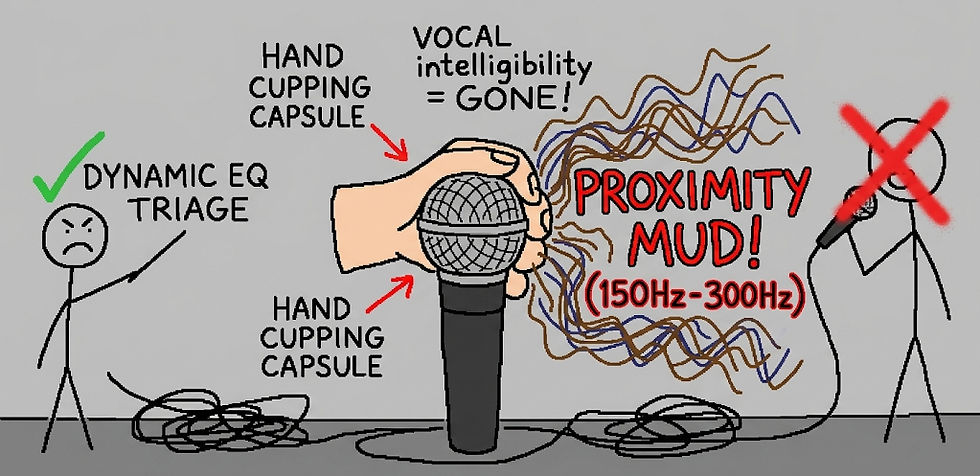
When tracking a vocalist in a pristine studio setting, the microphone is carefully placed on a sturdy stand, and the singer is instructed to maintain a precise, calculated distance from the capsule to ensure absolute tonal balance. On a live stage, particularly in high-energy rock or punk environments, the singer rips the microphone off the stand, wraps their hand entirely around the metal grille, and presses it directly against their mouth.
When a singer "cups" the microphone, the vocal tone instantly transforms into a muffled, unintelligible, and boomy mess. The critical high-frequency articulation required to understand the lyrics is swallowed by a massive buildup of low-midrange mud, making the vocal impossible to seat cleanly in the mix.
Industry-standard live vocal microphones rely on rear acoustic ports to maintain their directional polar patterns and reject background noise. Wrapping a hand around the capsule blocks these ports, physically converting the microphone into an omnidirectional receiver while simultaneously triggering an extreme overload of the Proximity Effect.
Because the singer will constantly change their hand position during the performance, static equalization is useless. You must deploy aggressive Multiband Compression and Dynamic Equalization to automatically carve out the 200Hz to 300Hz mud only when the capsule is choked, allowing the vocal to breathe when the singer's grip relaxes.
How pushing erratic, highly dynamic live vocals through physical analog tape circuits naturally compresses aggressive screams and adds harmonic clarity to muddy, low-frequency build-ups, bypassing the sterile limitations of digital processing.
The Performance vs. The Physics
To be a successful audio engineer, you must first understand the psychology of the performer. Singers cup the microphone because it feels visceral. Gripping the metal grille provides a physical anchor during an explosive performance, and getting intimately close to the capsule creates a feeling of power. As audio professionals, we never want to compromise the raw, authentic emotion of a live take. A technically flawed but intensely passionate vocal will always outshine a pristine, boring one.
However, that aggressive physical performance comes with a devastating acoustic cost. The moment the singer's hand covers the rear half of a standard dynamic vocal microphone (like the ubiquitous Shure SM58), the physics of the capsule fundamentally break down. The vocal suddenly sounds like it is being broadcast through a thick wool blanket inside a cardboard box. If the lyrics cannot be understood, the emotional connection with the audience is severed. To fix this in the mix, we must first understand the microscopic physics of the microphone's design, a concept thoroughly explored in deep technical breakdowns of Q. What is the proximity effect?.
The Destruction of the Polar Pattern
Directional microphones (Cardioid and Supercardioid) do not naturally reject sound from behind; they are engineered to do so through complex acoustic phase cancellation. Behind the wire grille of the microphone, there are precisely calibrated rear acoustic ports. When a sound wave approaches from the rear of the microphone, it enters these ports and is delayed just enough so that it arrives at the diaphragm completely out of phase with the sound hitting the front, physically canceling the noise out.
When a vocalist wraps their hand around the grille, they physically seal off these critical rear ports. Instantly, the phase cancellation stops. The microphone technically reverts to an omnidirectional polar pattern. It begins picking up the blaring cymbals, the roaring guitar cabinets, and the wedge monitors bouncing off the floor.
Simultaneously, blocking these ports alters the resonant frequency of the capsule itself. It creates a small, highly resonant acoustic chamber inside the singer's hand, causing a massive, unnatural spike in the 2kHz to 3kHz range (creating a harsh "honk"), while violently exaggerating the low frequencies. The microphone is no longer capturing the human voice; it is capturing the distorted physics of the blocked capsule.
The Proximity Effect Overload
Compounding the polar pattern destruction is the Proximity Effect. This is an acoustic phenomenon inherent to all directional microphones where low-frequency response dramatically increases as the sound source moves closer to the capsule.
When a singer presses their lips directly against a cupped microphone, the frequencies between 100Hz and 300Hz can be artificially amplified by as much as 10 to 15 decibels. This creates a massive buildup of "mud." This low-end energy completely masks the upper-midrange frequencies (2kHz to 5kHz) where human consonant articulation lives. You can see the waveforms in your DAW, but all you hear is a booming, unintelligible rumble.
Dynamic Triage: Why Static EQ Fails
The amateur approach to fixing a cupped, muddy vocal is to apply a static equalizer. The engineer will simply place a heavy, 6dB cut at 250Hz. While this cleans up the mud during the choruses when the singer is gripping the mic, it introduces a new, catastrophic problem.
Live vocalists are erratic. During the quiet bridge of the song, the singer might relax their grip, pull the microphone a few inches away from their mouth, and sing softly. Because you have a permanent 6dB cut at 250Hz, the vocal will instantly become incredibly thin, brittle, and piercing.
The Professional Fix: Automated Frequency Control
Isolate the low-midrange band on your dynamic EQ (sweep between 150Hz and 300Hz until you find the most offensive "boxy" resonance). Set the threshold so that the equalizer only engages when that specific frequency builds up to an unacceptable level.
Now, the processing acts intelligently. When the singer cups the mic and screams, generating a massive 200Hz spike, the dynamic EQ instantly clamps down, carving out the mud and revealing the clarity of the lyrics. The exact millisecond the singer relaxes their grip and the proximity effect disappears, the EQ band returns to a flat, natural state, preserving the warmth and body of their natural voice. This ensures the vocal sits perfectly upfront in the mix, regardless of how erratically the performer handles the microphone.
The Tapetown Advantage: Analog Tape and Harmonic Masking
Even with perfect dynamic EQ, a highly erratic live vocal can still feel digitally sterile. The extreme transients of screaming, combined with the erratic proximity effect, often overwhelm digital converters, resulting in a brittle, fatiguing top-end.
This is where we lean heavily into The Live-to-Tape Philosophy: Why Real Records are Made with Bold Decisions. At Tapetown, we route these volatile live vocal tracks out of the computer and drive them into physical analog circuits—specifically, analog tape machines or heavy hardware transformers.
Analog tape handles extreme dynamic shifts entirely differently than digital math. When an aggressive, cupped vocal scream hits magnetic tape, the tape naturally compresses the signal. But more importantly, as discussed in The Analog vs. Digital Paradox: A Masterclass in Modern Sonic Authority, it generates subtle harmonic distortion.
This analog saturation acts as an acoustic glue. It rolls off the harsh, brittle transients caused by the capsule distortion, and adds rich, even-order harmonics to the thin parts of the vocal. It physically masks the abrasive digital artifacts of the live recording, smoothing out the erratic performance into a thick, cohesive, and powerful anchor for the mix. By combining the surgical precision of digital dynamic EQ with the forgiving, musical warmth of analog hardware, you can rescue even the most aggressively mishandled live vocal, turning a muddy disaster into a defining performance.
References & Further Reading


