


Beyond the Ceiling: Mastering Headroom and Analog Summing
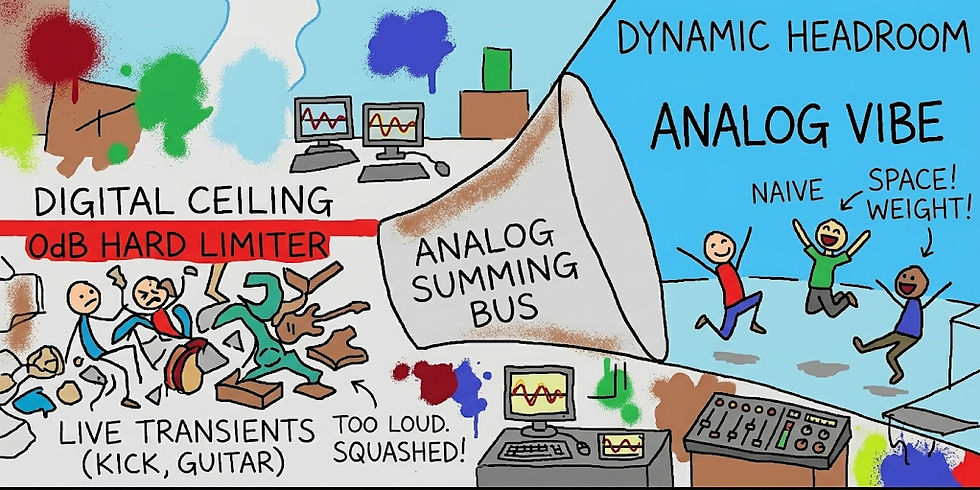
In a heavily controlled studio environment, spending hours managing the dynamic range of an isolated drum kit is a calculated procedure. But on a live stage, capturing the uninhibited, chaotic energy of a human performance results in massive, erratic volume spikes that fundamentally challenge the mathematical limits of digital recording technology.
The Problem: The persistent industry obsession with extreme loudness causes engineers to apply digital brickwall limiters to already dense live mixes. This forces the entire band into a flat, exhausting, and claustrophobic digital ceiling, shaving off crucial explosive transients in a desperate search for competitive volume.
The Physics: A digital peak limiter is designed with clinical precision to stop audio waveforms from clipping at 0dBFS. Live audio is defined by its massive peak energy. Eliminating these peaks with a digital algorithm physically eliminates the perceived dynamic impact, replacing human energy with linear, mathematical distortion.
The Fix: Abandon the reliance on the master fader limiter for loudness. Mix individual channels with aggressive intent, deploying detailed subtractive equalization, precise transient shaping, and parallel compression. Leave the final volume maximization to the dedicated mastering phase.
The Tapetown Advantage: How utilizing physical dynamic range and hybrid analog summing—driving audio signals through physical console transformers and discrete circuitry—restores the moving depth, visceral separation, and "Raw Nerve" that digital math completely flattens.
The Loudness Trap and the Biology of Listening Fatigue
The temptation to maximize overall track loudness is one of the single most destructive forces in modern audio engineering, particularly when dealing with the raw, untamed energy of a live performance. When you are mixing in your digital audio workstation (DAW) and you pull down the threshold on a master bus limiter, the immediate acoustic feedback is intoxicating. Suddenly, the quiet, nuanced elements of the track are pushed forcefully to the front. The mix sounds massive, aggressive, and "radio-ready" on your studio monitors.
However, this instantaneous gratification masks a severe physiological cost: listening fatigue. The human ear is an incredibly sensitive, biomechanical system. When it is exposed to sustained, unrelenting volume without any dynamic relief, a biological defense mechanism known as the acoustic reflex is triggered. The stapedius muscle in the middle ear literally contracts to dampen the transmission of acoustic energy, attempting to protect the inner ear from damage.
When you present an audience with a hyper-compressed, digitally limited mix, you are constantly triggering this physical defense mechanism. As extensively documented in historical and technical analyses of 'Dynamic Range' & The Loudness War, the listener's brain quickly interprets this aggressively compressed audio not as pleasurable music, but as a continuous, exhausting physical pressure. Within minutes, the audience will subconsciously tune out the music or simply turn the volume down.
A live performance is inherently about tension and release—the emotional arc from a quiet, whispered verse to a towering, explosive chorus. If you squash that entire dynamic range into a narrow two-decibel window, you delete the emotional narrative of the performance. A great rock band sounds incredible live not because they are merely loud, but because they utilize the physical space and air of the venue to move energy. We must prioritize this physical, moving energy over static mathematical volume.
The Crest Factor Conundrum: Peaks vs. RMS
To fully grasp why digital limiters are so dangerous to a live mix, you must understand the core acoustic metric known as Crest Factor. Crest Factor is the mathematical difference between the Root Mean Square (RMS) average—the sustained, continuous energy that the human ear actually perceives as overall "volume"—and the instantaneous transient peaks. These peaks are the incredibly fast bursts of acoustic energy that provide physical "smack," "crack," and "kick."
In alternative and punk music, the rhythm section defines the Crest Factor of the entire mix. When a drummer strikes a snare drum with full force, the initial transient of the wooden stick hitting the plastic drumhead might last for less than five milliseconds. Yet, in that microscopic window of time, that transient peak might be 15 to 20 decibels louder than the average RMS level of the ringing drum shell. This peak is pure, unadulterated physical energy.
A digital brickwall limiter is a mathematical algorithm designed to analyze and intercept these extremely fast peaks. If your limiter's absolute output ceiling is strictly set to -0.1dBFS, and your snare drum peak attempts to hit +4dB, the limiter clamps down instantly. If you are pushing your mix aggressively to achieve a competitive modern loudness standard (such as -8 LUFS), you are forcing that limiter to violently shave off that entire 15dB of transient energy on every single drum hit.
When you flatten these peaks, you destroy the physical impact of the instrument. The music measures louder on a digital meter, but it stops feeling visceral in the room. The snare drum stops sounding like a physical object pushing air and starts sounding like a static, synthetic burst of white noise. This catastrophic loss of transients is the primary reason purely "in-the-box" digital mixes often feel physically smaller and less impactful than dynamic, uncompressed live productions.
Digital Brickwalls, Aliasing, and Inter-Sample Peaks
The problem with digital limiting extends far beyond just the loss of transient impact; it introduces highly unnatural distortion. Digital audio relies on sampling—taking tens of thousands of digital "snapshots" of an analog audio waveform every second (typically 44,100 or 48,000 times per second). When you push a signal hard into a digital brickwall limiter, the algorithm essentially squares off the top of the waveform, turning a smooth, rolling acoustic curve into a flat, jagged plateau.
This squaring effect generates severe harmonic aliasing. The mathematical algorithm creates non-musical, high-frequency artifacts that literally bounce back down the frequency spectrum, heavily cluttering the upper midrange. This phenomenon makes electric guitars sound brittle, causes cymbals to sound like harsh static, and makes lead vocals feel piercing and aggressively sibilant.
Furthermore, digital limiters often fail to account for the reality of Inter-Sample Peaks (ISPs). While the digital snapshots inside your DAW might measure exactly at 0.0dB, the actual continuous analog waveform that is reconstructed by the listener's Digital-to-Analog Converter (DAC) can peak significantly higher between those two specific digital samples. This causes the listener's consumer-grade playback equipment to physically clip, adding a layer of nasty, crackling distortion to an already exhausted mix.
Intention Over Mass Limitation: Mixing the Source
The root cause of over-limiting in modern mixing is almost always a lack of foundational mix discipline. Engineers rely on the master fader limiter to artificially glue together a mix that is fundamentally disjointed. If your kick drum lacks the necessary sub-frequencies to anchor the track, or if the bass guitar is swallowing the snare drum, slapping a limiter on the final stereo output will not fix the arrangement. It will simply crush the conflicting instruments together.
When the foundational elements of the mix are carved out with absolute precision, the overall track will naturally sound massive and loud without ever touching the master fader. You leave the transients intact, allowing the final mix to retain its dynamic soul, depth, and three-dimensional width. Leave the final volume maximization to the mastering engineer, as detailed in comprehensive discussions on Mastering: Admit it. Some of you don't know what it is.
The Physics of Analog Headroom vs. The Digital Ceiling
If you have optimized your individual tracks but still feel the mix lacks the dense, heavy impact required for a commercial release, you must move away from digital math and embrace analog physics. Embracing The Analog vs Digital Paradox is essential here, as it forms the cornerstone of the hybrid mixing workflow.
Analog circuitry behaves fundamentally differently than digital code. Digital audio possesses a rigid, binary ceiling. Analog equipment—such as vintage mixing consoles, outboard compressors, and analog summing mixers—operates on continuous electrical voltage. When you push an electrical audio signal beyond the nominal "zero" level on an analog console, it does not hit a brick wall. Instead, it enters a zone of musical saturation.
When a high-energy transient (like an explosive kick drum) is driven into a physical vacuum tube, a discrete operational amplifier, or a heavy iron transformer, the physical components simply cannot react fast enough to perfectly reproduce the spiky peak. The circuitry naturally and musically rounds off the transient. It acts as an incredibly fast, natural limiter that relies on physical resistance rather than lines of code.
More importantly, this analog saturation generates complex harmonic distortion. Pushing a signal into a transformer adds dense, musical overtones to the fundamental frequencies. It literally creates new sonic information that thickens the lower midrange, making the instruments feel physically larger, heavier, and more dangerous. It replaces the brittle, fatiguing precision of digital limiting with a warm, dense mass, an effect championed by top engineers in interviews like Howie Weinberg: Mastering Legend on Loudness Wars.
Hybrid Summing: Restoring the 3D Soundstage
Mixing entirely "in the box" requires the computer's CPU to mathematically sum dozens of chaotic audio tracks into a single stereo file. Digital summation is perfectly linear; 1 + 1 always equals 2. While this is mathematically flawless, it often results in a mix that feels completely flat, two-dimensional, and claustrophobic. The instruments lack depth and spatial separation.
At Tapetown, we resolve this by utilizing analog summing. We take the surgically prepared digital tracks from the DAW and send them out through high-end digital-to-analog converters. We group them into stems and route these physical voltage signals into a dedicated analog summing mixer.
The physical act of combining these electrical signals through analog resistors, capacitors, and transformers introduces subtle, beautiful imperfections. The slight phase shifts and harmonic crosstalk between the left and right channels naturally push the instruments apart, creating a massive, three-dimensional soundstage. The vocals step forward into the room, the bass anchors itself solidly to the floor, and the wide-panned guitars wrap around the listener's ears.
This hybrid approach harnesses the surgical precision of digital tools while relying on analog hardware to provide the final, physical limitation and summing. A mix with proper analog headroom does not need to be squashed to 0dB to make an emotional connection; it connects through moving air, rich harmonics, and dynamic authority.
References & Further Reading


